Highlight

Successful together – our valantic Team.
Meet the people who bring passion and accountability to driving success at valantic.
Get to know usCooperation partner

SAP transformation: current status and future trends
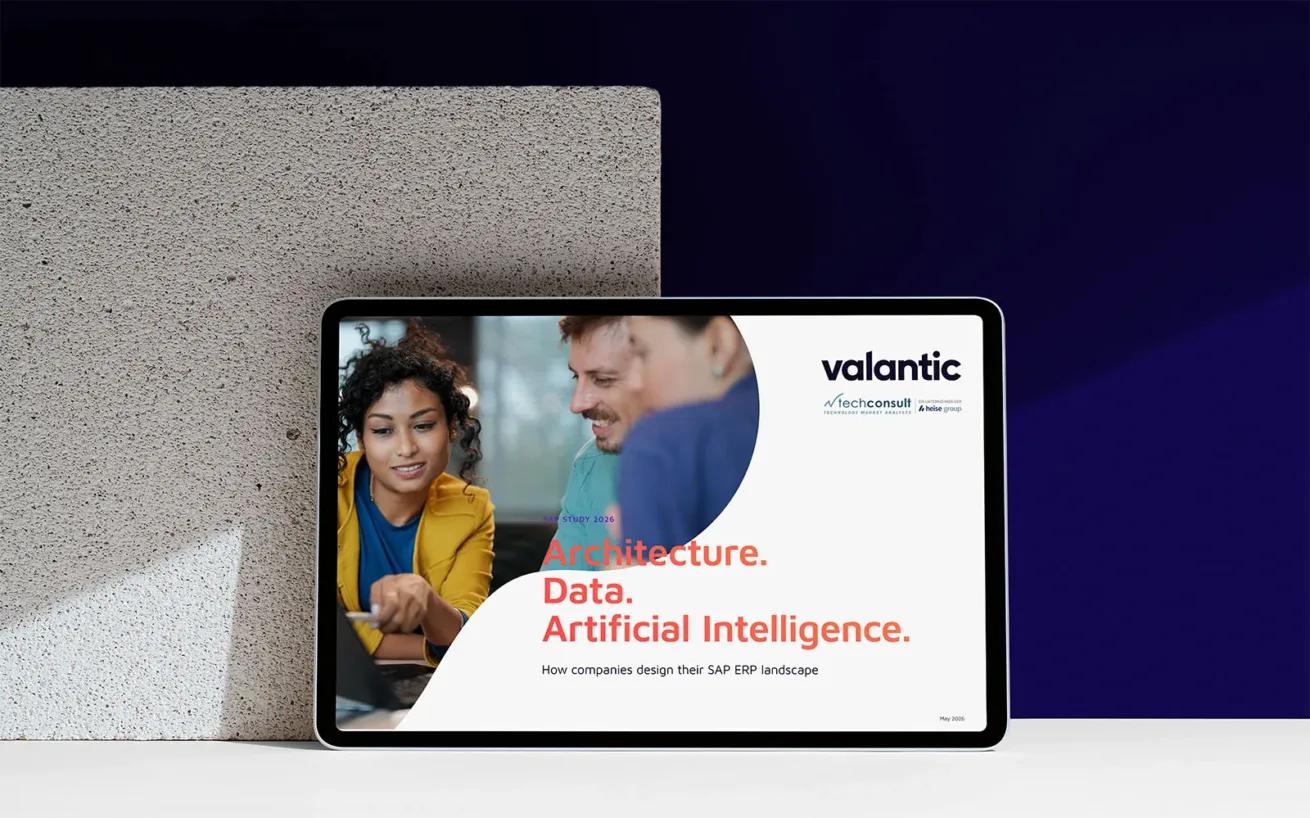
The valantic SAP Study is an important barometer of sentiment in the SAP community. Since 2018, we have been asking SAP customers in the DACH region about their investment intentions and expected business opportunities. Our current report "Architecture. Data. Artificial Intelligence" provides information on the current status of the S/4HANA transformation in companies using SAP technologies as well as the change in IT architectures towards the cloud, data platforms and AI-supported applications.
Facts & Figures
Three key findings
60 %
see SAP BDC as a central element of their data management
SAP S/4HANA Transformation
Clear majority with ongoing & completed projects
Your opinion
What is the approximate percentage of AI-supported business processes in your company?
0 %
100 %
409
executives from SAP customers provided their assessment of current digitalization topics
AI functionalities in the SAP ecosystem
Top 3
Cloud
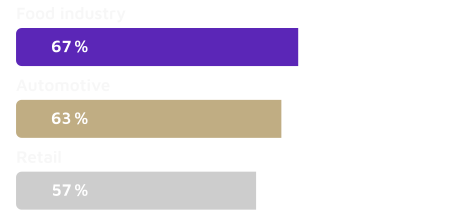
SAP Cloud ERP as an accelerator of innovation capability by industry
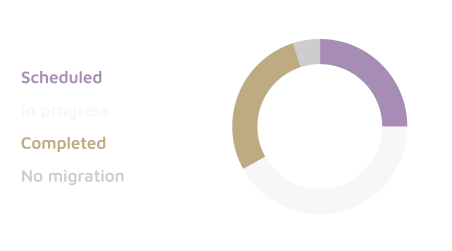
The SAP Study 2026 by valantic shows: The transformation of SAP landscapes has reached the implementation and stabilization phase in German-speaking countries. Around 70 percent of the companies surveyed are currently migrating to SAP S/4HANA or have already completed the process.
The transformation is moving through the market segments: While larger organizations started earlier and are gradually going live (65 percent of completed projects), the proportion of ongoing implementations among SMEs has risen from 17 to 25 percent year-on-year.
SAP S/4HANA
A Comparison of Migration Strategies
Sample size: 2025 = 201 companies, 2026 = 409 companies
Extended brownfield/bluefield conversion remains the most frequently used migration strategy in this year’s SAP study at 47%, but is declining overall (previous year: 57%). In contrast, brownfield (18%) is gaining preference and could develop into a new “ERP comfort zone”, particularly in combination with the private cloud.
In terms of deployment models, the private cloud continues to expand its dominant position to 64%. This confirms the trend from last year's SAP study: the majority of companies prefer a continuous, controlled transformation. This is particularly true for industrial sectors such as discrete manufacturing, the food industry and transportation and logistics. The public cloud is growing slightly, while on-prem installations are once again declining significantly. Operation in in-house data centers is becoming less and less attractive.
64 %
prefer the private cloud as deployment model
SAP S/4HANA
A Comparison of Deployment Models
Sample size: 2025 = 201 companies, 2026 = 409 companies
Trend
1
0
Most companies in German-speaking countries are currently either in the middle of their SAP S/4HANA project or have already completed the migration. The task now is to use S/4HANA strategically to modernize processes, better evaluate data and scale innovations. The go-live thus marks the start of a continuous transformation.
In terms of the cloud, the focus shifted to actual project experience in the SAP Study 2026, as the number of ongoing implementations and already productive SAP Cloud ERP systems increases. The evaluation of the technology is differentiated in the transformation phases of implementation and operation.
Financial ambivalence prevails among respondents during migration. For example, 42% expect more cost efficiency from the cloud, while at the same time a majority fear high project costs and complexity. Industrial sectors in particular are struggling with high integration costs and a high degree of process individuality.

Sebastian Rübbelke, Head of the Cloud ERP line of business at valantic
Sebastian Rübbelke is Vice President at valantic. He heads the Cloud ERP line of business.
The cloud in the SAP environment is no longer an infrastructure issue, but a strategic decision about digital sovereignty, innovation capability and risk profile.
Sebastian Rübbelke, Head of the Cloud ERP line of business at valantic
The go-live fundamentally changes the perspective on cloud ERP. Companies are now evaluating whether the transformation effort is actually paying off.
51 percent attest to the cost efficiency of SAP cloud systems in productive operation. The accessibility and scalability of cloud systems also score well in the operating phase for one in two companies – with trade-related sectors benefiting even more. In the complex chemical and pharmaceutical industries, this is appreciated by 56% of the organizations surveyed.
The security debate is also being conducted in a concrete and measurable way. 47% see data security as an advantage, while security concerns are down slightly to 34%.
Legal security and compliance requirements remain relevant, especially for regulated sectors such as utilities or the food industry. They are becoming a permanent control framework for cloud use.
SAP Cloud
Advantages and obstacles of cloud transformation: Comparison of operational and implementation phases
Sample size: 365 companies | Filter: Companies with active and completed implementations | Figures in %
Trend
1
0
When it comes to the SAP S/4HANA transformation, most companies are now opting for a cloud deployment, primarily in the form of SAP Cloud ERP Cloud Private. In order to benefit from the cloud as an innovation accelerator, a clear target picture is required.
The SAP Business Data Cloud (SAP BDC) will establish itself as the central reference point for data management in SAP landscapes in 2026 and will play a key role in the transformation roadmap at an early stage. 66% of companies already see SAP BDC as an integral part of their future data management at the planning stage in order to enable data-based decisions across the entire organization.
SAP Business Data Cloud
The Role of SAP BDC in Enterprise Data Management
Sample size 2025: 201 companies | Sample Size 2026: 409 companies
In terms of industries, approval is particularly high in the food and retail sectors. Here, 78% and 72% of companies respectively consider SAP BDC to be central to their data management. In contrast, the figure in the manufacturing industry is 58%, which reflects the mostly complex IT and data architectures with numerous connected production systems, plants and machines.

Marcel Beckmann, Head of SAP BDC at valantic
Marcel is our expert for the SAP Business Data Cloud and heads the Center of Excellence SAP Data Warehouse at valantic.
The true strength of modern SAP landscapes comes from the interaction between S/4HANA, SAP BTP and SAP BDC – this is where an ERP system becomes an innovation platform.
Marcel Beckmann, Head of SAP BDC at valantic
When it comes to data integration, the second key benefit of SAP BDC, every second company expects the platform to simplify system integration and reduce data silos.
In the SAP study, approval is growing particularly strongly among SMEs (up 28 percentage points). As a lack of integration is increasingly recognized as a problem, SAP BDC is gaining acceptance as a standard solution. In the enterprise segment, approval rises to 52 percent. At the same time, the use of comparable architectures outside the SAP portfolio is decreasing significantly. This underlines the tendency to link the data strategy more closely to the SAP target architecture as soon as the ERP transformation is complete.
With the SAP Business Technology Platform (SAP BTP) and SAP BDC, SAP landscapes are developing in the direction of platform architectures for data, processes and innovation.
If you don't think in terms of data products, you make decisions based on your gut - and not in real time. In the valantic Trendtalk, Marcel Beckmann, Head of SAP BDC at valantic, explains how companies can immediately make data-driven decisions with the SAP Business Data Cloud.
Trend
1
0
More and more companies are relying on SAP BDC and SAP BTP as a strategic, central layer for innovation, analytics and AI. Formerly monolithic ERP landscapes are becoming platform architectures. To achieve this, it is essential to develop a roadmap and initial use cases.
Fewer experiments, more operational benefits: With the desire for clear business added value such as process acceleration, cost savings and better problem analysis, artificial intelligence (AI) is clearly business-relevant for companies in the SAP context.
A total of 67% of respondents in the SAP study are already using the technology or have even firmly integrated it into their processes – the latter particularly in the automotive industry and companies that have completed their cloud ERP transformation. Only three percent are still completely inactive in this area.
SAP solutions in the area of Business AI and beyond are the technological basis for the integration of AI and robotic process automation (RPA) for more than half of the respondents – particularly in the food industry, retail, the financial sector and utilities.
Artificial intelligence
Maturity level of AI use among companies in the DACH region
Sample size: 409 companies

Sascha Göpfert, Head of SAP AI at valantic
Sascha is Head of SAP AI and an expert in AI and software development, including on SAP BTP.
Voice-based AI agents can significantly reduce the workload for employees. Projects in sales and maintenance show not only efficiency effects but also higher data quality. We provide support with orchestration and secure integration into SAP landscapes.
Sascha Göpfert, Head of SAP AI at valantic
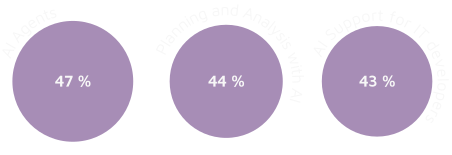
When it comes to specific AI solutions, companies want SAP and its partners to provide AI agents in particular (42% demand), i.e. systems that can take on tasks and execute processes independently. Other priorities are AI-supported planning and analysis, AI support for developers and AI functions integrated into SAP applications; the latter is particularly in demand in logistics (around 70 percent) as well as in discrete manufacturing, the automotive and pharmaceutical sectors.
Even if the potential of AI is increasingly perceived as a significant economic and operational lever, its wider use is heavily dependent on security, governance and strategy issues. IT security risks are the biggest obstacle, followed by legal and regulatory uncertainties. Our SAP Study 2026 shows that technological capabilities alone are not enough – clear governance structures, regulatory orientation and organizational anchoring are required.
AI is not just hype, but is becoming increasingly relevant to the business of more and more companies. In the valantic TrendTalk, Sascha Göpfert, Head of SAP AI, explains how companies can unleash the potential of artificial intelligence – especially in conjunction with SAP.
Trend
1
0
Artificial intelligence and SAP AI are now being used in practice by many SAP customers. The focus is primarily on business-relevant, agent-based use cases. Robust governance, security and data structures are essential here.
valantic SAP Study 2026
Download the comprehensive study report now and gain exclusive insights into strategic decisions, future trends and priorities for digital transformation with SAP.