Highlight

Successful together – our valantic Team.
Meet the people who bring passion and accountability to driving success at valantic.
Get to know usOptimizing Planning and Decision-Making Processes
More precise planning, a more resilient supply chain: SAP Integrated Business Planning (SAP IBP) combines sales and operations supply chain management, and operational planning in a single platform. AI-based, modular, and flexibly configurable, it helps companies meet dynamic market demands. valantic supports customers from concept phase through to application operation.

7 Key Facts
SAP Integrated Business Planning helps companies with the integrated planning of their supply chain and business processes. The cloud-based solution covers sales and operations planning (S&OP), forecasting and demand planning, response and procurement planning, demand-driven replenishment, and inventory planning. It thus enables seamless, data-driven decision-making.
Up to 30% higher productivity through real-time planning and monitoring
Up to 20% faster order fulfillment thanks to shorter planning cycles
Up to 10% lower inventory costs due to reduced safety stock and inventory levels
1–2% increase in revenue through improved efficiency and rapid, data-driven decisions
Up to 10% improvement in service through accurate forecasting and efficient planning

Integrated Data
SAP Integrated Business Planning integrates data from various areas—such as supply chain, demand planning, and strategic corporate planning—and provides a unified view of the entire value chain. This integrates strategic and operational planning approaches, for example, by linking financial planning and supply chain management.

AI Support
SAP Integrated Business Planning uses AI-powered algorithms and advanced analytics to generate accurate demand forecasts. With the “Supply Chain Control Tower” module, the solution provides real-time monitoring of your specific KPIs and enables the identification of risks and bottlenecks. For efficient disruption management and rapid problem resolution in the supply chain.

Real-Time Scenarios & Simulations
SAP Integrated Business Planning enables real-time scenario planning and simulations, allowing companies to respond flexibly to changes such as shifts in demand or supply issues. The solution helps calculate optimal inventory levels and improve the balance between supply and demand.
SAP Integrated Business Planning covers the entire spectrum of integrated business planning. It provides companies with tools to make their supply chains more efficient, agile, and resilient. Each module fulfills a specific function in integrated enterprise planning. Together, they offer an end-to-end solution that helps companies make their supply chains more agile, transparent, and cost-efficient.
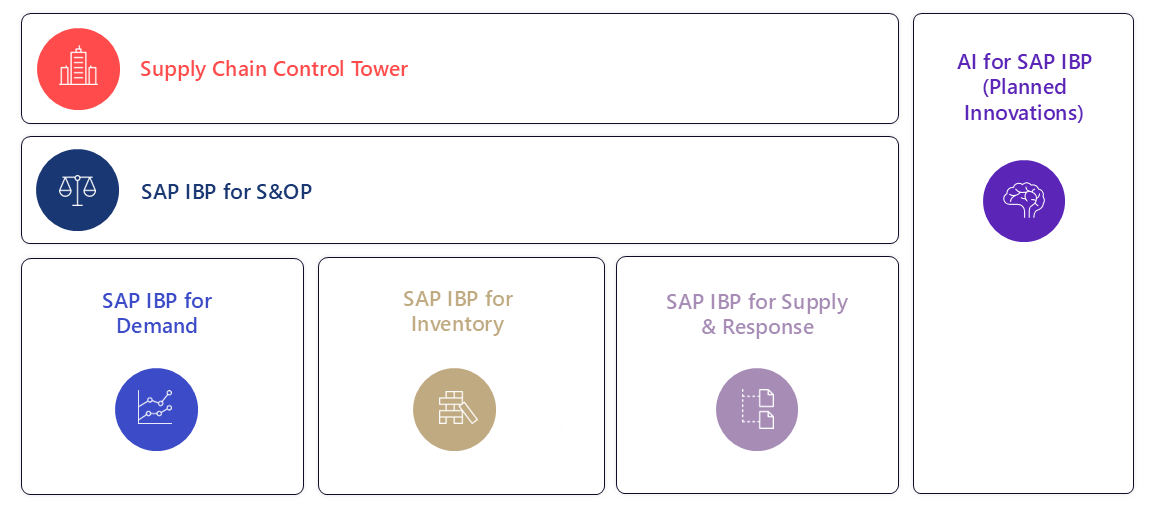
Enables the synchronization of sales, production, and financial plans to achieve an optimal balance between supply and demand.
This module supports the coordination of sales, production, and financial plans on a single platform. It enables companies to link strategic planning with operational decisions and simulate scenarios for various business models. By integrating real-time data and KPIs, companies can make informed decisions that take both demand and capacity planning into account. In addition, it offers collaborative features to involve various departments and external partners in the planning process. The result is a closer alignment of supply and demand, as well as improved cost and resource efficiency.
Provides accurate demand forecasts through advanced analytics and machine learning to prevent over- or underproduction.
This module helps companies accurately forecast demand based on historical data, external market information, and advanced algorithms. It uses machine learning and statistical models to identify trends and seasonal fluctuations. By integrating real-time and customer-specific data, companies can tailor their production and distribution plans more effectively. Forecasting accuracy is improved by incorporating strategic planning and market insights and by fostering collaboration between different departments within the company. This ensures that all perspectives are taken into account and that consensus is reached among sales, marketing, and demand planning. The module also offers the ability to simulate “what-if” scenarios to assess the impact of market changes or capacity constraints. This leads to optimized demand planning and a reduction in inventory levels and misplanning.
Optimizes inventory levels by calculating the ideal stock levels across the warehouse network to reduce costs while ensuring delivery capability.
With this module, companies can optimize their inventory levels by calculating the ideal stock levels throughout the entire supply chain. Multi-level optimization enables the calculation of inventory targets while taking into account interdependencies within the network. It considers factors such as safety stock, service level targets, and demand uncertainties. The integrated analysis tools help minimize inventory costs while ensuring delivery capability. It also supports inventory segmentation, allowing different product groups to be planned individually. This achieves a balanced approach between cost reduction and customer satisfaction.
Enables a rapid response to supply chain disruptions by simulating alternative scenarios and accelerating decision-making processes.
This module helps companies respond quickly to changes or disruptions in dynamic market environments. It enables real-time planning and prioritization of customer orders based on current capacities and material availability. By modeling locations and multi-level bills of materials, it creates an effective supply plan for the entire network. Companies can simulate multiple scenarios to identify the best options in the event of unexpected occurrences. By combining planning and production processes, delays can be minimized and customer requirements met more quickly. Planners can choose between three algorithm options: unrestricted heuristics, prioritization, or optimization. Prioritization and optimization enable the system to generate a feasible and constrained supply plan in a single step, taking all modeled constraints into account.
Provides real-time visibility and collaboration across the supply chain to proactively manage risks and bottlenecks.
SAP Supply Chain Control Tower creates comprehensive visibility across the entire supply chain and provides real-time insights into operational processes. It offers functions for monitoring KPIs, detecting deviations, and proactively managing disruptions. Companies can identify risks and vulnerabilities within the supply chain early on and take corrective action. Complex supply chains can be overwhelming due to a flood of information—machine learning algorithms for personalized notifications reduce information noise and enable more relevant insights. The Control Tower also supports collaborative decision-making by providing relevant data and analytics to all stakeholders. This leads to effective management and control of the supply chain.
At valantic, we’re convinced that digital transformation is much more than just implementation. Our approach ensures that every solution is tailored to the specific needs and processes of your company. Because success depends not only on technology but also on synergies. Let’s create them together!
Holistic approach
We don’t just implement SAP systems; we also gain a comprehensive understanding of your business to create solutions that optimize your processes, increase productivity, and enable sustainable growth.
Proven expertise
With many years of experience across numerous industries, we combine technical expertise with a deep understanding of processes to deliver measurable results.
"Business-First" mindset
We conduct a comprehensive analysis of your business processes to ensure that the integration of SAP solutions aligns perfectly with your goals and workflows.
Customer focus & agility
We always tailor our solutions to each customer’s specific needs and rely on agile methods to deliver results quickly and efficiently.
Partnership from A to Z
From strategy to implementation—we guide you every step of the way and provide the expertise needed to turn challenges into opportunities. Even after implementation, comprehensive support is available to ensure that the solution continues to function effectively over the long term.

Excellence Workshop
Work with our experts to gain a comprehensive overview of the features and potential of SAP solutions. Identify your current planning challenges and work with us to create your customized implementation roadmap.
Proof of Concept
Get a detailed overview of your organization as well as your production and detailed planning processes. Work with us to define your business requirements and gain insight into how your SAP solutions will operate in the future, as well as the added value they will bring to your company.
Master Data Readiness Check
Lay the groundwork for a successful implementation project and work with us to ensure that your planning-related master data meets the required quality standards. This will help you avoid incorrect master data, which can lead to inaccurate planning results or production plans that cannot be implemented.
Implementation
Get a comprehensive assessment of your current production planning processes and IT infrastructure. Take advantage of our customized implementation services, including change management, training, and detailed plans for a global rollout.
valantic insights on SAP IBP

On-Demand Webinar: Planning, Production, Transportation
Bike AG: End-to-End Process for Discrete Manufacturing

Success Stories
ThyssenKrupp Takes a Major Leap into Cloud Planning with SAP IBP

On-Demand Webinar
How to Optimize Your Sales and Operations Planning for Configurable Products

On-Demand Webinar
Plan, Buy, Deliver: Turning Complexity into Seamless Supply Chain Success

End-to-End Process
Configure2Operate in Mechanical and Plant Engineering
Are you looking for an integrated process solution for your entire supply chain that offers greater transparency and planning reliability? Our experts would be happy to explore your options with SAP IBP.
The key insights on integrated planning with SAP IBP, summarized concisely:
SAP IBP connects demand, inventory, production, and supply planning in one cloud platform for full supply chain transparency.
Benefits include up to 30% higher productivity, faster planning cycles, lower inventory costs, and increased revenue through data-driven decisions.
valantic supports the full journey, from strategy and proof of concept through implementation to AMS support — for resilient end-to-end planning.
SAP Integrated Business Planning (SAP IBP) is a cloud-based solution for the integrated planning of supply chain and business processes. The software supports companies in sales, inventory, production, and procurement planning and creates a unified data foundation for informed decisions throughout the entire supply chain.
SAP IBP is particularly well-suited for companies with complex supply chains, multi-stage production processes, and high requirements for transparency, flexibility, and planning reliability. The solution is frequently used in industrial, manufacturing, consumer goods, retail, and logistics companies.
SAP IBP supports the entire sales and operations planning (S&OP) process, as well as demand planning, inventory planning, procurement planning, production planning, supply planning, and real-time supply chain monitoring.
SAP IBP enables integrated planning across business units, improves transparency throughout the supply chain, and supports faster, data-driven decision-making. Companies benefit from more accurate forecasts, optimized inventory levels, and better alignment of supply and demand.
Yes. SAP IBP is a cloud-based software solution from SAP. It enables companies to benefit from high scalability, regular innovations, and easy collaboration across locations and departments.
SAP IBP consists of several modules:
The modules can be used individually or as an integrated end-to-end solution.
With SAP IBP for Demand, companies can generate demand forecasts based on historical data, market information, and AI-powered algorithms. This enables them to identify demand fluctuations early on and improve planning decisions.
SAP IBP for Inventory calculates optimal inventory levels throughout the entire supply chain. It takes safety stock, service levels, and demand uncertainties into account to reduce inventory costs while ensuring delivery capability.
The SAP Supply Chain Control Tower provides real-time visibility across the entire supply chain. Companies can monitor key performance indicators, identify risks early on, and respond more quickly to disruptions or bottlenecks.
Yes. SAP IBP enables the simulation of various scenarios and “what-if” analyses. Companies can assess the impact of changes in demand, supply bottlenecks, or capacity constraints and make informed decisions.
With SAP IBP for Response and Supply, companies can simulate alternative planning scenarios, check material availability, and adjust priorities in real time. This enables them to proactively manage risks and make supply chains more resilient.
SAP IBP (Response & Supply) offers two key methods for automating supply planning. The Supply, Deployment, and Allocation Heuristic enables fast and pragmatic planning. It plans based on demand and bill of materials (BOM) data across the entire network, primarily achieving locally optimal results. Due to its high speed, it is particularly well-suited for daily replanning as well as for running “what-if” scenarios. The Supply and Deployment Optimizer, on the other hand, takes a mathematical optimization approach for the entire supply network. It takes capacity and cost constraints into account to either minimize total costs or maximize the service level. The optimizer is particularly well-suited for periodic, tactical, or strategic planning tasks, as well as for bottleneck allocation.
SAP IBP uses machine learning and advanced analytical techniques to improve demand forecasts, identify risks early on, and support planning processes with data-driven insights.
valantic supports companies from strategy development through implementation to ongoing operations. Its range of services includes workshops, proofs of concept, master data analyses, implementation, change management, training, and support.
Yes. Through its Application Management Services (AMS), valantic supports companies in the day-to-day operation of SAP IBP. This includes system monitoring, error analysis, support, and the continuous optimization of the solution.
A typical project begins with an analysis of existing processes and requirements. Next, the target state, roadmap, and implementation strategy are developed. After the solution is implemented, valantic supports companies with training, rollout, and ongoing support.