Highlight

Successful together – our valantic Team.
Meet the people who bring passion and accountability to driving success at valantic.
Get to know usWhen it comes to the SAP S/4HANA transformation, most companies are now opting for a cloud deployment, primarily in the form of SAP Cloud ERP Cloud Private. In order to benefit from the cloud as an innovation accelerator, a clear target picture is required.

The transformation of SAP landscapes towards the cloud is in full swing, but it does not follow a uniform pattern. The valantic SAP Study 2026 shows that traditional on-premises architectures are becoming less important, while cloud models are becoming the new standard.
At the same time, many companies are relying on hybrid scenarios to balance different requirements in terms of sovereignty, innovation and speed. Between regulatory framework conditions, the right cloud strategy with SAP and the pressure for greater agility, management and IT must consciously align their cloud roadmap.
In practice, very few companies are already in a completely public cloud-based world. Instead, various operating models exist side by side. The valantic SAP Study 2026 shows: The status quo in the DACH region is clearly hybrid. To date, the vast majority has migrated to the private cloud and not to the public cloud, as SAP strategically intends for the future. Public cloud shares are growing, but moderately: from 22 to 25 percent. This signals acceptance, not yet dominance.
The public cloud is currently perceived by many companies as an industry-specific option rather than a universal target model. At the same time, according to SAP’s plans, the public cloud should be the preferred operating mode for core ERP in the long term for processes that are close to the standard and have little competitive differentiation, such as finance or HR.
Hybrid scenarios primarily arise where parts of the system landscape are already running in the public cloud, but at the same time certain systems or processes remain in private cloud or on-premises environments. Two-tier approaches are often used here: for example, when individual units or subsidiaries rely on the public cloud while the head office uses a different operating model. In this way, the path to the cloud can be designed gradually without having to convert the entire organization at once. In general, most companies are currently faced with the question of how quickly and to what extent they can follow the public cloud target image – and which hybrid intermediate stage makes sense for them.
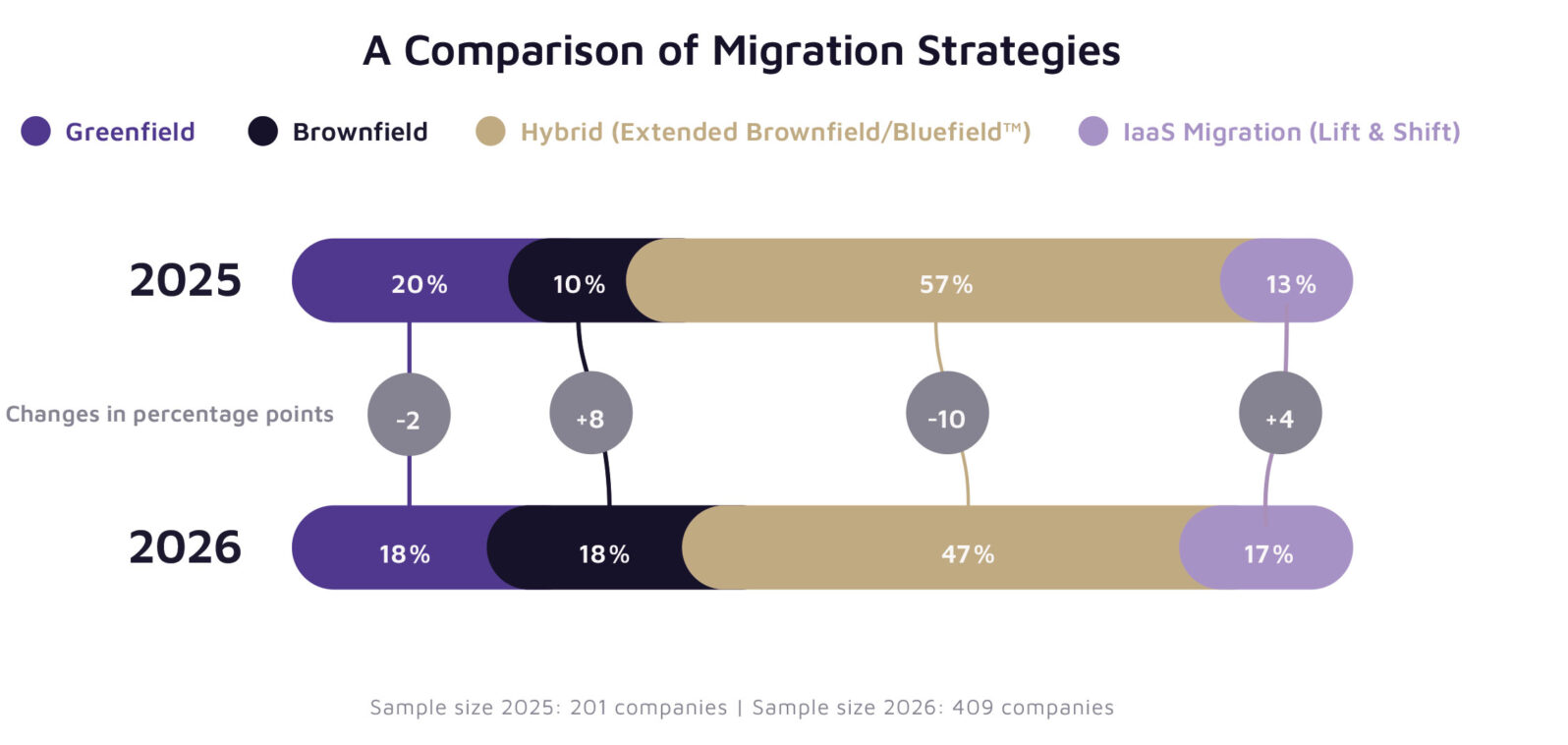
The private cloud is currently the dominant SAP S/4HANA operating model
A key finding of the valantic SAP Study 2026 is the growing importance of digital sovereignty. Regulated industries in particular, such as energy suppliers, pharmaceuticals and the food industry, are scrutinizing very closely where their data is stored, which jurisdictions apply and how regulatory requirements can be complied with. This has a significant impact on the design of cloud architectures.
Many companies are consciously opting for:
Cloud thus becomes a strategic decision about risk profiles and the ability to act. The challenge is to understand digital sovereignty not as a contradiction to the public cloud, but as a design framework for a target image that takes into account both regulatory requirements and the ability to innovate.
Cloud strategies cannot be viewed in isolation from the S/4HANA transformation and AI initiatives. The study makes it clear that companies with a clear cloud vision generally make faster progress with the introduction of S/4HANA and can scale AI use cases more easily. Standardized, cloud-based infrastructures facilitate the introduction of new services, reduce dependence on individual special solutions and shorten innovation cycles.
For the C-level, this means that the choice of cloud operating model is also a decision about the future scope for innovation in the SAP environment. Anyone who wants to use S/4HANA and AI as a platform for business innovation in the long term can hardly avoid a clear commitment to public cloud and 2-tier scenarios – while at the same time taking into account specific private cloud needs in the segment of really large companies.
Specific recommendations can be derived from the study results. Companies should first define a cloud target picture that takes their own starting position into account. This target picture should clarify where 2-tier approaches are worthwhile due to specific business requirements or different operating models and which systems or processes justify permanent hosting scenarios in the private cloud or even on-premises.
Based on this, it makes sense to systematically evaluate your own applications in order to decide which workloads belong in which operating model. In addition to technical criteria, data criticality, regulatory requirements and the contribution to the business model play a key role. At the same time, expertise in the areas of cloud architecture, security and integration must be built up in a targeted manner – both in IT and at the interfaces to the specialist departments.
Finally, cloud decisions should always be made in the context of the SAP S/4HANA roadmap and planned AI initiatives. The valantic SAP Study 2026 clearly shows: Cloud in the SAP environment is not an end in itself, nor is it purely an infrastructure topic. Properly understood and implemented, it becomes an enabler for a flexible, resilient and innovative ERP landscape – with public cloud as a strategic target and hybrid scenarios as a bridge to it.
Questions? We would be happy to support you with your project. Get in touch with us!
valantic SAP Study 2026
Since 2018, valantic has been asking SAP customer executives about investment intentions and business opportunities. The valantic SAP Study 2026 shows where companies from the DACH region currently stand in their digitization process and what course they are setting for the future.