Highlight

Successful together – our valantic Team.
Meet the people who bring passion and accountability to driving success at valantic.
Get to know usArtificial intelligence and SAP AI are now being used in practice by many SAP customers. The focus is primarily on business-relevant, agent-based use cases. Robust governance, security and data structures are essential here.

In the SAP context, artificial intelligence is no longer a promise for the future, but is developing into an operational and strategic lever for efficiency, resilience and new business models. The valantic SAP Study 2026 shows that a large number of companies in the DACH region is already using specific AI solutions – though the level of maturity varies widely, and there are significant differences between industries and countries.
While some pioneers have deeply integrated AI into their SAP processes and are pursuing clear roadmaps, others are still struggling with isolated pilot projects, unclear responsibilities and a lack of governance. Those who now take the step away from singular use cases towards a strategic, company-wide AI agenda will secure a sustainable competitive advantage.
According to the valantic SAP Study 2026, around two thirds of the companies surveyed in the DACH region are already using AI in the SAP environment. The fields of application range from forecasting models in controlling and automated scheduling suggestions in the supply chain to chatbots in customer service. Industries such as the automotive and food sectors are particularly advanced, where volatile markets, fluctuating demand and complex supply chains are increasing the pressure to boost efficiency. Here, AI models are being used in a targeted manner to forecast requirements more accurately, optimize stocks and keep service levels stable.
At the same time, there is a clear spread in maturity levels. Companies with a high level of AI maturity have defined roles such as AI product owners or data scientists, dedicated budgets and a roadmap that plans the expansion of use cases over several years. On the other hand, there are organizations in which AI is primarily seen as an experiment by individual teams – without any connection to an overarching data or platform strategy. In these cases, the added value often falls short of expectations because technical feasibility does not go hand in hand with organizational anchoring.
Against this backdrop, it is not surprising that the companies surveyed in the study have long since stopped asking about general “AI models”, but rather about specific AI agents that noticeably reduce workloads. The focus is on scenarios in which there is a lot of manual routine today – for example in the processing of service tickets, in accounts receivable management or in scheduling.
What is needed are AI agents that can take over steps independently within clear guidelines: Pre-sorting cases, preparing decisions, initiating standard processes. These agents access the relevant SAP S/4HANA data via SAP BTP and the SAP Business Data Cloud, thus achieving a new level of automation in the SAP environment.
The message from the study: the market is moving away from abstract AI pilots towards clearly defined, agent-based use cases – and companies expect their SAP platforms to support precisely this form of “hands-on” automation.
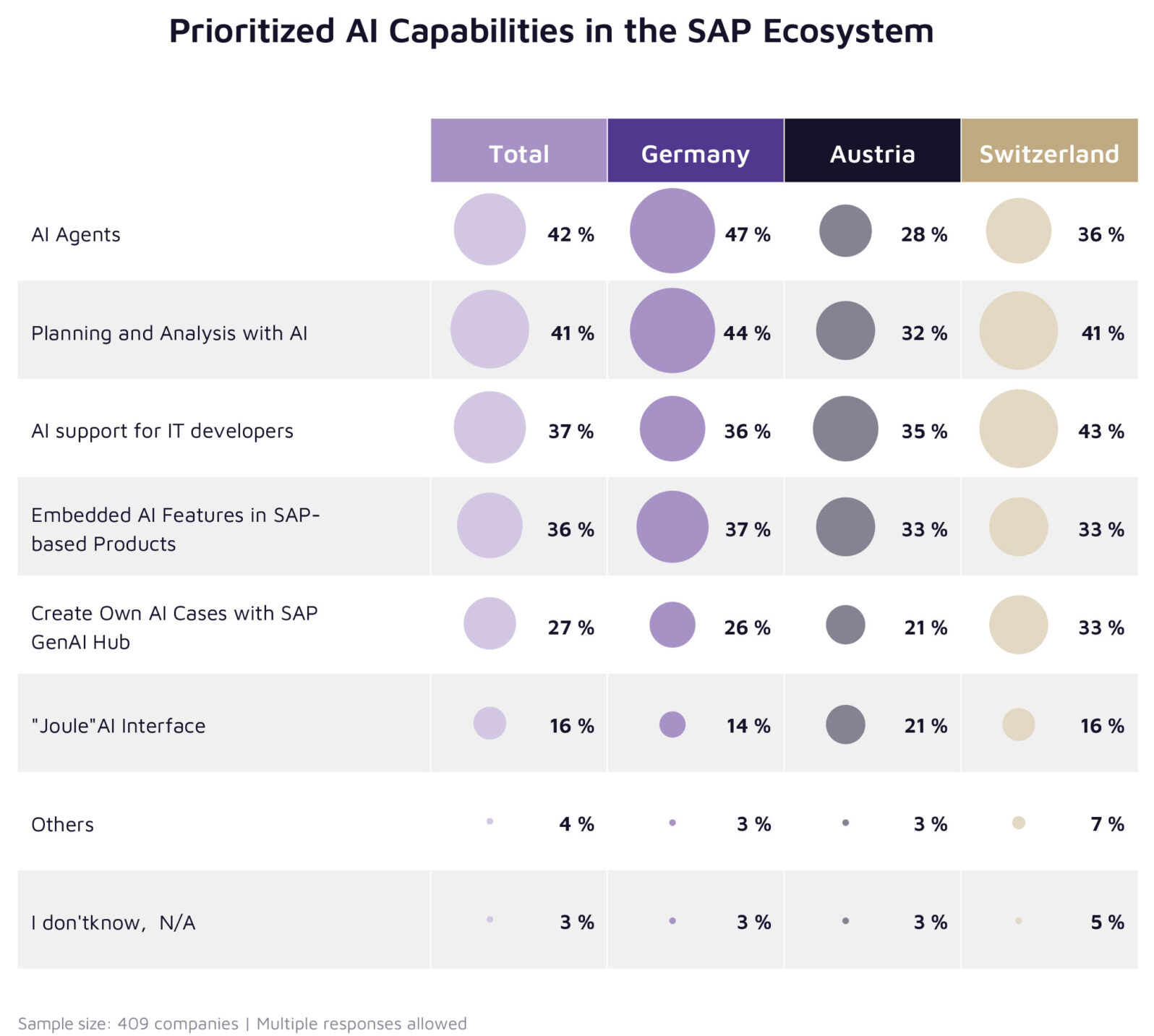
The AI functionalities prioritized in the SAP ecosystem according to the valantic SAP Study 2026
The study makes clear that the perceived benefits of AI are weighted differently from region to region. In Germany, process acceleration and relief for employees dominate. AI is primarily seen as a tool for automating routine tasks, shortening throughput times and making decisions faster and more data-based. In Switzerland, on the other hand, the focus is more on reducing costs; there, AI is primarily associated with increasing efficiency and optimizing existing resources.
These differences reflect different framework conditions and cultural influences. For C-level decision-makers, this means that AI strategies must not only be technologically consistent, but also organizationally and regionally compatible. A central roadmap can set the framework, but should leave room for local variations – such as the emphasis placed on efficiency, growth, or risk reduction.
.
Despite growing acceptance, governance, security and data quality remain key obstacles. Although many companies see AI in the SAP context as an opportunity, they fear risks in terms of data protection, compliance and IT security. Particularly in the case of generative AI solutions and autonomous decision support systems, the requirements for traceability and control are increasing.
The study shows that companies with clear governance structures move more quickly from pilot to productive use. Successful organizations are characterized by three features:
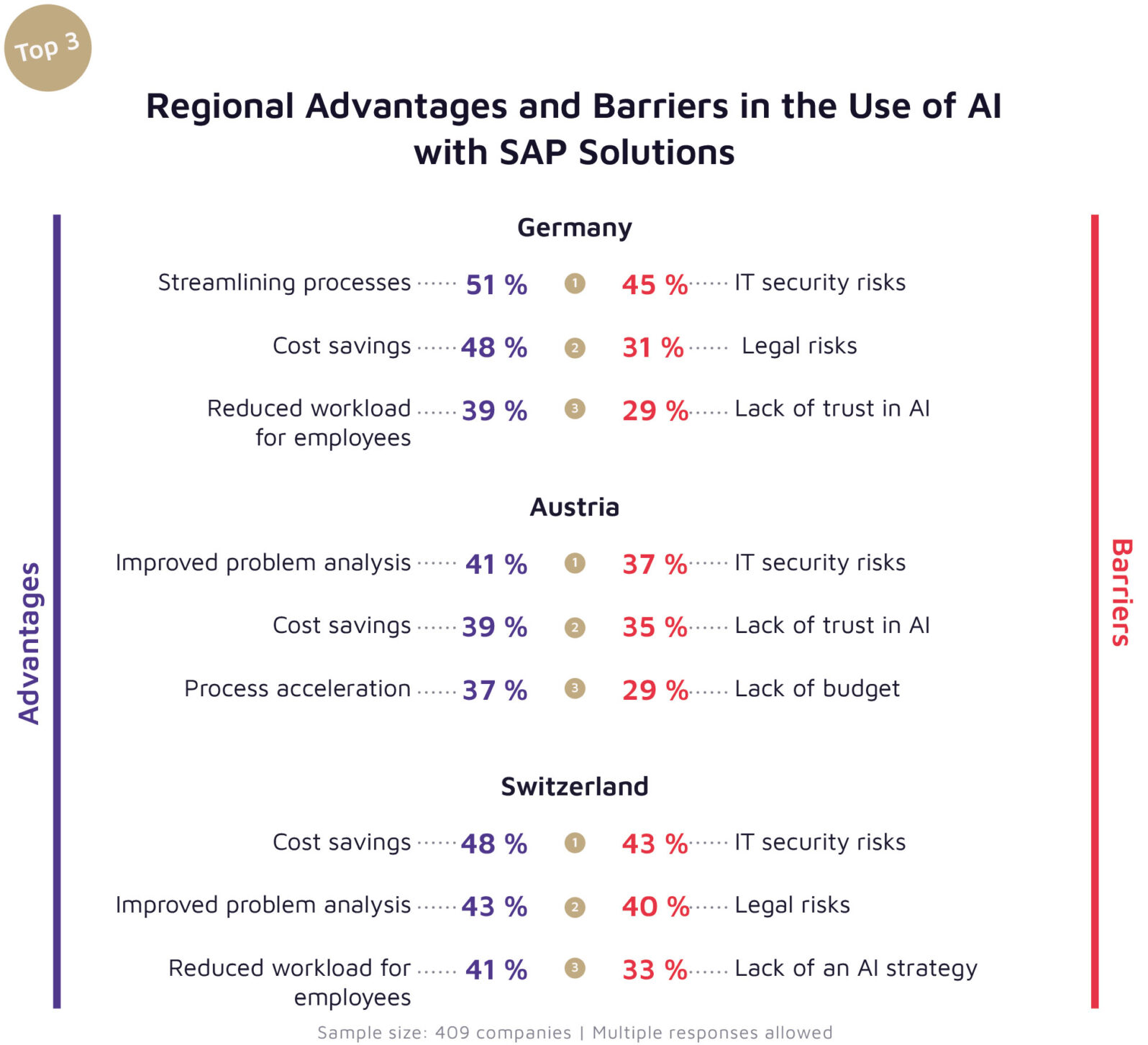
Regional barriers to the use of AI – security and compliance issues are slowing down scalability.
The central task is to take the step from an isolated use case to a strategic AI roadmap. To do this, companies should first systematically analyze their processes to determine where AI can provide the greatest leverage – for example in forecasting, pricing, procurement or service. On this basis, a prioritized pipeline of initiatives can be developed that addresses both quick wins and structural improvements.
At the same time, a technical basis is needed that is based on SAP S/4HANA, SAP BTP and SAP Business Data Cloud and enables a scalable, secure AI landscape. And last but not least, the organization and culture must be brought along: new roles, new skills, an open approach to data-driven decisions. The valantic SAP Study 2026 makes it clear that AI in the SAP environment is not an end in itself. When properly anchored, it becomes a strategic instrument for sustainably securing one’s own competitiveness in a volatile environment.
Questions? We would be happy to support you with your project. Get in touch with us!

valantic SAP Study 2026
Since 2018, valantic has been asking SAP customer executives about investment intentions and business opportunities. The valantic SAP Study 2026 shows where companies from the DACH region currently stand in their digitization process and what course they are setting for the future.