Highlight

Successful together – our valantic Team.
Meet the people who bring passion and accountability to driving success at valantic.
Get to know usFrom legacy systems to the cloud
SAP Cloud ERP is an integrated cloud ERP that brings finance, procurement, sales and manufacturing together in a single system, replacing disconnected, siloed applications. valantic implements SAP Cloud ERP with standard processes and predictable effort, either as a full rollout or in phases, starting with finance.

The key insights on SAP Cloud ERP, summarized briefly.
SAP Cloud ERP is cloud-based enterprise software. Thanks to preconfigured processes, a full implementation typically takes 36 to 52 weeks.
In our experience, implementation costs at least 30% less than an on-premises project. Two automatic updates a year are included in the subscription.
The system runs on the SAP HANA in-memory database: built-in business intelligence delivers real-time analytics, and embedded AI automates routine tasks.
valantic supports companies on their move to SAP Cloud ERP, from software selection and implementation through to ongoing operations.
SAP Cloud ERP, formerly SAP S/4HANA Cloud Public Edition and often referred to as S/4HANA Cloud, is SAP’s ERP solution delivered as software as a service (SaaS). Preconfigured standard processes and embedded AI capabilities automate routine tasks, while two updates a year deliver new functionality without an upgrade project. Because SAP typically releases new AI innovations in the cloud first, the system is a core element of the Autonomous Enterprise. The software is aimed primarily at midsize and growing companies that are replacing a legacy system and work with largely standardized processes. At STREIF, a manufacturer of prefabricated homes, valantic implemented SAP Cloud ERP for finance and order-to-cash, and the company went live in 12 weeks.
Get started quickly
Reduce costs
SAP Cloud ERP keeps IT budgets in check with low upfront investment. In our experience, implementation costs at least 30% less than a traditional on-premises project. The monthly subscription fee covers maintenance, support and two automatic updates a year.
Stay agile & innovative
Proven, harmonized standard processes, the SAP HANA in-memory database and built-in business intelligence keep companies agile and ready for what’s next. The system scales with the business, delivers fast analytics, supports data-driven decisions and uses embedded AI to automate routine processes.




Martin Carstensen
Senior Project Manager Finance at The Quality Group
”In SAP Cloud ERP, we have a business solution that suits us and will guide our company into the future. Process standardization eliminates the need for internal coordination, freeing up resources for more innovation. Thanks to our partner valantic, we will use this basis to secure our business success, and we are ideally positioned for further growth.“

Guido Czampiel
Partner & Managing Director at valantic
”Our solution at The Quality Group demonstrates how SAP Cloud ERP and the SAP Integration Suite can establish a flexible, composable commerce architecture that combines flexibility with stability. It supports TQG's dynamic business model, with a quick time-to-market, as well as the requirements for the availability and resilience of processes and data. We look forward to helping our customer with its successful transformation.“
Martin Carstensen
Senior Project Manager Finance at The Quality Group
”In the long term, AI can help us manage processes from demand planning to customer contact even more intelligently.“
Software selection
SAP’s cloud enterprise software comes in two deployment options that address different business requirements and support different transformation paths. SAP Cloud ERP offers the benefits of a standardized, scalable system, while SAP Cloud ERP Private allows tailored customizations for greater control and flexibility.
SAP Cloud ERP: ready to use
SAP Cloud ERP combines the flexibility and cost efficiency of Software as a Service (SaaS) with powerful ERP functions for all core areas in companies, from procurement to sales and service. The solution has integrated intelligence, is flexibly scalable, can be easily adapted to dynamic growth and supports international expansion thanks to the global availability of a harmonized ERP infrastructure. Individual requirements can be mapped via the SAP Business Technology Platform (SAP BTP) and the functional scope can be expanded as required thanks to modularity, for example in human capital management, purchasing or planning.
SAP Cloud ERP Private: tailor-made
SAP Cloud ERP Private is available for companies that need more customizing options for their cloud digitalization. This solution can be flexibly adapted to individual requirements and paves the way for a customized transformation at your own pace. The private cloud ERP enables the gradual conversion to a pure SaaS landscape with a well-defined conversion methodology. The business software combines the full functionality of an SAP S/4HANA on-premises system with the economic benefits of a subscription-based cloud system. Previous investments and existing customizations are protected.
Short & compact:
Short & compact:

Strategy paper: With SAP S/4HANA to the cloud
Which SAP cloud ERP solution is the right one? Our free strategy paper offers guidance on software selection.
Choosing a cloud solution is primarily a question of mindset and priorities – but ERP as a service is particularly suitable for small companies, start-ups, scale-ups and SMEs. With SAP Cloud ERP, they receive professional, quick-to-use and low-maintenance business software that allows them to quickly achieve added value and use their limited resources efficiently. The solution keeps pace with changing requirements and remains at the cutting edge of technology thanks to automatic updates. Flexible, intuitive to use and infinitely scalable, SAP Cloud ERP is ideal for agile, growth-oriented companies.

Whitepaper: Scale-up easily with SAP Cloud ERP - Boost for start-ups & scale-ups
Find out how SAP Cloud ERP supports your company’s growth and what 10 concrete benefits the solution offers you.
Implementation
Preconfigured processes, industry best practices and a structured project methodology accelerate the implementation of SAP Cloud ERP. Additionally, tailored packages that include software, services, tools, methods, and training resources ensure companies can deploy their cloud solution quickly and securely. While SAP Cloud ERP is exclusively introduced as a greenfield implementation, transitioning to SAP Cloud ERP Private can also be achieved via a brownfield conversion or through a selective data migration approach.
Fast access to reliable financial data, clean processes and scalable structures for well-founded business decisions: Our structured valantic Finance-first approach enables a short-term go-live of SAP Cloud ERP focused on the core processes & functions essential for finance. The key benefits:


Michael Peters
Head of IT / Organization / Processes at STREIF
”Implementing SAP Cloud ERP in just three months was an ambitious goal for us. Thanks to our excellent collaboration with valantic, a clear project structure, and a shared commitment to standard processes, we were able to achieve it. Today, we have a modern, future-ready ERP platform that makes our finance processes more efficient, transparent, and scalable.“
The GROW with SAP bundle is available to help companies accelerate their transition to the cloud. The package includes a wide range of specific software and services, including SAP Cloud ERP and access to the SAP Business Technology Platform innovation platform. The latter, for example, supports the development and integration of custom applications and functions and facilitates the use of AI directly in a business context. In addition, GROW with SAP provides implementation tools and methods, learning and training resources, and access to the SAP community.

The RISE with SAP bundle enables companies to drive their unique transformation journey. It is specifically designed to support existing SAP customers with on-premise ERP systems as they transition to the cloud. Additionally, it serves new customers looking to implement SAP Cloud ERP Private to optimize their business operations. For continuous innovation, they receive software solutions, including SAP Signavio and SAP BTP, tools and methods, cloud infrastructure & security as well as services from partners such as valantic, in addition to SAP Cloud ERP Private. Our team accompanies the RISE project and takes care of operation, support and application management.

Industry deep dives
From manufacturing to utilities: SAP Cloud ERP helps companies in a wide range of industries to optimize processes, create transparency and react more quickly to changes. valantic offers a wide range of customized industry solutions and extensive expertise. Find out more about our offering in selected deep dives:

Discrete manufacturing
Knowledge and approaches for companies in the manufacturing sector:

Consumer goods industry
Best practices, insights and solutions for the consumer goods industry:

Food industry
Our expertise for the digitalization of the food industry:
We guide you through the implementation of SAP Cloud ERP from start to finish—so you can get the most out of your business solution:

Our Cloud team stands out for its in-depth technological expertise. We not only master the entire SAP portfolio—from asset lifecycle management to warehousing—but also technologies from approximately 25 other providers. As a recognized pioneer in innovation, we develop effective solutions in areas such as analytics, automation, data management, AI, and robotics.
From manufacturing to the utilities sector—thanks to our many years of project experience across various markets, industries, and business models, we understand the specific challenges facing your industry and develop solutions that enable you to address them effectively and position your business for the future.
Our 360° digital transformation approach covers the entire value chain seamlessly and encompasses all levels of transformation. Strategy, consulting, and implementation go hand in hand. At valantic, more than 4,300 experienced experts in 20 countries worldwide are dedicated to ensuring our clients’ business success.
Business requirements are as individual as your company’s industry, strategies and customers. That’s why we listen to you carefully, identify relevant pain points together and develop customized solutions.
For us, the partnership does not end with the implementation of your SAP Cloud ERP solution. As a consultant, sparring partner and drivers for innovation, we also accompany you after the go-live and contribute to your sustainable business success and future security with continuous support and targeted optimization of the system and process landscape.
valantic Insights on SAP Cloud ERP

Webinar on demand
How The Quality Group scales its business with SAP Cloud ERP
Agile business
with SAP Cloud ERP! Let's get started together!

Expertise
Get to know the advantages for start-ups and scale-ups
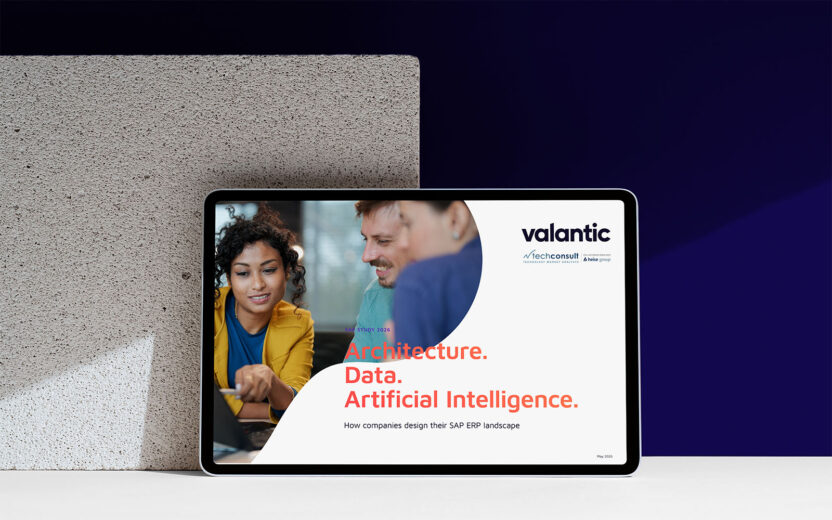
valantic SAP study
What SAP users say about cloud transformation

Success stories
TQG secures its performance with SAP Cloud ERP

Success stories
How STREIF transformed finance in just 12 weeks with SAP Cloud ERP

Blog · April 30, 2026
SAP Cloud ERP doesn’t have to be a massive project: With a clear focus on finance and a standardized approach, mid-sized companies can go live in just three months. valantic demonstrates how to reduce complexity, ensure cost transparency, and build a scalable foundation for future growth.
Learn more SAP Cloud ERP: How mid-sized companies can go live in just three months
Blog · April 9, 2026
How to get started quickly with SAP Cloud ERP in manufacturing? With the valantic Manufacturing Solution, midsize manufacturing companies can go live in just four months—with a clearly defined scope, predictable costs, and end-to-end processes from order to production.
Learn more SAP Cloud ERP in Manufacturing: Get Started Quickly and Securely with QPPS
Blog · November 11, 2025
The benefits of AI and SAP Cloud ERP only materialize when their possibilities are consistently leveraged. For this, technology must become an integral part of everyday business operations. As a consulting partner, valantic makes innovation visible, prioritizes relevant use cases, and ensures that our clients fully harness the existing potential.
Learn more AI is Not a Surefire Success: 5 Impulses to Unlock Its Potential
Blog · August 14, 2025
With SAP Cloud ERP and the valantic Manufacturing Solution, manufacturing companies can successfully position themselves in their dynamic market environment. They can cover all central processes in discrete manufacturing and immediately benefit from innovations. Furthermore, they can implement new business requirements quickly. The valantic solution package accelerates implementation.
Learn more SAP Cloud ERP and the valantic Manufacturing Solution promote efficient production
Blog · April 29, 2025
Introduce SAP S/4HANA Cloud successfully with change management! For transformation projects to succeed, employees need to be involved right from the start. Continuous information, training, feedback structures and mentoring programs create the necessary culture to exploit the potential of the new technology.
Learn more With change management, SAP S/4HANA Cloud projects succeed
Blog · June 4, 2024
Cloud computing is part of everyday life, and for enterprise resource planning, there’s no way around the cloud. With the two cloud versions of its S/4HANA Business Suite, SAP offers future-oriented ERP as a service to suit many requirements.
Learn more SAP S/4HANA Public Cloud or Private Cloud?We show you how to quickly achieve added business value with SAP Cloud ERP
Yes. SAP Cloud ERP is the current name for the former SAP S/4HANA Cloud Public Edition, also often called S/4HANA Cloud or SAP Public Cloud. SAP renamed its cloud ERP offerings in 2025: the former SAP S/4HANA Cloud Private Edition is now called SAP Cloud ERP Private. Both versions are based on SAP S/4HANA but differ in their operating models and degree of customization.
It depends on the scope. Depending on the starting point, a full implementation across all core processes typically takes 36 to 52 weeks. A deliberately limited scope can shorten that timeline: with valantic’s finance-first approach, finance processes go live in 12 weeks, with other areas following in stages. Manufacturing companies can get started with the valantic Manufacturing Solution in around four months because the scope and processes from order to production are defined in advance.
There are two cost components: the software subscription and the implementation project. The monthly subscription fee includes maintenance, support and two automatic updates a year. Its price depends mainly on the number of users, how they use the system and the scope of functionality. Project costs depend on the scope, the number of legal entities and the extent of data migration. valantic offers a fixed price per legal entity for its finance-first approach; licenses are not included.
According to SAP, mainstream maintenance for SAP ECC 6.0 as part of SAP Business Suite 7 ends at the end of 2027. SAP then offers paid extended maintenance until the end of 2030. Companies that choose not to take up this option and continue operating the system automatically move to customer-specific maintenance with a limited scope of services.
For companies with large, complex system landscapes, SAP also offers the “SAP ERP, private edition, transition option”: a paid cloud subscription that supports operations from 2031 to 2033, provided the systems have been moved to SAP ERP, private edition by the end of 2030. This does not extend maintenance for on-premises systems.
ECC customers have two routes to the cloud: a fresh start with SAP Cloud ERP (greenfield) or a move to SAP Cloud ERP Private, which also supports system conversion (brownfield) or selective data migration.
For existing SAP customers, two factors in particular favor a move: the end of SAP ECC maintenance and access to new features such as AI, which SAP primarily delivers through its cloud solutions. The right option depends on the extent of existing custom development. SAP Cloud ERP uses standard processes and requires a fresh start. SAP Cloud ERP Private accommodates existing extensions, including ECC customizations, and allows a phased transition. The valantic SAP Roadmap Assessment analyzes your current system landscape to determine the right path.
SAP provides the SAP S/4HANA Migration Cockpit for this, accessible through the “Migrate Your Data” app. It transfers master and transactional data from SAP and non-SAP systems using either template files or a direct connection to an SAP system. You can simulate the import and check for errors before transferring the data. In a new implementation, only the data needed in the new system is migrated, so it pays to clean up your data beforehand. valantic also offers an AI-assisted tool for SAP S/4HANA data migration. In one customer project, it reduced migration effort by almost 50%.
SAP Cloud ERP does not allow changes to the core system. You can still address individual requirements in three ways: key user extensibility for custom fields, interface adjustments and simple logic; developer extensibility in ABAP Cloud for more complex in-system extensions; and applications on SAP Business Technology Platform (SAP BTP) that run alongside the ERP. This keeps the core clean and ready for updates. Companies with many custom processes are usually better served by SAP Cloud ERP Private.
SAP Cloud ERP runs in SAP data centers and those of selected hyperscalers. European locations include Frankfurt, Walldorf and St. Leon-Rot. Companies choose a region based on their regulatory requirements. The data centers meet international standards such as ISO/IEC 27001 and SOC 2. SAP also has the solution assessed against the C5 criteria of Germany’s Federal Office for Information Security (BSI).
The most important requirement is a willingness to work with standard processes. SAP Cloud ERP is particularly suitable for companies with largely standardized workflows and limited customization needs. Implementation takes the form of a new deployment (greenfield). This calls for fit-to-standard workshops to compare your processes with SAP best practices, clean master data and key users who can represent the business throughout the project. You do not need your own infrastructure; SAP operates the system.
AI is embedded directly in SAP Cloud ERP business processes, for example in financial closing, procurement and production planning. The Joule AI assistant answers questions in natural language, analyzes business data and guides users through transactions. AI agents are increasingly taking on routine tasks, such as releasing production orders. Basic Joule features are included in the subscription; advanced AI scenarios are billed according to usage through AI Units.
Because SAP Cloud ERP receives two automatic updates a year, new AI capabilities become available without an upgrade project. valantic helps customers prioritize use cases that deliver measurable value for their business.
Both are cloud-based ERP systems for midsize companies. The choice depends mainly on three factors: your existing system landscape, willingness to adopt standard processes, and requirements for industry-specific capabilities and international operations. SAP Cloud ERP suits companies that want to get started quickly with preconfigured best-practice processes and grow across national borders. Microsoft Dynamics 365 may be a natural choice for companies already heavily invested in Microsoft applications. A structured software selection process, in which both systems are demonstrated against your own processes, provides a sound basis for a decision.
A good partner has demonstrable SAP Cloud ERP project experience, understands your industry and follows a structured methodology. Other important criteria include a clear focus on standard processes (clean core), systematic change management and support after go-live. valantic implements SAP Cloud ERP using a methodology based on SAP Activate and standardized templates, and supports companies from software selection through to application management. At STREIF, valantic implemented SAP Cloud ERP for Finance and Order-to-Cash in 12 weeks.