Highlight

Successful together – our valantic Team.
Meet the people who bring passion and accountability to driving success at valantic.
Get to know usMore and more companies are relying on SAP BDC and SAP BTP as a strategic, central layer for innovation, analytics and AI. Formerly monolithic ERP landscapes are becoming platform architectures. To achieve this, it is essential to develop a roadmap and initial use cases.

With the SAP Business Technology Platform (BTP) and the SAP Business Data Cloud (BDC), SAP is establishing an architecture that brings together data, processes and innovation. The valantic SAP Study 2026 shows that companies that use BTP and BDC strategically create a central layer for integration, analytics and AI and at the same time relieve the burden on their ERP system. This shifts the focus away from monolithic ERP landscapes towards a platform approach in which SAP S/4HANA, BTP and BDC together form the backbone for digital business models.
According to our study, SAP BTP is increasingly perceived as a central innovation platform. Companies are using it to integrate heterogeneous system landscapes, extend standard processes without modifying the core and build data-driven applications that go beyond traditional ERP functionalities. This makes BTP a place where new ideas can be prototyped quickly and scaled up if successful.
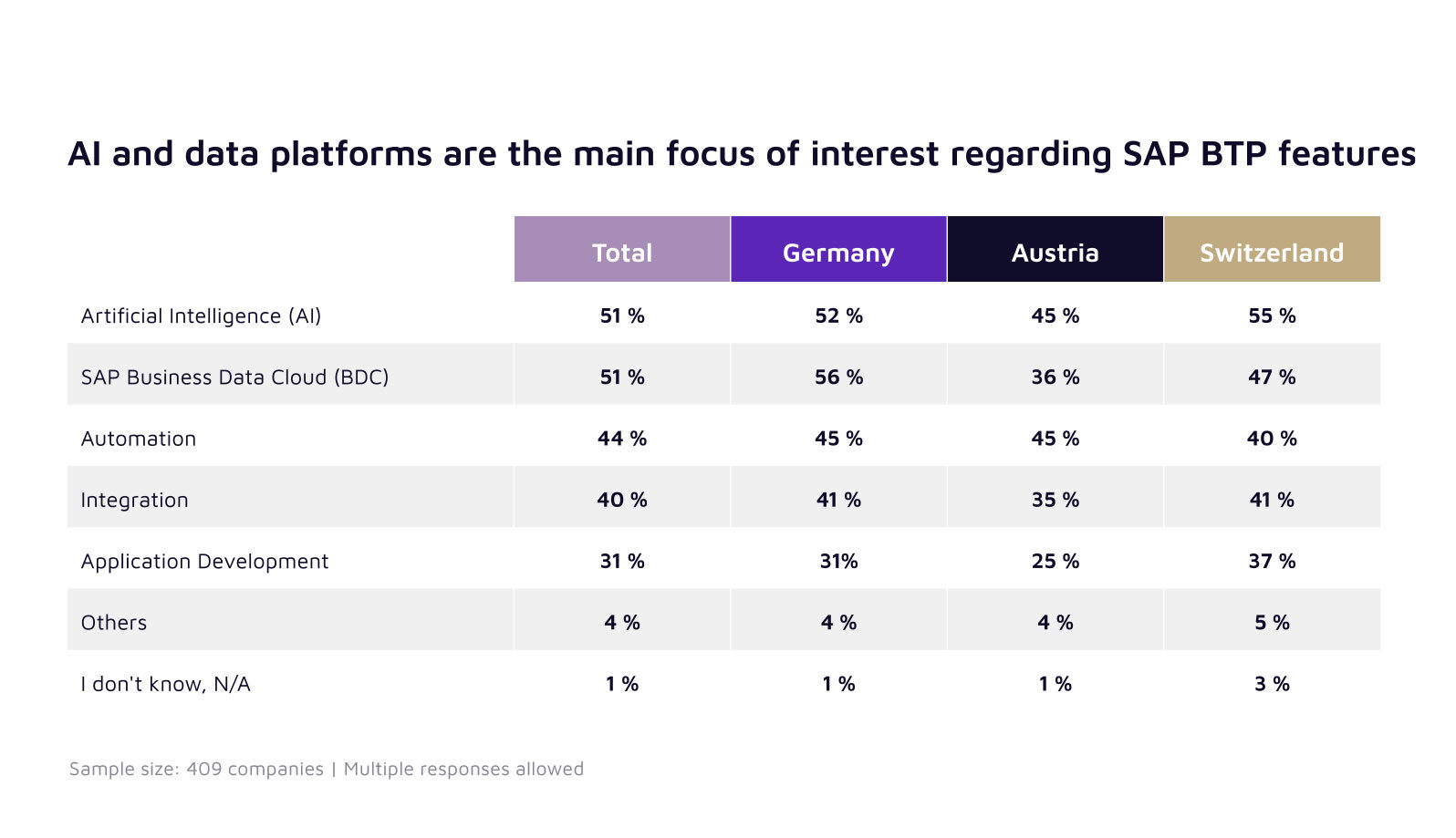
Artificial intelligence and data platforms are currently the most interesting functions of SAP BTP for SAP customers.
For IT organizations, this means a change of role: away from pure system administration and towards platform and product management. Successful companies define clear guidelines as to which extensions are implemented in the BTP, how APIs are designed and how security and governance are ensured. BTP thus becomes the control center through which new services can be brought into the business quickly without jeopardizing the stability of the ERP core.
The SAP Business Data Cloud (BDC) is becoming the central building block for company-wide data strategies. Around 60 percent of the companies surveyed see BDC as indispensable for their data-driven initiatives, particularly in data-intensive sectors such as retail and the food industry. BDC addresses three structural challenges:
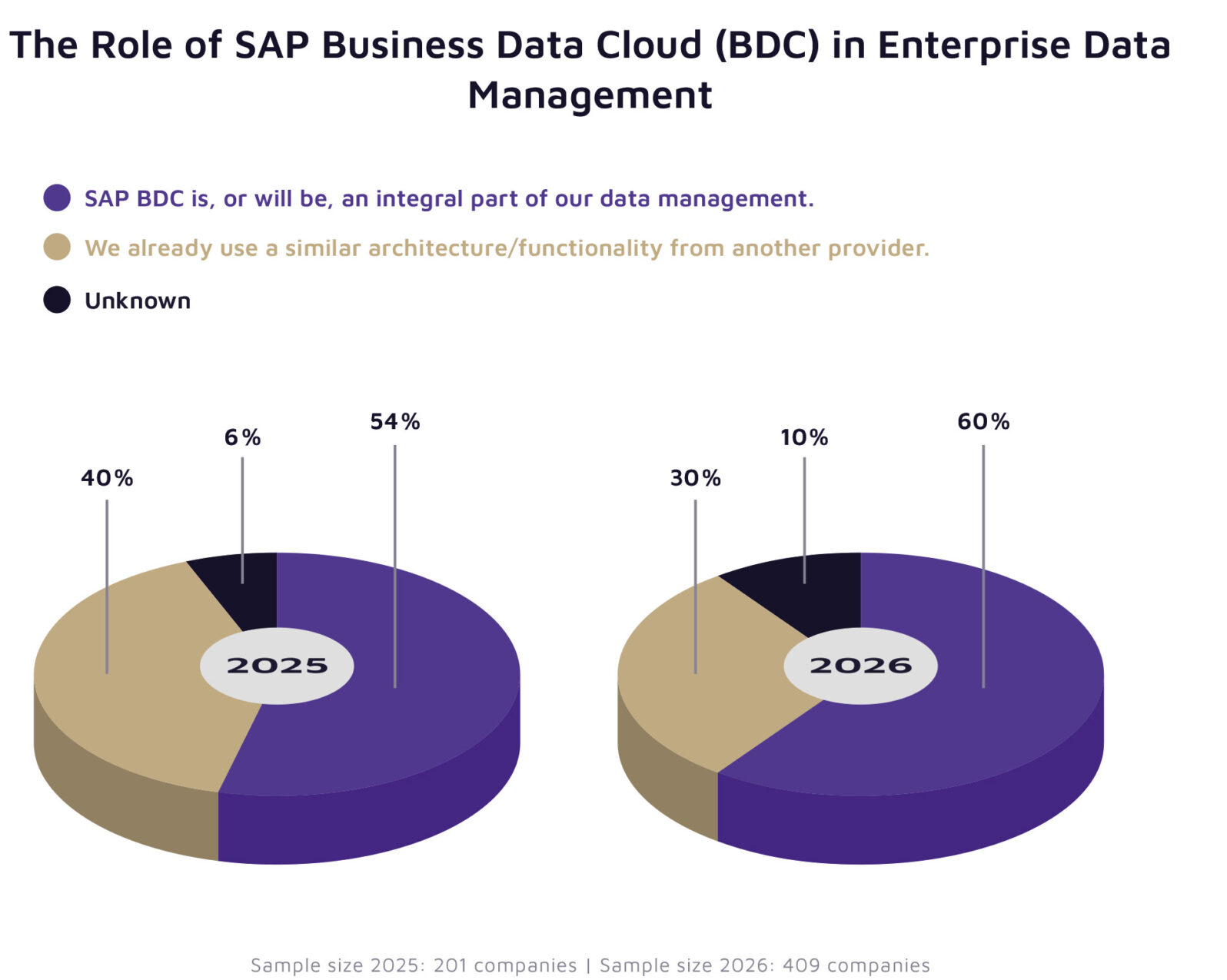
60% of executives see SAP BDC as a central element of data management in their companies.
The bundling of data in a consistent platform, combined with clear governance mechanisms, creates a basis on which transaction data from S/4HANA, IoT information, external market data and unstructured data can be merged. On this basis, sophisticated analytics and AI scenarios can be implemented that go far beyond traditional reporting.
The valantic SAP Study 2026 shows that the strongest effects arise when SAP S/4HANA, BTP and BDC are considered as an integrated overall picture. In such an architecture:
This interaction makes it possible to implement new use cases without permanently changing the ERP core. Examples range from predictive maintenance based on machine data and service processes to dynamic pricing using market and inventory data and AI-supported decision-making support in purchasing or supply chain management.
Several recommendations for a platform roadmap can be derived from the study results. Companies should first define a clear platform strategy in which the role of BTP and BDC is anchored in the target architecture. Based on this, it is important to prioritize use cases that are both professionally relevant and technically feasible in order to achieve visible success quickly.
Governance structures for data, APIs and extensions are essential in order to avoid uncontrolled growth and technical debt. Last but not least, platform and data management skills need to be developed in a targeted manner – ideally in cross-functional teams from IT, data & analytics and specialist departments.
The central message of the valantic SAP Study 2026 is: SAP BTP and SAP Business Data Cloud are forming the control center for innovation in the SAP ecosystem. Companies that consistently pursue this platform concept overcome the limits of traditional ERP systems and create the basis for an organization that can react quickly, data-driven and innovatively to new market requirements.
Questions? We would be happy to support you with your project. Get in touch with us!
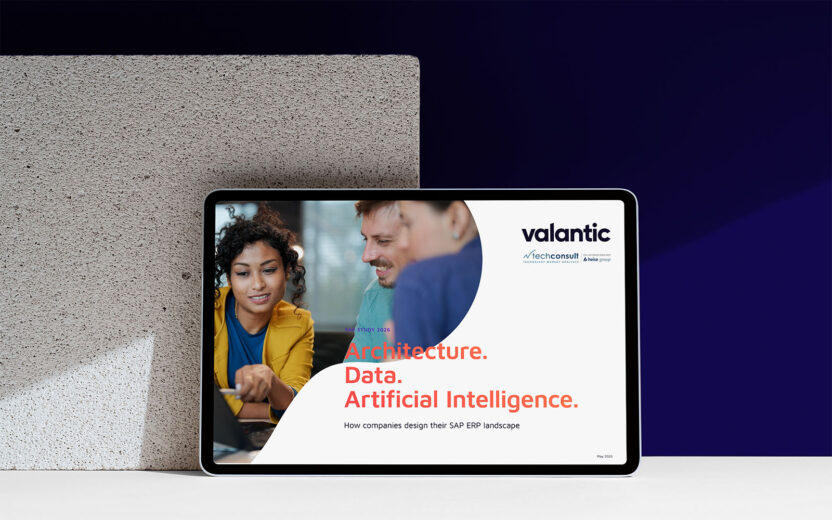
valantic SAP Study 2026
Since 2018, valantic has been asking SAP customer executives about investment intentions and business opportunities. The valantic SAP Study 2026 shows where companies from the DACH region currently stand in their digitization process and what course they are setting for the future. Find out more now!