Highlight

Successful together – our valantic Team.
Meet the people who bring passion and accountability to driving success at valantic.
Get to know usMost companies in German-speaking countries are currently either in the middle of their SAP S/4HANA project or have already completed the migration. The task now is to use S/4HANA strategically to modernize processes, better evaluate data and scale innovations. The go-live thus marks the start of a continuous transformation.

SAP S/4HANA has become a compulsory exercise for many companies in the DACH region – not least due to the foreseeable maintenance deadlines for the previous versions. The valantic SAP Study 2026 shows that around 70 percent of the companies surveyed are already in the implementation or operating phase.
But this is not the end of the actual task. The central question is no longer whether to migrate to S/4HANA, but how to use this platform to modernize processes, use data and scale innovations. The real change begins after the go-live.
The study paints a differentiated picture of the migration landscape. Large industrial companies, such as those in the automotive or pharmaceutical industries, are often more advanced, have transformation programs lasting several years and have set up the migration as a strategic project with strong business involvement.
SMEs, on the other hand, often take a step-by-step approach with focused projects and more limited resources. Brownfield approaches dominate where existing processes and individual developments are to be largely retained. Greenfield or selective approaches are primarily used when comprehensive process modernization and a radical clean-up of historically evolved structures are the goal.
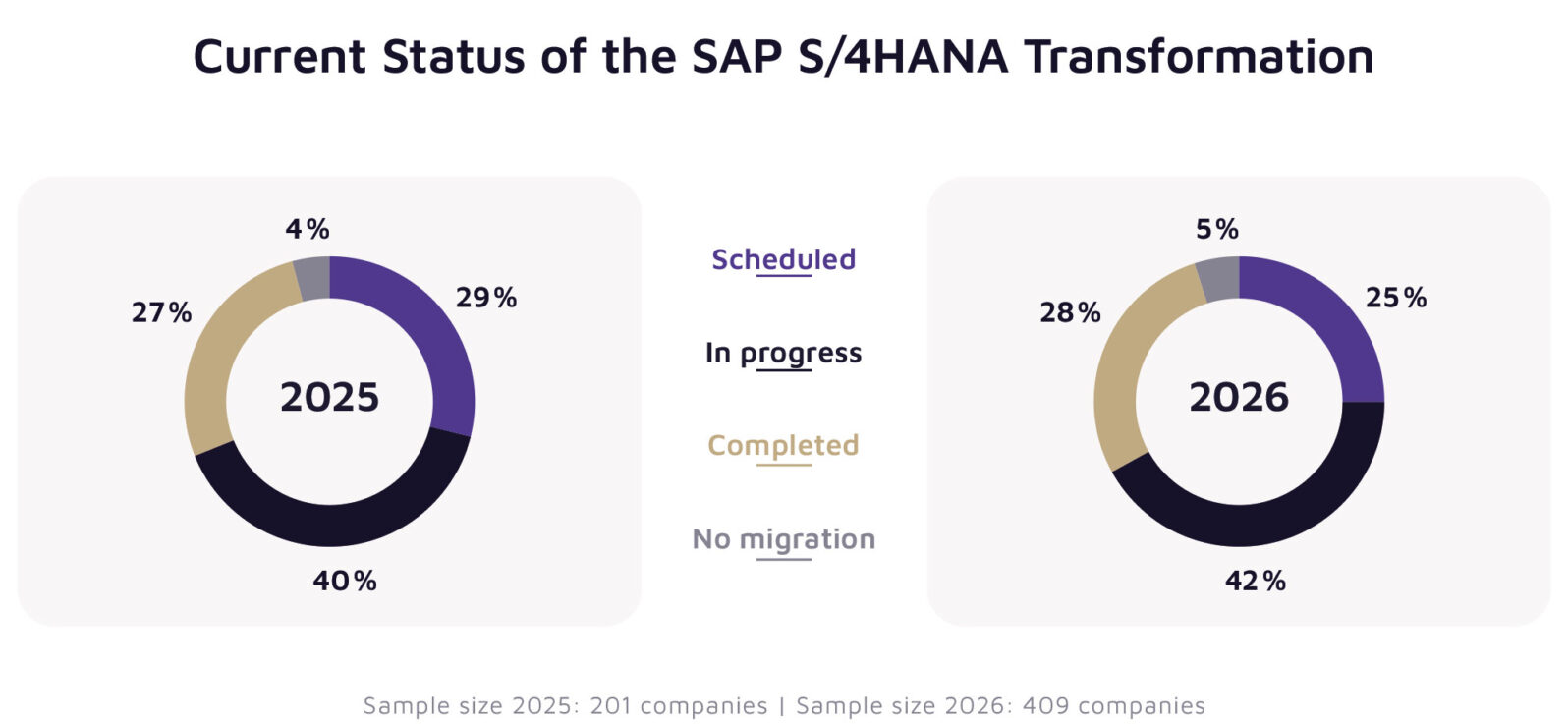
Most companies are currently in the process of transformation or have already completed it.
It is crucial for managers not to view the migration strategy as a purely technical issue. The choice between brownfield, greenfield or a selective approach determines how much transformation potential is leveraged in the short term and how flexibly the company can react to new requirements later on. A pure “technology upgrade” without accompanying process and organizational changes gives away a large part of the added value that S/4HANA offers, because: If you only migrate, you modernize IT. If you transform, you modernize the company.
By switching to S/4HANA, companies are not only switching to a new ERP version, but also laying the foundations for a modern, integrated platform architecture. The in-memory technology of the HANA database, simplified data models and standardized interfaces make it easier to consolidate data from different systems and make it usable in real time. The study shows that companies are increasingly expanding their focus beyond stabilization and troubleshooting after the go-live – towards data-driven initiatives.
In combination with the SAP Business Technology Platform (BTP) and SAP Business Data Cloud (BDC), an architecture is created in which S/4HANA forms the operational backbone, while BTP and BDC act as the innovation and data layer. Transaction data from S/4HANA can be linked with IoT information, external market data or unstructured data from other sources. This enables integrated analytics scenarios, AI-supported forecasts or cross-process views of customers, suppliers and assets.
The tension between standardization and individualization remains a defining factor. The valantic SAP Study 2026 confirms that companies that consistently rely on standard processes and outsource enhancements to BTP are more agile in the long term and can adopt new releases and innovations more quickly. At the same time, there are industry requirements and competitive advantages that make individual processes necessary.
It is therefore crucial for success to establish an architecture guideline that defines:
S/4HANA projects thus become architecture and change projects, not just technical migrations.
The study shows that successful S/4HANA programs have several things in common. They have a clear business sponsor who drives the business objectives. They define value cases against which success can be measured, rather than just managing scope and timeline. They embed platform thinking by considering BTP, BDC and AI scenarios from the outset. And they consciously invest in change management and enablement to prepare employees for new processes, interfaces and working methods.
The central message of the valantic SAP Study 2026 is therefore: SAP S/4HANA is more than just a technical upgrade. Companies that understand it as a platform for business transformation and embed it in a well thought-out cloud, data and innovation strategy create the basis for a resilient, data-driven and future-proof organization. The go-live does not mark the end of the transformation, but the starting point of continuous change.
Questions? We would be happy to support you with your project. Get in touch with us!
valantic SAP Study 2026
Since 2018, valantic has been asking SAP customer executives about investment intentions and business opportunities. The valantic SAP Study 2026 shows where companies from the DACH region currently stand in their digitization process and what course they are setting for the future. Learn more!