Highlight

Successful together – our valantic Team.
Meet the people who bring passion and accountability to driving success at valantic.
Get to know usRetail is benefiting in particular from digital trends and innovations such as AI, composable and unified commerce, hyper-personalization and intelligent supply chain management. Retailers who make strategic use of these trends increase their profit potential, address their target groups more successfully and operate more efficiently in a competitive environment.

Digitalization in retail is no longer a linear process. It is an organization-wide discipline that networks the data, processes and systems of all business areas – and is raised to new levels of quality and benchmarks with artificial intelligence (AI):
70 %
of retailers plan to invest in AI-supported customer experiences (McKinsey, 2024).
60 %
of retail sales are influenced by omnichannel purchases (BCG, 2024).
50 %
of efficiency gains will result from data integration (Gartner, 2025).
valantic has identified five trends that will shape the retail of the future and determine business success in the long term. Specialist retailers, retailers and wholesalers should be prepared for these developments in order to keep pace in a volatile market and highly competitive environment.

Unified Commerce for seamless Omnichannel Experiences
Facts & Figures

Hyperpersonalization in the Customer Experience
Facts & Figures

Intelligent Supply Chain for Resilience and Sustainability
Facts & Figures

From Generative AI to Agentic AI in Commerce
Facts & Figures

AI-enabled Database for Smart Retail Analytics
Facts & Figures
Consumers no longer think in terms of channels. They expect seamless experiences that are coordinated across all digital and physical touchpoints – when shopping in stores and online stores, via apps and social media.
There is no way around a sophisticated omnichannel strategy for retail brands – and unified commerce is becoming an enabler for the successful implementation of cross-channel communication and sales strategies.

Strategic recommendation: valantic Retail Solutions for Unified Commerce
Unified commerce for omnichannel retail excellence? We’ll show you how:
Customers expect brands to “know” them. They want tailor-made solutions, relevant content, personalized offers and recommendations that precisely match their needs. Where every point of contact in the customer journey should appeal to the individual, hyper-personalization is the new measure of all things.
From product search to advice: retailers, specialist retailers and wholesalers who consistently focus on their customers and communicate the right messages, offers and solutions at the right time increase conversions, exploit sales potential and strengthen customer loyalty.

Strategic recommendation: Hyper-personalization with AI and CX strategy
Retail solutions for hyper-personalized customer experiences? We’ll show you how:
Whether food retail or fashion retail: Goods should be available in sufficient quantities in the store and, in the case of online orders, ideally reach the customer on the same day. This logistical feat requires flexible supply chain management (SCM ) that can cope with bottlenecks, last-minute changes and ongoing price pressure as well as stricter regulations (e.g. supply chain law, CO₂ requirements) and rising personnel and logistics costs.
In this area of tension, supply chain management must reconcile cost optimization, responsiveness and ESG key figures. Digitalization and AI provide the edge: AI forecasts demand, improves planning accuracy, reduces costs and risks through predictive analyses and enables reliable deliveries.

Strategic recommendation: End-to-end retail solutions for supply chain management
Ready for an AI-supported supply chain that ensures efficiency and resilience? We’ll show you how!
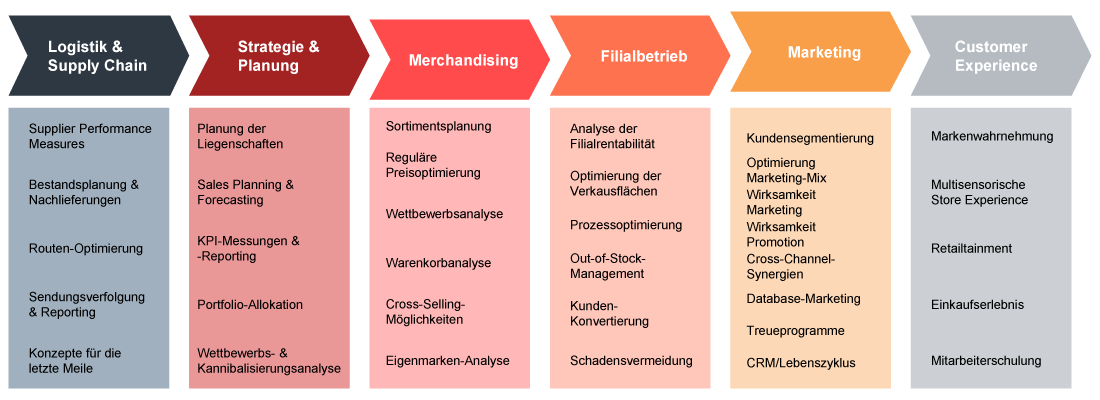
valantic supports you at all levels and paves the way for intelligent supply chain management, with which you can operate more agilely, efficiently and successfully. (Source: valantic)
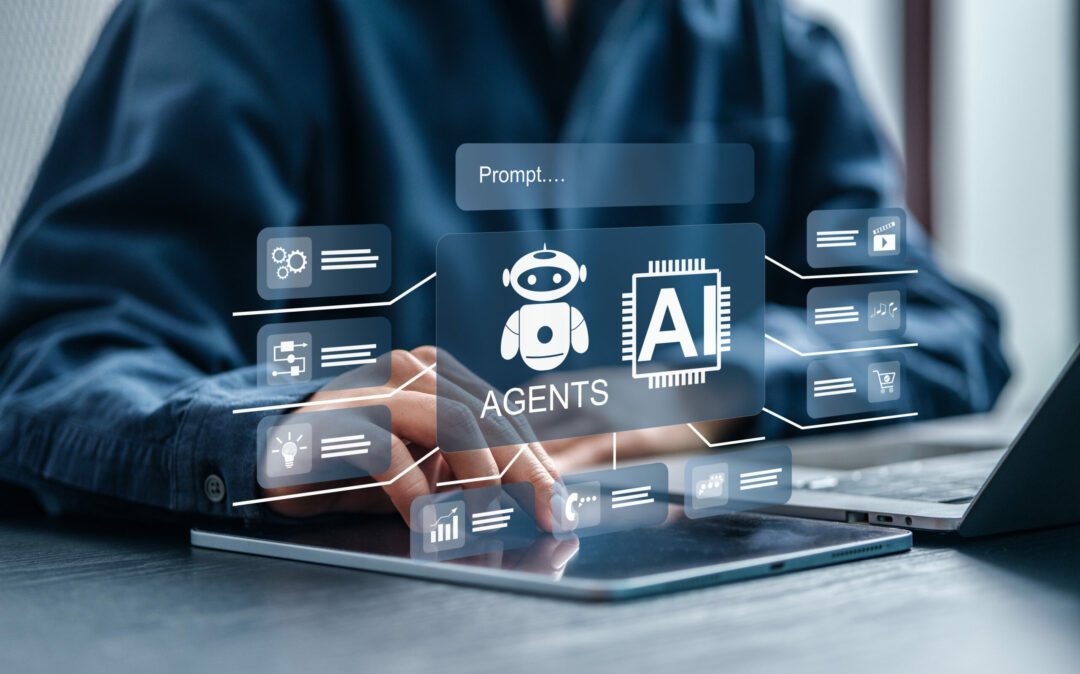
Automated support, flexible campaign planning, faster content creation: AI is already noticeably and measurably increasing the speed and productivity of marketing, service and sales teams.
Generative AI and AI agents make it easy to dynamically adapt prices, offers and promotions to customer behavior, demand and variable market trends. At the same time, chatbots and voice assistants are taking over live support: as personal advisors, they assist with product searches, answer questions and provide context-based solutions.
Strategic recommendation: Retail consulting for value-creating AI solutions
Which AI use cases bring measurable impact and business value to your company? We’ll show you:
Data is becoming the most valuable asset in retail, but only if it is reliable, precise and networked – and thus creates an AI-enabled database.
AI converts unstructured data such as images, videos, text and voice into understandable insights, enabling precise forecasts and decisions that are consistently aligned with KPIs and company goals. A central, AI-capable database raises value creation potential along the entire data stream and makes AI use cases scalable.

Strategic recommendation: Data management & performance optimization with valantic
AI-enabled solutions for efficient data management? We’ll show you how:
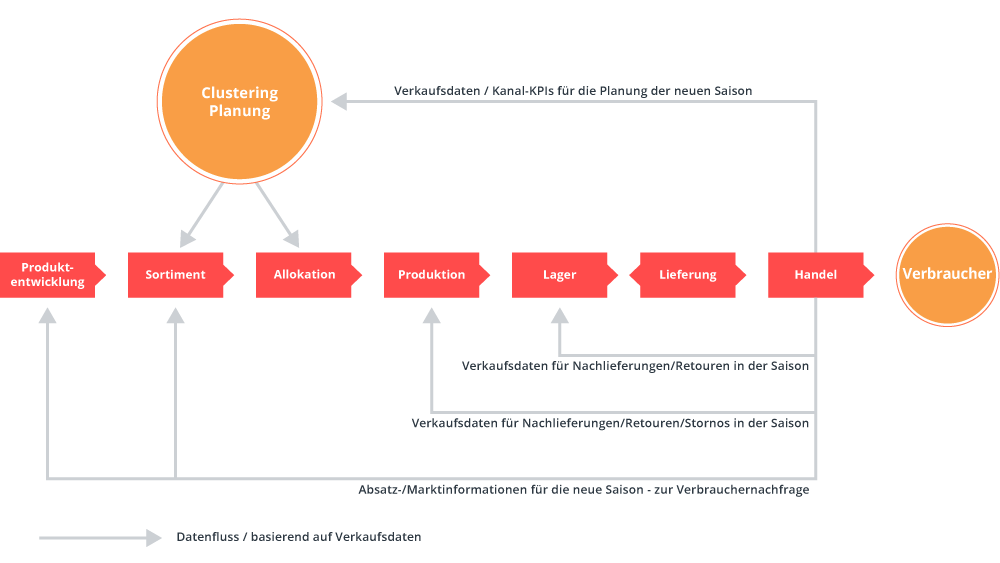
An AI-enabled database raises value creation potential along the entire data stream: from production to delivery to the consumer. (Source: valantic)
The ideal path to retail excellence is the digitalization of the entire retail value chain. To build measurable business value, we drive digital transformation holistically and unlock potential along the entire value chain – with a clear go-to-market approach, in-depth industry understanding and the tech expertise of our end-to-end services:
Strategy for Transformation & Optimization
Strategy and system for a KPI-based roadmap for unified commerce, hyperpersonalization and AI in retail
Data & Business Analytics
Using PIM, MDM and DAM to create an AI-enabled database for smart retail analyses, forecasts and data-driven decision making
AI & Automation
AI solutions for automation and increased efficiency in sales, marketing, production and the supply chain
ERP & Supply Chain Management
Digitally integrated supply chain for resilience, compliance and efficient process control - from inventory planning to delivery
E-Commerce & Product Experience
Data-driven campaigns, hyper-personalization and automation in marketing, sales and service for strong customer relationships, efficiency and loyalty
CRM & Customer Engagement
Data-driven campaigns, hyper-personalization, and automation in marketing, sales, and service for strong customer relationships, loyalty, and efficiency
Together with our partners, we develop, integrate and optimize digital commerce solutions that make the difference in the highly competitive retail sector.










We are proud of this


BAUHAUS: Optimizing customer experience and logistics
Learn more

Vileda Relies on a Central Digital Platform for B2B and B2C with the SAP Commerce Cloud
Learn more

HOHNER and SONOR optimize Supply Chain Management with wayRTS
Learn more




We combine strategy, technology and customer benefits – for measurable results:

Alexander Fetzer
Director Retail & Consumer Business
valantic

Gude from Frankfurt
Julia Saswito
Senior Vice President Customer Experience
valantic

Daniel Belka
Partner & Managing Director
valantic

Dieter Kosancic
Director Sales Business Development
valantic

Lars Schultz Hansen
Director Business Analytics
valantic

Antje Böttger
Principal
valantic
Omnichannel and unified commerce differ in the technical implementation of a common strategic goal: both concepts are designed to offer customers a seamless shopping experience across all touchpoints. The difference:
Unified commerce takes omnichannel models a step further in practical terms and removes obstacles to implementation: since all retail and sales channels are integrated into a common solution, data, systems, and processes are consolidated. The result is a shared database that allows inventory, price, product, and customer data, as well as interactions and transactions, to be managed centrally and controlled in real time.
In unified commerce in particular, ERP systems such as SAP S/4HANA form the backbone of an efficient system landscape, as this is where a lot of business-critical data comes together, e.g., on prices, orders, inventories, customers, transactions, and finances. A central ERP system such as SAP S/4HANA ensures that this data is available in real time to enable transparent processes across all channels. The result: consistent customer experiences, precise inventory management, and efficiency across all sales channels.
The key difference between personalization and hyper-personalization in retail lies in the degree of individualization of offers and communication measures, as well as the use of real-time data.
Retailers who continue to work solely with customer segments risk scattering losses, declining conversion rates, and weaker customer loyalty.
The reason: traditional customer segmentation is based on static target groups and historical data. This makes it almost impossible to meet rising customer expectations for speed, quality, and real-time personalization.
Consumers are increasingly moving between multiple channels (e.g., online stores, apps, social media, and brick-and-mortar stores). They expect relevant offers and tailored content at all touchpoints, not standardized campaigns for a specific age or interest group.
To be successful in retail in 2026, companies must address customers individually, contextually, and accurately in every interaction and at all stages of the customer life cycle. AI, real-time analytics, and unified commerce platforms enable a much more precise approach at the individual level.
With Agentic Commerce, end consumers use AI agents as personal shopping assistants. These agents search for, compare, and evaluate products, prices, and suppliers, suggest suitable offers, and could even take care of reorders and purchases in the future (with the appropriate permissions). The recommendations and decisions made by AI agents are based on real-time data on individual preferences, behaviors, and habits from past purchases, budget specifications, and the current context.
That means for customers:
The main difference between Generative AI and Agentic AI in retail lies in their degree of autonomy and functional applications: While Generative AI (GenAI) primarily creates content and delivers prompt-driven results, Agentic AI acts more autonomously and makes decisions within a defined framework of action.
The difference in more concrete terms:
Agentic AI in particular has an enormous impact on retail supply chain management, as it increases efficiency, resilience, and responsiveness throughout the entire supply chain. AI agents analyze historical sales and real-time data, taking into account seasonal effects and external factors such as weather, market trends, and industry developments. With these AI-powered insights, retailers can manage supply chains in a much more agile, precise, and intelligent way.
AI in retail supply chain management enables, for example:
Agentic AI optimizes the retail supply chain by analyzing real-time data, making context-based decisions, and automating processes. Specialized AI agents act independently and in a goal-oriented manner within an orchestrated framework: they monitor inventory, automatically adjust scheduling parameters, trigger reorders, and prioritize deliveries in the event of bottlenecks. Overall, Agentic AI makes the retail supply chain more resilient, efficient, and agile.
Relevant use cases of Agentic AI for optimizing supply chains:
The Supply Chain Act makes sustainability, transparency, and risk management core strategic tasks in retail supply chain management. It obliges retail companies to systematically integrate human rights and environmental standards into their supply chain management.
In Germany, the Supply Chain Due Diligence Act (LkSG) regulates binding requirements such as risk analyses, preventive measures, and transparent reporting. At the EU level, the Corporate Sustainability Due Diligence Directive (CSDDD) expands these requirements.
For supply chain management in retail, this means: