Highlight

Successful together – our valantic Team.
Meet the people who bring passion and accountability to driving success at valantic.
Get to know usJune 10, 2026

The conversations I have been having with retail decision-makers for months are similar: they are about agentic commerce, AI agents and product data strategies. The topics are understood. So is the urgency. And yet too little is happening.
This is not due to a lack of interest. It is due to a structural weakness that I observe time and again in many companies: the inability to make a clear strategic decision when the answer is not yet clearly on the table.
What is currently paralyzing many companies is not a lack of knowledge. It is a lack of clarity about responsibilities.
Instead of taking a strategic position, many small use cases are being tried out. A pilot here, a vendor discussion there, a workshop in the next quarter. Each of these steps makes sense on its own. Taken together, however, the result is not a strategy, but activity. And activity without direction is a waste of budget and time.
McKinsey estimates that AI agents will influence 3 to 5 trillion dollars in retail sales worldwide by 2030. The shift is not a distant forecast – it is already underway. It’s worth stepping back from the German perspective for a moment. Four markets (and one special case) illustrate how agentic commerce is gaining momentum and speed globally:
The open AI purchasing protocols ACP(Agentic Commerce Protocol) and UCP (Universal Commerce Protocol) have been live since September 2025 and January 2026 respectively. Walmart has completed both the ChatGPT and Gemini integration. 20 percent of its referral traffic now comes from ChatGPT. Kroger lets AI curate complete weekly groceries including recipe suggestions. The retail chains Target, Sephora, Nordstrom and Best Buy are also integrated.
John Lewis announced in March 2026 that it would become one of the first UK retail chains to fully adopt AI-powered shopping – backed by a significant investment as part of an £800 million transformation program. Tesco and Sainsbury’s report over 200 productive AI use cases, several of which are towards agentic commerce. 88% of UK retail decision makers are actively exploring AI agents, with a third already in the implementation phase.
This paints a picture of a market that is structurally more advanced than the German market – not only in terms of adoption, but also in terms of infrastructure. Klarna is a co-developer of the payment protocols for agent-supported purchases. Stockmann processes over 2,000 checkout API calls per minute at peak times.Elkjøp (Elgiganten) reports that during Black Friday 2025, seven out of ten product recommendations in major categories were made by their own companies – the result of a consistent marketplace and data strategy.
The lesson from the Nordics is clear: those who invest early in API maturity and data hygiene will have a structural advantage in the age of agentic commerce that is difficult to make up for with money alone.
The movement is strongest here. 29% of Asia-Pacific consumer goods companies use Agentic AI today – with an expected increase to 76% within the next few years. Almost three quarters of consumers in the region are already using AI to discover, compare and learn about products. South Korea and China are considered the most mature e-commerce markets globally. Japan is a pioneer in AI-supported store formats: Lawson Go has been around since 2022, with integration with computer vision and machine learning reaching the next level in 2025.
Benelux is interesting because the starting position is similar to Germany. However, the strategic response is different: Bol.com (Ahold Delhaize) has a highly developed recommendation system that is estimated to generate around 35 percent of sales. There is no official integration with ACP or UCP yet, but the US arm of Ahold Del haize has been building the data infrastructure with the AD Retail Media platform Edge since January 2026, which is a prerequisite for the next stage. Belgium is structurally a cross-border e-commerce market. A third of purchases here are made in foreign stores.
The implication: those who are not agent-ready in German-speaking countries will not only lose out to domestic competitors, but also to neighboring markets with better infrastructure.
What the markets described have in common: They have stopped asking whether they should trade. They only ask how.
In conversations with decision-makers from German-speaking retail, on the other hand, I see four patterns again and again:
We at valantic assume that the share of agent-driven purchases in the German grocery and CPG market will develop in waves over the next ten years. The following estimate is based on historical adoption curves (e-commerce, mobile payment, voice commerce) and the current speed of protocol development.The figures should be seen as a guide, not as a validated forecast. The decisive factor is the direction:
Even in the most conservative scenario, a significant proportion of standard purchasing behavior will shift to agent-driven channels over the next few years. Those who make the infrastructure decisions now can help shape this shift. Those who wait will see it from the outside at some point.
| Period | Share | Drivers |
|---|---|---|
| Today (2026) | less than 2 % | Pioneers and early adopters; primarily outside the German market |
| 2027–2028 | 5–10 % | Smartphone-native agents (Apple Intelligence), Google Gemini Shopping, urban target groups |
| 2029–2030 | 15–25 % | Standardized payment integration, social habituation, quality leaps in agent capabilities |
| 2030–2035 | 30–45 % | Structural shift in standard purchases; physical stores retain relevance for experience and impulse buying |
The most important point is not technical. In most German companies, nobody knows exactly who is responsible for agentic commerce. The topic lies somewhere between marketing, e-commerce, IT and product management – and therefore nowhere.
As long as Agentic Commerce hovers between the departments, no decisions are made. Only workshops are created.
What is needed is a clear assignment to a person high enough up to mobilize resources. With decision-making scope, budget and explicit permission to explore. Without this structure, no strategy is created.
The companies that are setting the pace today do not have the best understanding of tech. They have the clearest organization.
The timing is not arbitrary. It results from three coinciding developments:
From my observations and conversations, I can conclude three steps that retail decision-makers should tackle and implement now:
The next 18 months will not decide everything. But they will decide which starting position companies take into the next phase. If you move now, you build up options. Those who stand still lose them. It’s as simple – and as uncomfortable – as that.

Julia Saswito
Senior Vice President Customer Experience
valantic

Customer Experience October 8, 2026
Interview: From PIM to Data Spine – How companies prepare their data for AI
AI is changing the requirements for data, governance, and processes. Where should companies start, and what skills do they need? In this interview, Dietmar Rietsch, CEO of Pimcore, and Timo Huguet of valantic discuss the importance of clean data, the concept of the “Data Spine,” and the changing role of humans in the age of agentic AI.
Interview: From PIM to Data Spine – How companies prepare their data for AI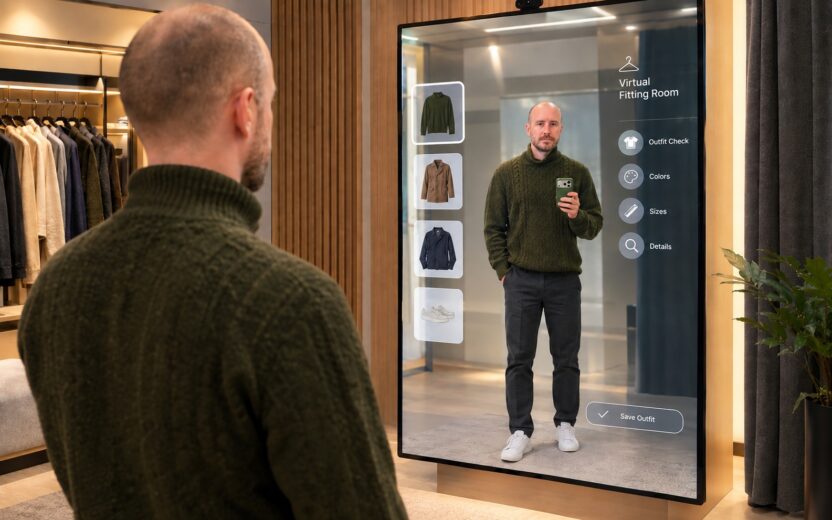

Customer Experience September 18, 2026
From webshop to virtual try-on: how AI is making its way into retail stores
Digital interfaces such as smart mirrors turn AI in the store into a tangible business case. What potential does this hold for the customer experience and in-store personalization? Matthias Vollmer explains how the retail industry can combine the best of both worlds and turn physical touchpoints into an intelligent part of the omnichannel journey.
From webshop to virtual try-on: how AI is making its way into retail stores
Digital Marketing September 3, 2026
ChatGPT Ads: a new touchpoint in the customer journey
ChatGPT Ads bring advertising to a new stage of the customer journey. We explain how the new ad format works, where its strengths lie, and what role it could play alongside Google Ads, paid social, and organic AI visibility.
ChatGPT Ads: a new touchpoint in the customer journeyDon't miss a thing.
Subscribe to our latest blog articles.