Highlight

Successful together – our valantic Team.
Meet the people who bring passion and accountability to driving success at valantic.
Get to know usJuly 22, 2026

Agentic AI only creates long-term value when AI applications are seamlessly integrated into processes and equipped with clear control mechanisms. We spoke with Maria Kern, Digital Experience Architect at valantic, about how an AI Workshop can support a structured entry into Agentic AI — and how organizations can achieve early wins by developing a near-production-ready AI agent.
Sarah Groß
Maria, many companies recognize the potential of Agentic AI but struggle to get started. What's holding them back, in your view?


Maria Kern
Most companies don’t lack ideas; they lack clear direction. They ask themselves: Where do we start? Which use case is truly worthwhile? And how do we avoid getting stuck in a pilot phase? At first glance, Agentic AI seems complex because it affects processes, data, systems, and organization all at once. This makes a structured approach all the more important—and it doesn’t start with the technology, but with specific business goals.
Sarah Groß
This is where the valantic AI Discovery Workshop comes in. What is the basic idea?
Maria Kern
The AI Workshop is deliberately designed so that companies can not only understand agentic AI but also experience it firsthand. In a compact format, business units and IT work together on real-world challenges—for example, in marketing, customer service, sales, e-commerce, or data management. The goal is not to develop a theoretical roadmap, but to achieve a tangible result: a first functional AI agent tailored to a real-world use case, including measurable KPIs, concrete implementation steps, and a concept for orchestration and seamless integration into existing systems. Participants experience the entire process, from the initial idea through the agent design to an initial production-ready workflow.
Sarah Groß
What exactly does the AI workshop involve?
Maria Kern
We always start by asking: Which business goals currently have the highest priority? These might include improving efficiency, shortening time-to-market, personalization, or improving conversion rates. Building on that, we work together to assess data and system readiness: What data is available? What systems are in use? Where are there gaps? We also take governance requirements into account early on to ensure that data flows, responsibilities, and control mechanisms are clearly defined from the start. Only then do we look at the potential and possible use cases for agents: Which tasks are repetitive or time-sensitive? Where can an agent prepare or automate decisions? Which types of agents make sense – such as analytics, content, personalization, or orchestration agents? In the subsequent build phase, the teams – supported by valantic – develop an initial production-ready agent tailored to the prioritized use case. We ensure that the agent is not only technically functional but is also embedded into existing processes – including control mechanisms and guidelines that ensure trust and transparency.
Sarah Groß
What sets this approach apart from traditional AI workshops?
Maria Kern
From my perspective, it’s above all about commitment. Many approaches end with ideas, sketches, or presentations. We, on the other hand, build a tangible solution – one that takes real-world processes and goals into account – often orchestrated across multiple systems and teams. An important part of the workshop is integrating the developed agent into everyday work. We define which process it supports, how its impact will be measured, and who is responsible for it. This leads to the next implementation step: a clearly defined development sprint that enables the agent to transition from prototype to production.
Sarah Groß
For which companies is this entry-level position particularly suitable?
Maria Kern
The workshop is particularly well-suited for companies that are moving beyond the phase of isolated AI experiments and want to systematically integrate Agentic AI into their organization. Companies with interdisciplinary teams or more complex structures benefit the most: departments such as marketing, sales, IT, and operations can work together toward a clear goal. A major advantage of this format is that we tailor it individually to the specific requirements and circumstances of each team. The format is flexible enough to address the respective structures, challenges, and goals.
Sarah Groß
What exactly do companies take away from the AI workshop?
Maria Kern
Companies walk away from the workshop with three key takeaways: First, clarity on which Agentic AI use cases are truly relevant to them and create the greatest value. Second, a working prototype that is aligned with real-world goals and was co-developed by their own teams. And third, a concrete implementation roadmap that shows how the prototype will make an impact in production. This transforms Agentic AI from an abstract vision of the future into a manageable component of the company’s own organization. Companies with clear governance and implementation plans are significantly more successful at scaling AI solutions and generating business value. This is precisely what the valantic AI Discovery Workshop aims to achieve. This results not only in the creation of an initial agent but also in a shared understanding of how Agentic AI can be sustainably established and scaled within the company.
Sarah Groß
Thank you very much, Maria, for these concrete insights!

AI Discovery Workshop: Your Path to Agentic AI with Business Impact
The valantic AI Discovery Workshop offers a results-oriented introduction to agentic AI. Business units and IT work together on a real-world use case and develop an initial, functional AI agent – aligned with clear KPIs, designed for your system landscape, and focused on a productive implementation.
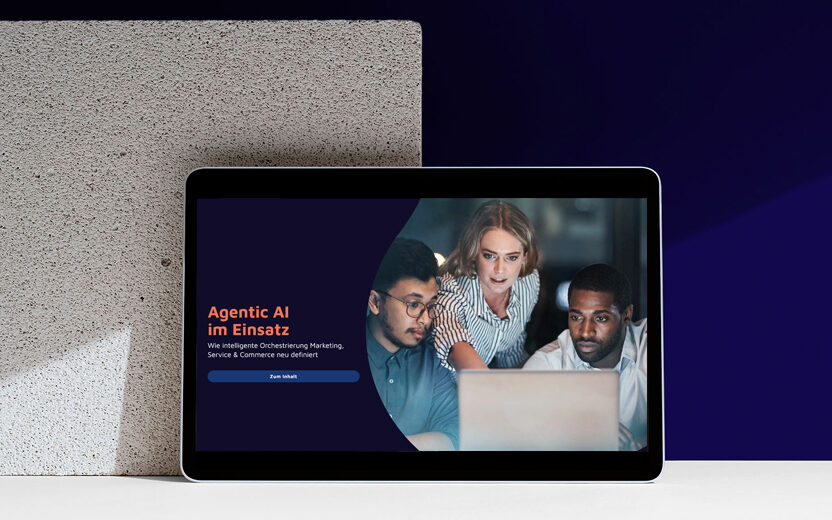
Agentic AI Guide 2026: Get Started with the AI Workshop Using Practical Knowledge
Proven use cases, real-world practical examples, and further expert tips in our Agentic AI Guide show how intelligent orchestration in marketing, sales, and commerce creates measurable value and scales success.
Maria Kern is happy to serve as your point of contact. As a Digital Experience Architect with more than 18 years of experience in UX, customer journey, and frontend development, she advises companies on implementing modern digital experience platforms and develops practical AI solutions — ranging from agents with system integrations to AI features in frontends. At valantic, she supports organizations in identifying and implementing concrete AI use cases. Get in touch to discuss your next steps:

Maria Kern
Digital Experience Architect
valantic

Customer Experience June 17, 2026
Interview: From GenAI to Agentic AI – What Will Make the Difference in 2026
How do companies make the transition from GenAI pilot projects to the value-adding use of agentic AI? In this interview, Sarina Hermann, Principal Consultant CX, addresses common misconceptions and explains how to successfully move toward the effective use of AI.
Interview: From GenAI to Agentic AI – What Will Make the Difference in 2026
Customer Experience June 10, 2026
Agentic Commerce: Why the next 18 months will decide the next ten years
Agentic AI is changing the rules of the game in digital commerce. Where do retailers from the DACH region stand, what do global markets have ahead of them and how can companies become fit for agentic commerce? A personal assessment from retail practice with specific recommendations for action.
Agentic Commerce: Why the next 18 months will decide the next ten years
Customer Experience March 26, 2026
Data-driven optimization: A/B Testing with Optimizely & Agentic AI
The basics of A/B testing are no longer sufficient in the fast-moving digital landscape. In order to exploit all possibilities and adapt optimization strategies in a targeted manner, intelligent functions are needed that provide precise insights for data-based decisions. This is where Optimizely One comes into play.
Data-driven optimization: A/B Testing with Optimizely & Agentic AIDon't miss a thing.
Subscribe to our latest blog articles.