Highlight

Successful together – our valantic Team.
Meet the people who bring passion and accountability to driving success at valantic.
Get to know usJuly 24, 2026

It’s 10:47 p.m.
A buyer sits in front of her supplier’s procurement platform. She has almost found the right replacement component, and the cart is already full. Just one question is still holding her back: Does the new variant really fit my existing system?
The answer already exists. The technical advisor knows it from experience. He has handled similar cases countless times and could answer in a matter of seconds. But at this hour, he is no longer reachable.
The buyer abandons the purchase and writes an email the next morning.
What could have become a digital sale ends up back in a manual process — or, in the worst case, with a competitor.
Situations like this happen every day — in B2B just as much as in B2C. Not because information is missing, but because the very knowledge needed to make a decision stays where it originated: in the minds of employees.
The real challenge in digital commerce today is therefore not a lack of data. It is the lack of access to experiential knowledge.
In recent years, companies have invested heavily in their digital infrastructure. Product data is managed centrally, ERP and CRM systems are integrated, documentation is maintained, and processes are standardized. And yet, at the decisive moment, a gap appears.
The digital channel knows article numbers, prices, and technical specifications. What it lacks is experience.
These are precisely the questions that often determine whether a purchase is completed or not.
The difference between a catalog and an advisor does not lie in the amount of information. It lies in being able to apply knowledge at the right moment.
Customer expectations have long since changed.
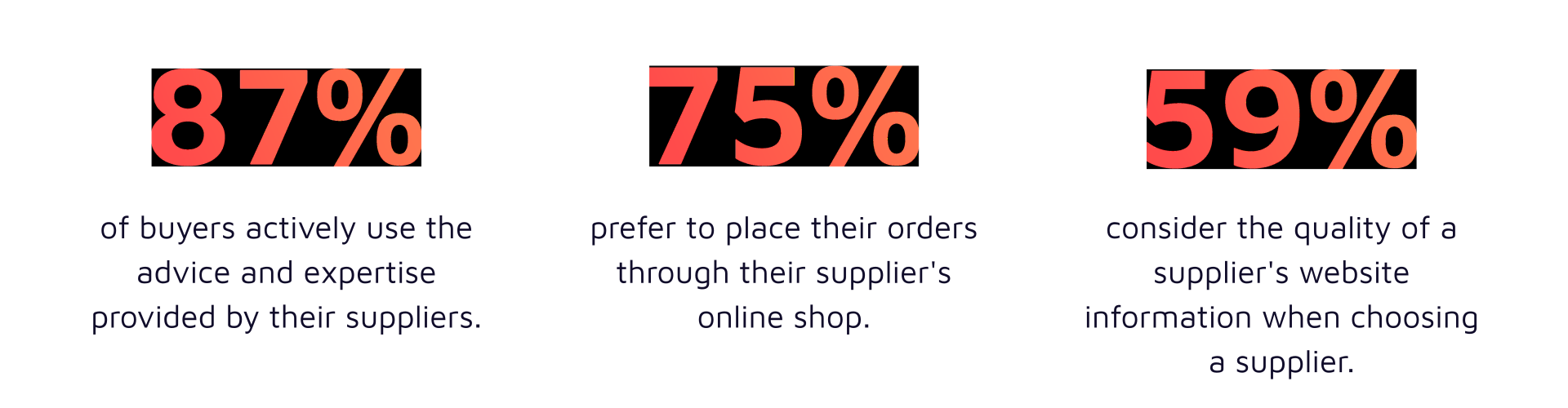
The current B2B Monitor by Carpathia paints an interesting picture: 87 percent of buyers actively use their supplier’s advisory services. At the same time, 75 percent prefer to order through that supplier’s online shop. For 59 percent, the quality of information on a website is even a decisive criterion in choosing a supplier.
At first glance, this seems contradictory. In reality, it describes exactly what modern customers expect.
Today, customers do not want to choose between personal advice and digital purchasing. They expect both at the same time. They want to order independently — and still receive competent answers precisely when uncertainty arises.
The decisive question is therefore no longer whether a company can advise. It is whether that advice is also available in the digital channel.
Many companies talk about knowledge management today. Often the focus is on documentation, wikis, or databases. But knowledge consists of far more than neatly filed documents.
A company’s largest knowledge repository is its employees.
It is the experiential knowledge of the service technician who has maintained the same systems for fifteen years. The knowledge of the sales advisor who knows which product combination proves itself in practice. The product specialist’s instinct for special cases that are described in no documentation.
This knowledge is often a company’s real competitive advantage.
At the same time, it is the knowledge companies find hardest to access. It is spread across emails, service reports, and meeting notes — or it simply stays in the heads of the people who work with customers every day. This is exactly why it is no longer enough today to merely document knowledge. It must become available where decisions are made.
This is where artificial intelligence opens up a new possibility. Not because it creates knowledge, but because it can connect existing knowledge.
The real strength of modern AI does not lie in answering questions from the internet. It lies in intelligently bringing together different sources of knowledge: product data, technical documentation, service cases, publicly available information, and above all the experiential knowledge of employees.
Only this combination creates a digital advisor that recognizes connections and delivers answers grounded in the company’s actual knowledge.
This fundamentally changes the role of the digital channel. It evolves from a digital catalog into a digital advisor.
Many companies start their AI initiatives by selecting a model or a chatbot. But a successful project begins much earlier. The decisive question is:
What knowledge actually makes our company unique?
Anyone who simply places a chatbot on top of a document repository often gets answers that sound plausible but are not reliable. In commerce in particular, this can become expensive.
A false statement about the compatibility of an industrial component, a flawed recommendation, or incomplete safety information causes far higher costs than an honest answer that is forwarded to a person.
That is why it is not the language model that determines a project’s success. What matters is the quality of the knowledge base.
A good digital advisor does not answer every question. It answers the right ones. And it knows when it has to hand over to a human. Not every good answer comes from an AI. Sometimes its most important task is to bring in the right person. This is precisely why every successful knowledge project begins with four simple steps:
Bring knowledge from advisory, service, and documentation into one place.
Link this information with product and context data.
Base every answer on a traceable source rather than on assumptions.
Deliver the knowledge where customers make their decisions.
Just as important, however, is defining the boundaries. Not every request belongs in an automated process. Price negotiations, complex special cases, or individual project consulting deliberately remain with people.
It is precisely this clear division of tasks that builds trust — both with customers and within the company.
Companies have invested in better product data for years. But the next competitive advantage arises somewhere else. Not where information is stored, but where knowledge becomes available.
Those who bring their employees’ experiential knowledge into the digital channel shorten search times, relieve the sales team, accelerate the onboarding of new employees, and at the same time improve the purchasing experience.
Above all, something emerges that was previously hard to scale: the expertise of your best employees — available at any time, independent of opening hours or individual people.
At a Swiss provider with a product range requiring explanation, recurring technical inquiries could be answered directly in the channel once the experiential knowledge was structured and linked to the product data. Advisory support thus gained time for the cases that really need it. (V-Zug AI Assistant)
A few years ago, digital commerce meant making products available online.
Today, customers expect answers. And tomorrow, they will expect advice. Not at some point, but precisely in the moment a purchase decision arises.
The decisive question is therefore not whether companies have enough knowledge. Most already do. The real question is whether this knowledge is available exactly where customers make their decisions.
Over the past twenty years, companies have primarily digitized their data. The coming years will be decided by whether they also make their knowledge digitally available. Because competition in the future will no longer be won through the better catalog — but through the better digital advisor.
Once again, a buyer sits in front of her cart; once again, the question comes up. This time she gets the answer within seconds, because the company’s knowledge is available exactly where it is needed — regardless of who happens to be in the office.
Together, we’ll find out which knowledge in your channel offers the greatest leverage.
valantic supports companies in digital commerce and customer experience, in B2B as well as B2C, from selecting the right use cases to measurable business outcomes. Get in touch with us — no obligation.

Fabian Ritter
Director of Sales
valantic

Artificial Intelligence October 23, 2025
Agentic Commerce and Agentic AI are more than technology – they represent a paradigm shift
Agentic Commerce and Agentic AI are more than technology – they represent a paradigm shift. AI agents are increasingly taking over research, evaluation, and purchasing decisions, fundamentally transforming visibility, customer experience, and business models in e-commerce. In this conversation with Adobe, valantic reveals why Generative Engine Optimization (GEO) is now becoming the key success factor.
Agentic Commerce and Agentic AI are more than technology – they represent a paradigm shift
Customer Experience June 10, 2026
Agentic Commerce: Why the next 18 months will decide the next ten years
Agentic AI is changing the rules of the game in digital commerce. Where do retailers from the DACH region stand, what do global markets have ahead of them and how can companies become fit for agentic commerce? A personal assessment from retail practice with specific recommendations for action.
Agentic Commerce: Why the next 18 months will decide the next ten years
Digitalization November 27, 2025
Agentic Commerce Protocol: Redefining E-Commerce with OpenAI and Stripe
The Agentic Commerce Protocol (ACP), developed by OpenAI and Stripe, is redefining e-commerce by enabling AI agents to conduct secure, scalable transactions autonomously. Using Shared Payment Tokens and robust cryptographic verification, ACP ensures seamless interactions between AI agents, merchants, and consumers, paving the way for the future of autonomous commerce.
Agentic Commerce Protocol: Redefining E-Commerce with OpenAI and StripeDon't miss a thing.
Subscribe to our latest blog articles.