Highlight

Successful together – our valantic Team.
Meet the people who bring passion and accountability to driving success at valantic.
Get to know usTransformation works when people are brought along
Continuous organizational development is the cornerstone of lasting business success. As experienced transformation and organizational experts, we identify the critical levers of systematic development. We help companies evolve transformation from a one-time initiative into an ongoing driver of success.


Matthias Uhrig
Partner at valantic
”Technology innovation cycles have accelerated dramatically in recent years, driven by AI and much more. On top of that, IT is becoming increasingly democratized: artificial intelligence, social media, low-/no-code platforms, and other advances are moving users from passive consumers to active co-developers of technology. All of this raises the stakes for change management in digital transformation projects - both as a critical success factor and as a tool for risk mitigation.“

Mona Usling
Manager & Change Management Chapter Lead at valantic
”Successful change happens with people, not to them. Any organizational change or transformation, whether digital or agile, only succeeds when the conditions enable employees to embrace it. That means making the need for change transparent and communicating what each group and individual actually requires. This is only possible when everyone shapes those conditions from the start - from leadership down to each team member.“
Why change management is non-negotiable today
Markets, technologies, and employee expectations are shifting faster than ever - adaptability is no longer optional
Markets are evolving rapidly. Technologies are disrupting business models. Employee expectations are changing at a fundamental level. In this environment, the capacity for change is a core competency for any organization that wants to stay competitive. Yet organizations don’t transform on their own. It takes targeted interventions, clear strategies, and a deep understanding of how people, teams, and structures actually work.
In digital transformation, technological innovation is only the tip of the iceberg. Time and again, we encounter organizations where change has been announced but never truly understood or embraced.
70%
of digital transformations fall short of their goals.¹
67%
of experienced managers have experienced at least one transformation in the last five years that failed to deliver on its objectives.¹
16%
of digital transformations resulted in sustained performance improvements.¹
Experience shows: when transformations are actively supported by organizational change management, companies are far better equipped to respond to new demands. As a consulting partner, we help organizations build change capability systematically and seize emerging opportunities — from new technologies to shifting customer needs.
The value of change management in transformations is well-documented²:
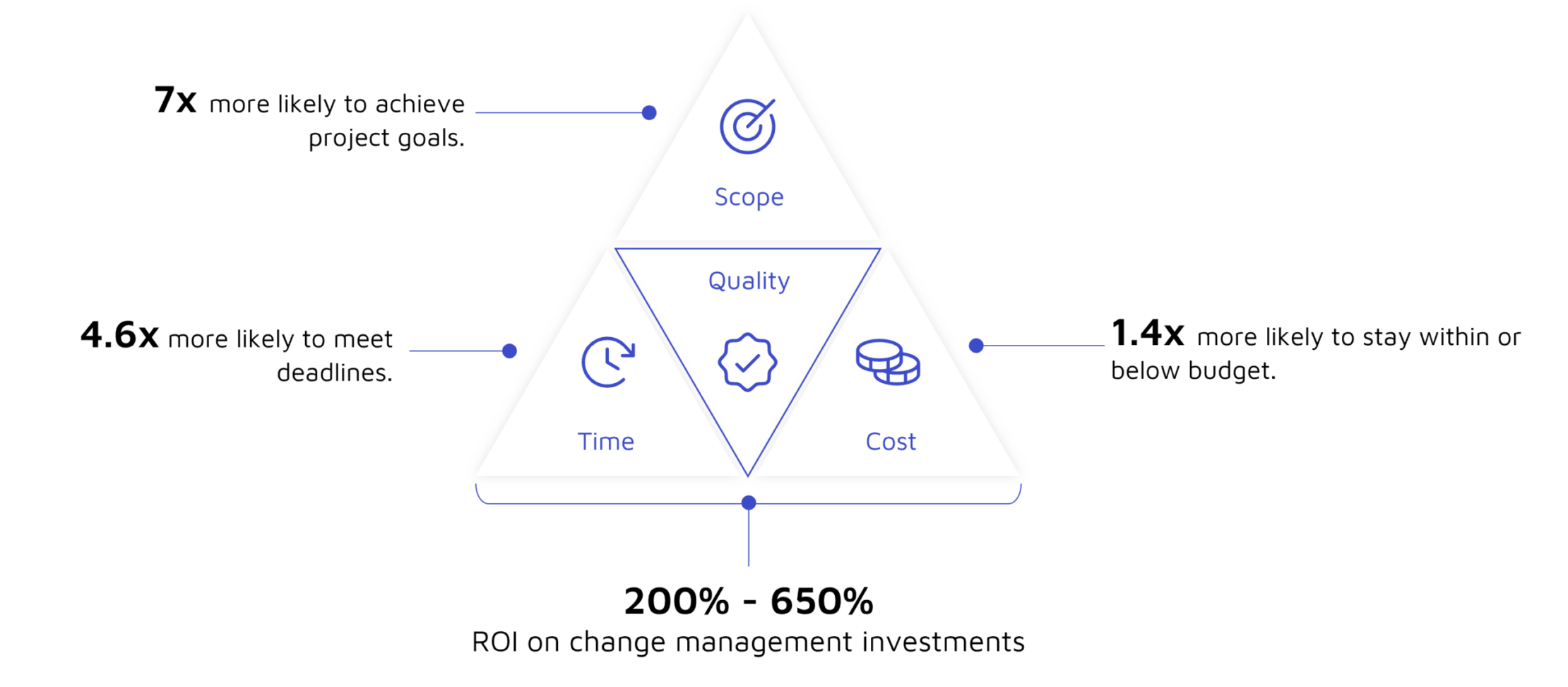
Our experience confirms: the success of a transformation depends equally on solving the technical challenge, winning over employees, and developing the organization’s culture.
We translate strategic goals into lasting organizational transformation across six change dimensions
Change management is the critical bridge between business strategy and organizational, process, and technological change. Only when strategic vision, the organization, and new technologies are effectively brought together can transformation create lasting impact. That is why we take a holistic approach to change management, guiding transformations systematically across key dimensions.
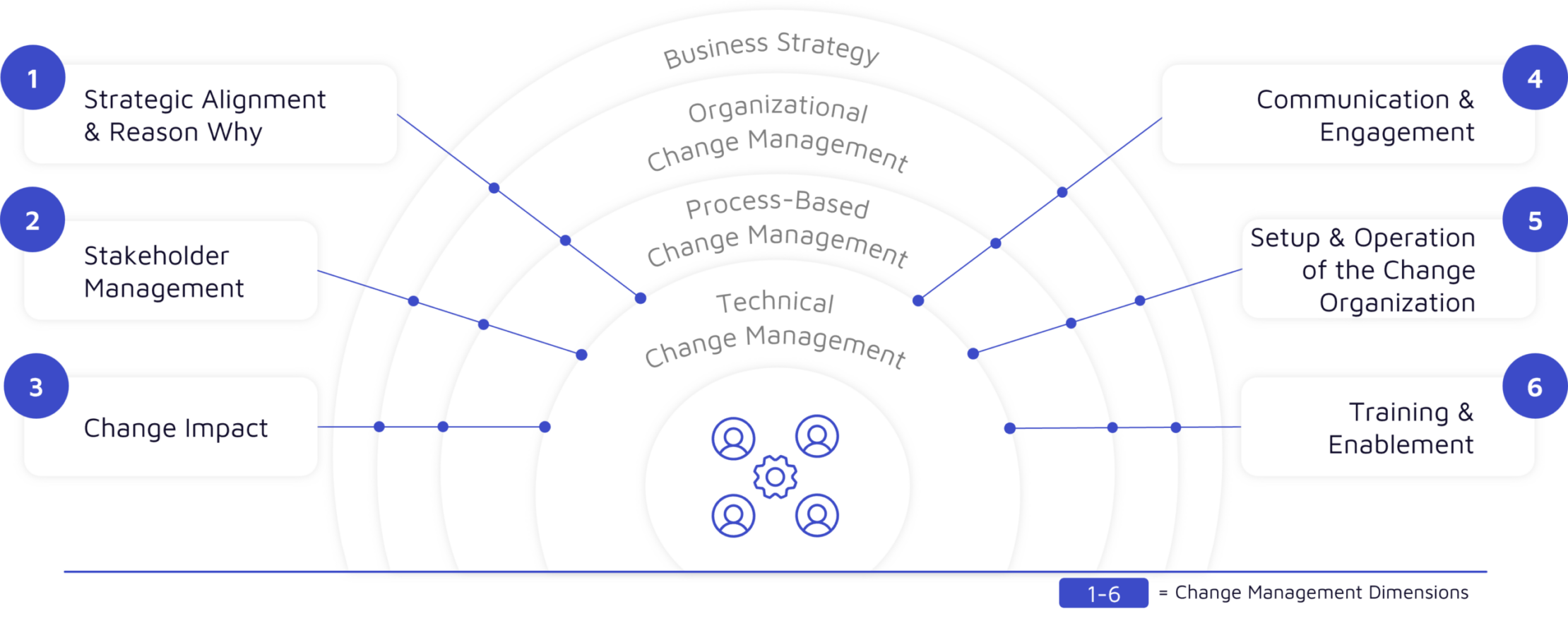
Strategic Alignment and Reason Why
A clear strategic direction and a compelling rationale lay the foundation for a successful change process and enable organizational alignment.
Change Organization
A strong change organization means having an executive sponsor for change, along with clear accountability structures that enable sustainable delivery.
Change Readiness
Assessing change readiness helps identify resistance early and tailor measures to the organization’s specific needs.
Stakeholder Management
Effective management at executive level ensures support, minimizes resistance and anchors changes sustainably.
Communication
Clear and targeted communication leads to informed, motivated employees who are actively involved in the change process.
Training and Enablement
Targeted training is essential to equip employees for the transition and drive sustainable delivery.
Across all change management dimensions, one principle holds:
Change succeeds when it is not only planned, but understood, co-created, and embedded. Organizations that focus solely on processes or tools miss what matters most: the people. Poor communication, unclear roles, and structures that obstruct change all ensure that transformation remains theoretical rather than lived.
That is why our framework combines structure with empathy, guiding organizations through four clearly defined phases.
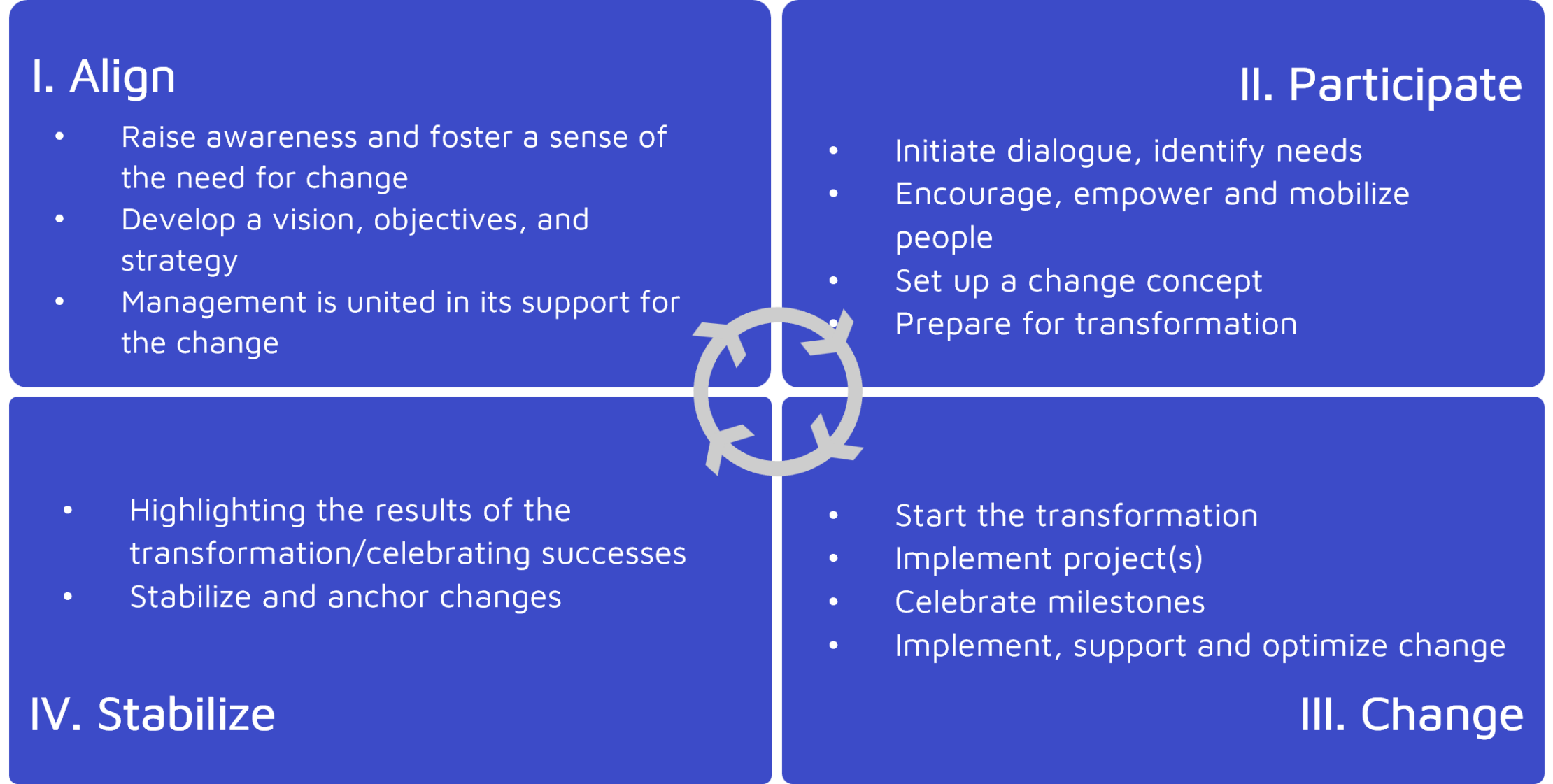
Our systemic approach at valantic targets long-term structural and cultural adaptability. It opens up new room to act, strengthens individual accountability, and fosters a shared understanding of development, driven from within, across all levels: from the organization as a whole, to teams, to the individual.
External perspective. Internal progress.
Why an outside partner can make all the difference
Even organizations with strong internal capabilities sometimes see change processes stall. External consulting brings fresh perspectives, methodological depth, and an objective viewpoint. We ask the right questions, facilitate change processes professionally, and help open up new ways of thinking. As a sparring partner, facilitator, and catalyst, we guide the change journey.

valantic accompanies you from the beginning of the transformation to successful implementation
What you gain with us and our approach to organizational change management:
Higher acceptance because firsthand experience counts
Our consultants have worked on the client side themselves and understand the day-to-day reality into which change must land. That insider perspective shapes every initiative: those affected are engaged early, and the purpose behind the change is developed together. This reduces resistance and increases readiness to actively champion new solutions.
Faster adoption through leadership experience and agile practice
Our coaches have led teams and departments themselves and know agile methods from hands-on application, not from textbooks. Through targeted capability-building and supported transition phases, they shorten the time to productive use. Employees work confidently in the new setup faster, rather than working around it.
Less friction by bridging levels and generations
Transformation rarely fails because of the technology. It fails because of misaligned expectations between the executive team, middle management, and business units – and between generations with different working styles. valantic addresses unclear roles, competing priorities, and informal counter-movements early. This protects project budgets and timelines from the most common non-technical causes of delay.
Change as a strength, through knowledge that stays in the organization
valantic does not just accompany transformations. We build institutional change knowledge alongside you. Before we begin, we take the time to understand your context: decision-making paths, cultural DNA, change history, and leadership style. The result is an approach that fits your organization and gets faster and more cost-effective with each subsequent engagement.
Given the sensitivity of this topic, we have chosen not to publish client references on this page. In a direct conversation, we are happy to share concrete insights into comparable projects.
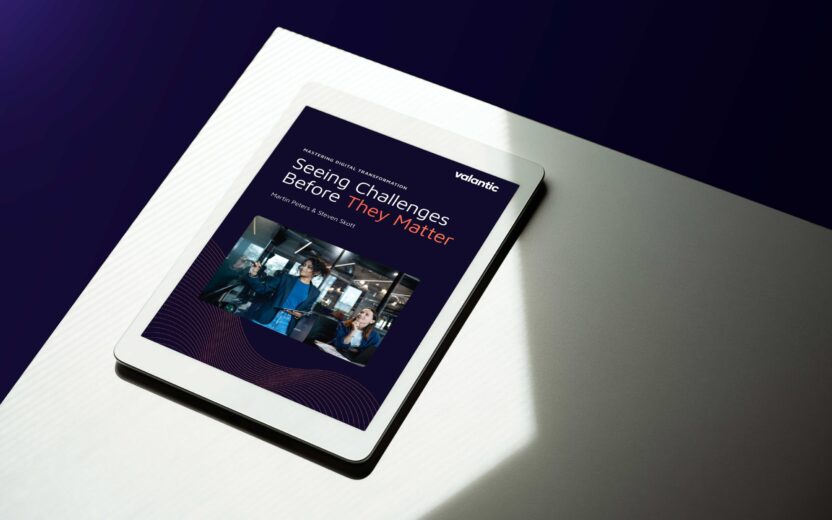
Field Guide: Mastering Digital Transformation - Seeing Challenges Before They Matter
Our guide to preventing risks from becoming major problems, covering the common challenges organizations face during digital transformation, from human factors like resistance to change and communication, to technical and…
Whether you are planning a comprehensive transformation or looking to adjust specific levers: we bring experience and a systemic perspective. Always tailored. Always at eye level.
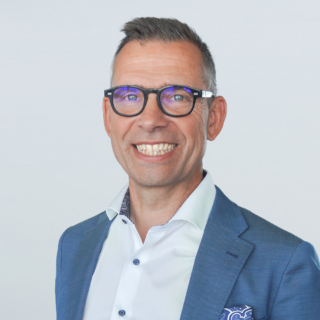
Dr. Markus Irmscher
Director Strategic Organizational Developement & Change Management
valantic
¹ McKinsey & Company, Unlocking Success in Digital Transformations (McKinsey & Company, 2018), https://www.mckinsey.com/capabilities/people-and-organizational-performance/our-insights/unlocking-success-in-digital-transformations
² Prosci, Best Practice in Change Management (Prosci Inc.), https://www.prosci.com/resources/articles/change-management-best-practices
² Change First, The ROI for Change Management (Change First, 2022), https://info.changefirst.com/the-roi-for-change-management-the-impact-on-project-performance-and-results