Highlight

Successful together – our valantic Team.
Meet the people who bring passion and accountability to driving success at valantic.
Get to know usAI tools in engineering rarely change the operating model. AI in the Software Engineering Lifecycle helps CTOs redesign roles, cadence and governance for faster delivery with quality, IP and EU AI Act guardrails intact.


Most engineering organizations already use AI. Copilots are switched on, pilots are running, and few CTOs would argue with the potential. The harder question is where AI actually creates value across the lifecycle, and whether the operating model has changed to capture it. That answer tends to get deferred.
That gap between adding AI tools and changing how engineering works is expensive. It’s also where most AI-in-engineering efforts quietly lose momentum.
AI in the Software Engineering Lifecycle is valantic’s engineering transformation program for CTOs and Heads of Engineering in software-intensive sectors. We work with you to find where AI creates real value across the lifecycle, redesign the operating model around it, run a governed pilot, and put the quality, IP and EU AI Act guardrails in place to scale safely.
Where most AI-in-engineering efforts stall
The same four patterns come up in almost every engineering organization we work with. A credible approach has to address all of them:
The program runs across three modules. Each one produces specific deliverables on its own. Together, they take you from scattered tooling to an operating model redesigned for AI-native delivery.
Maturity & Value Assessment
We assess four areas across the engineering lifecycle:
In the process, we surface the blockers that most commonly keep AI in engineering below its potential:
What comes out is a clear baseline your engineering leadership can agree on, and a focused view of where AI value and risk actually sit.

Operating Model & Blueprint
We turn assessment into an operating model your teams can actually run:
Quick wins
Lifecycle use cases that show measurable throughput gains within weeks, building credibility with engineering teams.
Scale patterns
Reusable practices, prompts and guardrails that become shared engineering standards rather than individual habits.
Foundational investments
Operating-model, quality and governance work that won’t show up immediately but is necessary for AI-native delivery to hold.
The result is a blueprint and business case with enough detail to make delivery decisions real and to hold teams accountable for outcomes.
Pilot-to-Scale & Governance
A blueprint without a governed pilot doesn’t change delivery. Most efforts leave a set of engineering and governance questions unanswered, and those gaps are exactly where momentum dies. We work through them directly:
The goal is an engineering organization that delivers faster with quality intact, not one that added AI tools and hoped the operating model would follow.

Five concrete results your engineering leadership walks away with:
A lifecycle value & maturity baseline
An honest view of AI maturity, risks, and where value actually sits across the software engineering lifecycle.
A prioritized use-case focus
A shortlist of lifecycle use cases worth targeting first, ranked by value, feasibility, and risk.
An AI-native operating model
Roles, cadence, and delivery practices redesigned so AI raises throughput without eroding quality.
A governed pilot & business case
A hands-on pilot that proves the model in practice, with a business case leadership can act on.
Quality, IP & EU AI Act guardrails
The quality gates and governance your organization needs to scale AI-assisted engineering safely and compliantly.
Together with a software-intensive company, we mapped where AI creates value across the lifecycle and redesigned roles and cadence for AI-native delivery.
Software-intensive company
With an engineering organization, we ran a governed pilot and set quality gates that raised throughput while keeping code quality intact.
Engineering organization
Together with a regulated product company, we put IP, security and EU AI Act guardrails around AI-assisted code, enabling safe scale.
Regulated product company
See all valantic case studies for more examples across industries.
The AI Engineering Kickstarter is the right starting point. A focused assessment, one leadership-ready read-out, and a clear picture of what your AI-native engineering journey should look like.
Lifecycle value & maturity scan
A structured assessment of AI maturity, risks, and where value sits across the software engineering lifecycle.
Operating-model workshop
A facilitated session with engineering leadership to prioritize lifecycle use cases and shape the target operating model.
Blueprint & business-case read-out
A clear articulation of the target model, quality and governance guardrails, and recommended next steps you can act on immediately.
Format: 2-day assessment + maturity read-out & blueprint
Investment: On request
Further AI insights

Study
The new study "Digital Excellence Outlook 2026: AI at Scale" shows how companies can strategically anchor AI and use it sustainably.
Learn more Learn more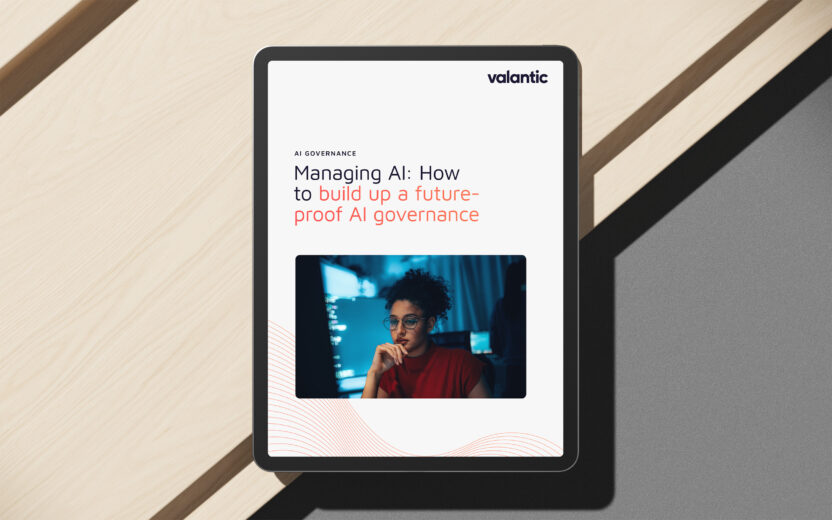
Download
AI governance is key to creating a strong foundation for future competitiveness, enabling responsible adoption and scalable innovation. This whitepaper presents a practical, future-proof approach to integrating AI governance into existing processes, roles and tools, following valantic's principle of "no new governance".
Download Managing AI: How to build up a futureproof AI governance
AI Offering
From AI-assisted experimentation to production-ready software.
Learn more Learn more
Blog · May 19, 2026
For many companies, customer service is an obvious starting point for experimenting with AI. The demo is convincing. Expectations are high. Nevertheless, only a few pilot applications make it into regular productive operation. Three typical patterns and concrete approaches to how AI works in service "
Learn more Why so many AI pilots in Customer Service fail – and how to make them work
Blog · June 25, 2026
In the manufacturing industry, AI is already one of the most important technologies. Yet there is a significant gap between ambition and productive use with measurable results. Where will AI be worthwhile in the manufacturing industry in 2026, and which use cases are already making its potential tangible today?
Learn more AI potential in manufacturing: Which use cases are already live – and what pays off?
Blog · June 18, 2026
valantic has joined the Claude Partner Network as a Select Partner in the Services Track, among the first consulting and solutions firms in Europe to do so. The partnership with Anthropic, the AI safety company behind Claude, positions valantic to bring Claude Enterprise to organizations across Europe.
Learn more valantic joins Anthropic’s Claude Partner Network, bringing Claude Enterprise to EuropeReady to move beyond vibe coding?
Plenty of engineering teams have AI tools. Fewer have an operating model built for them. AI in the Software Engineering Lifecycle is for engineering leaders who want to close that gap, with faster, better delivery and quality, IP and EU AI Act guardrails intact, not just more tools bolted on.