Highlight

Successful together – our valantic Team.
Meet the people who bring passion and accountability to driving success at valantic.
Get to know usSpreadsheets and traditional forecasting methods cannot keep up with volatile markets. valantic’s DemandSense AI combines machine learning, multi-modal product data, and stockout-aware modeling to turn demand planning into a competitive advantage.


Modern demand management cannot rely on spreadsheets, gut feeling, and disconnected planning tools. Volatile markets, fragile supply chains, and rapidly shifting consumer behavior require forecasting that is faster, more granular, and more accurate than traditional approaches can deliver.
Most organizations know this. The problem is not awareness but architecture. Demand forecasting is spread across legacy tools and siloed teams, external signals are ignored, and stockouts are underestimated because the data only captures what was sold, not what customers actually wanted.
DemandSense AI is valantic’s demand forecasting and planning offering for CxOs and supply chain leaders. We design and implement AI-based forecasting models that combine historical and contextual data into a single forecasting engine, and we deploy them within an integrated planning platform that replaces the patchwork of spreadsheets with one consistent source of truth.
Where most demand planning falls short
The same four patterns come up in almost every organization that has tried to improve demand planning:
We address demand planning from data to deployment. Each step builds on the previous one to produce a forecasting capability that learns and adapts with your business.
01 · AI-Based Forecasting Models
Machine learning methods combining transactional sales and inventory data with external signals to generate forecasts traditional methods cannot match.
AI-Based Forecasting Models
Machine learning methods combine transactional sales and inventory data with external signals to generate demand forecasts that traditional methods cannot match.

Feature Engineering and Model Optimization
We develop forecasting features, compare model approaches, and validate performance through rigorous backtesting before deployment.

Deployment and Forecast Monitoring
We deploy forecasting models within an integrated planning platform that connects demand signals directly to inventory, replenishment, and buying decisions.

Five concrete results your organization gains from DemandSense AI:
15 to 30% lower inventory levels
More precise demand and replenishment planning reduces safety stock and working capital without compromising service levels.
10 to 20% fewer forecast errors
Machine learning models capture patterns and external drivers that traditional forecasting methods systematically miss.
Lower operational costs
Reduced storage, fewer emergency procurements, and more efficient planning processes translate directly to margin improvement.
More data-driven planning
Transparent forecasting dashboards give stakeholders a shared, fact-based view of demand, inventory, and buying decisions.
A forecasting capability that learns
Continuous model monitoring and recalibration mean accuracy improves over time rather than degrading.
A global retail company operating across multiple brands and markets went from idea to live AI-powered demand planning in just 4 months, with full ROI achieved by month 8. Merchandisers can now predict trends, meet demand, and avoid stock issues 10 times faster, while the supply chain became measurably more sustainable and less wasteful.
A global retail company
Retail Industry
valantic transformed A1 Telekom Austria Group’s financial planning by cutting the effort for monthly forecasting from one full week to just 1.5 hours, enabling faster data-driven decisions and significantly improving operational efficiency and business agility.
A1 Telekom Austria
Telco Industry
The company's planning team went from making decisions on stale data to acting on live signals across sales, returns, inventory, and margins, enabling sharper replenishment, better campaign timing, and more confident collection planning across every phase of the season.
A fashion retailer
Retail Industry
See all valantic case studies for more examples across industries.
The right starting point is a focused one-week engagement. We evaluate your demand planning landscape, identify improvement areas, quantify the business case, and define a roadmap for AI-powered demand planning.
Pre-workshop questionnaire
Gather insights on current data sources, systems, planning processes, and pain points.
Workshop session
Stakeholder interviews, data landscape mapping, use case identification, and value quantification (onsite or remote).
Findings report and roadmap
Business case with quantified value potential, data readiness assessment, and phased roadmap with expected ROI.
Format: One week including preparation and follow-up
Investment: EUR 10,000

AI services overview
Discover the full portfolio of AI offerings at a glance.
AI services overview
Our teams turn ideas into measurable results with a clear path, pragmatic execution, and visible business impact. From concept to scale, we connect strategy, data, and technology to deliver AI that performs in the real world.

AI North Star & Value Roadmap
Turn AI ambition into a prioritized roadmap with measurable business impact.
AI North Star & Value Roadmap
Most AI initiatives stall between pilot and scale. The AI North Star & Value Roadmap gives CxOs a clear AI roadmap, prioritized use cases, and an operating model built for execution.

AI Code Factory
From AI-assisted experimentation to production-ready software.
AI Code Factory
Most engineering teams have vibe-coded PoCs that never reach production. The AI Code Factory gives development organizations the governance, standards, and enablement to scale AI-assisted coding across the entire software delivery lifecycle.

AI Customer Service Agent
24/7 omnichannel service that gets smarter with every interaction.
AI Customer Service Agent
Customers expect instant answers across every channel. valantic’s AI Customer Service Agent handles inquiries 24/7, integrates with your existing systems, and keeps getting smarter with every interaction.

Enterprise AI Agent Hub
The enterprise platform for AI agents that work together.
Enterprise AI Agent Hub
Most enterprise AI initiatives stay fragmented. valantic’s Enterprise AI Agent Hub brings scattered pilots together into a secure, scalable platform of coordinated AI agents that operate across systems, functions, and business units.

Golden Record Agent
Clean, governed master data as the foundation for AI at scale.
Golden Record Agent
Over 80% of AI projects fail because of poor data quality. valantic’s Golden Record Agent identifies, cleanses, and governs your master data so your AI initiatives have a foundation they can rely on.
Further AI insights

Study
The new study "Digital Excellence Outlook 2026: AI at Scale" shows how companies can strategically anchor AI and use it sustainably.
Learn more Learn more
Service
valantic accompanies SMEs and corporations through every step of the Claude implementation. Regardless of whether you are just exploring the first use cases or planning company-wide scaling.
Learn more Learn more
Blog · June 25, 2026
In the manufacturing industry, AI is already one of the most important technologies. Yet there is a significant gap between ambition and productive use with measurable results. Where will AI be worthwhile in the manufacturing industry in 2026, and which use cases are already making its potential tangible today?
Learn more AI potential in manufacturing: Which use cases are already live – and what pays off?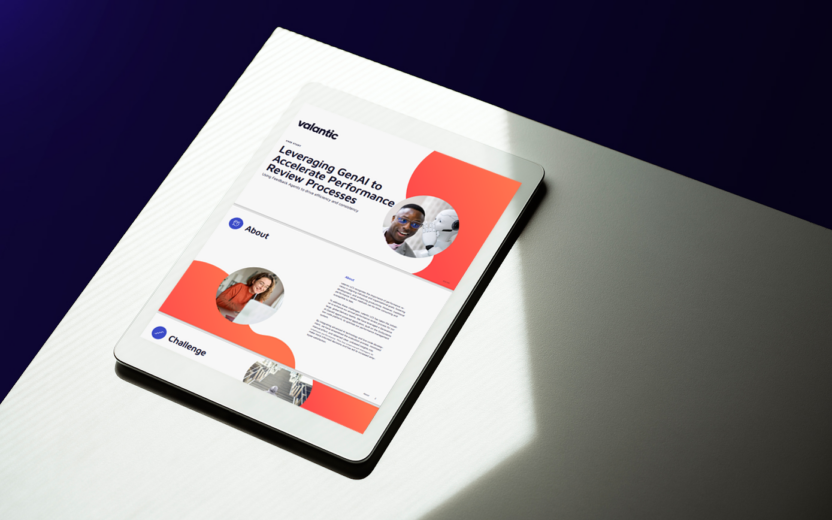
Download
Learn how valantic LCS is transforming performance management for its global delivery teams using innovative AI technology. Explore how our Generative AI-powered application, built on the OutSystems low-code platform, streamlines performance evaluations, reduces bias, and delivers clear insights.
Download Leveraging GenAI to Accelerate Performance Review Processes
Press
Combining the performance of international hyperscalers with central sovereignty criteria: This is a strategic goal that many companies in Germany are currently pursuing. They want to expand their IT infrastructure in Europe and thus become…
Learn more New valantic study: Sovereign hypercloud
Download
AI governance is key to creating a strong foundation for future competitiveness, enabling responsible adoption and scalable innovation. This whitepaper presents a practical, future-proof approach to integrating AI governance into existing processes, roles and tools, following valantic's principle of "no new governance".
Download Managing AI: How to build up a futureproof AI governanceReady to turn forecasting into a strategic advantage?
Demand planning is either a source of competitive edge or a drag on working capital and margins. DemandSense AI is for supply chain and commercial leaders who want to close the gap between the forecasts they have and the accuracy their business requires.