Highlight

Successful together – our valantic Team.
Meet the people who bring passion and accountability to driving success at valantic.
Get to know usMost engineering teams have vibe-coded Proof of Concepts (PoCs) that never reach production. The AI Code Factory gives development organizations the governance, standards, and enablement to scale AI-assisted coding across the entire software delivery lifecycle.

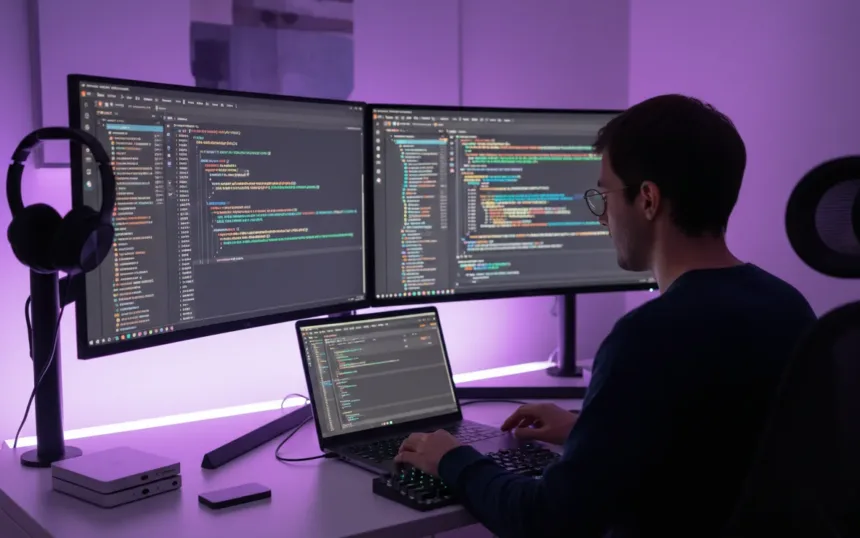
Business teams are building faster than ever. Vibe coding is compressing validation cycles, AI agents are accelerating innovation, and change requests are growing. Engineering organizations are feeling both the opportunity and the pressure.
What most teams are missing is not more tools. It is clear IT ownership, quality and governance guardrails for AI-generated code, and a repeatable path to move what works from vibe-coded prototype into production. Without those foundations, the gap between rapid PoCs and reliable software keeps widening.
The AI Code Factory is valantic’s structured offering for engineering organizations that want to scale agentic coding across their teams with the right governance, standards, and enablement in place from the start.
The same four patterns come up in almost every engineering organization that has started adopting AI coding tools:
The program runs in sequence across three phases. Each produces specific deliverables on its own. Together, they move your engineering organization from scattered AI experimentation to a governed, measurable agentic coding capability.
01 · Initialize
Assess current tooling, workflows, and organizational readiness. Define the target operating model and governance required for scaled adoption.
Initialize
The first phase establishes a clear current-state baseline and defines the target. Before standards can be set, the organization needs to understand where it actually stands.
Deliverable: a current-state assessment with a defined target architecture for agentic coding in your engineering organization

Align
The second phase builds the shared foundation that makes adoption consistent across teams.
Deliverable: a shared standard that holds across teams and projects, and a measurement framework to track progress

Setup
The third phase puts the governed environment in place and enables teams to use it.
Deliverable: a governed, running agentic coding environment with measurable outcomes and a clear path to scale

Five concrete results your engineering organization gains from the AI Code Factory:
A governed agentic coding environment
Auditable, secure, and compliant from day one, built on shared standards rather than individual experiments.
Consistent productivity gains across all teams
Not just for developers who adopted tools early, but systematically across the engineering organization.
A defined measurement baseline
For tracking and demonstrating the ROI of AI coding investment to engineering leadership and the business.
Shared standards and prompt libraries
Collective knowledge encoded in reusable patterns that scale across teams and projects.
A foundation that absorbs new tools
As the agentic coding landscape evolves, the program adapts without having to start over.
valantic practices what it recommends. AI is embedded into our own engineering workflows: coding, testing, CI/CD, documentation, and knowledge management. We use the same tools, face the same governance questions, and apply the same standards we help clients build. That makes us practitioners, not just advisors.
We have run large-scale technology and AI transformation programs for organizations including DATEV, Deutsche Bahn, Siemens Energy, and Munich Airport, bringing together agile practices, AI tooling, and sustainable adoption at scale.




See all valantic case studies for more examples across industries.
The right starting point for most organizations is a structured diagnostic. The AI Code Factory Readiness Assessment is a focused one-to-two-day engagement that gives engineering leadership a clear, shared view of where the organization stands and what the 90-day path forward looks like.
Pre-assessment questionnaire
On current tools, team structure, and existing AI usage across the engineering organization.
Workshop session
With engineering leadership and team leads: readiness assessment, use case mapping, governance gap identification.
Findings report and 90-day roadmap
Current-state summary, risk areas, prioritized quick-win recommendations, and a phased adoption plan.
Format: One to two-day workshop including preparation and follow-up
Investment: EUR 15,000 to EUR 25,000

AI services overview
Discover the full portfolio of AI offerings at a glance.
AI services overview
Our teams turn ideas into measurable results with a clear path, pragmatic execution, and visible business impact. From concept to scale, we connect strategy, data, and technology to deliver AI that performs in the real world.

AI North Star & Value Roadmap
Turn AI ambition into a prioritized roadmap with measurable business impact.
AI North Star & Value Roadmap
Most AI initiatives stall between pilot and scale. The AI North Star & Value Roadmap gives CxOs a clear AI roadmap, prioritized use cases, and an operating model built for execution.

AI Customer Service Agent
24/7 omnichannel service that gets smarter with every interaction.
AI Customer Service Agent
Customers expect instant answers across every channel. valantic’s AI Customer Service Agent handles inquiries 24/7, integrates with your existing systems, and keeps getting smarter with every interaction.

DemandSense AI
Highly accurate forecasts for inventory and revenue.
DemandSense AI
Spreadsheets and traditional forecasting methods cannot keep up with volatile markets. valantic’s DemandSense AI combines machine learning, multi-modal product data, and stockout-aware modeling to turn demand planning into a competitive advantage.

Enterprise AI Agent Hub
The enterprise platform for AI agents that work together.
Enterprise AI Agent Hub
Most enterprise AI initiatives stay fragmented. valantic’s Enterprise AI Agent Hub brings scattered pilots together into a secure, scalable platform of coordinated AI agents that operate across systems, functions, and business units.

Golden Record Agent
Clean, governed master data as the foundation for AI at scale.
Golden Record Agent
Over 80% of AI projects fail because of poor data quality. valantic’s Golden Record Agent identifies, cleanses, and governs your master data so your AI initiatives have a foundation they can rely on.
Further AI insights
Download
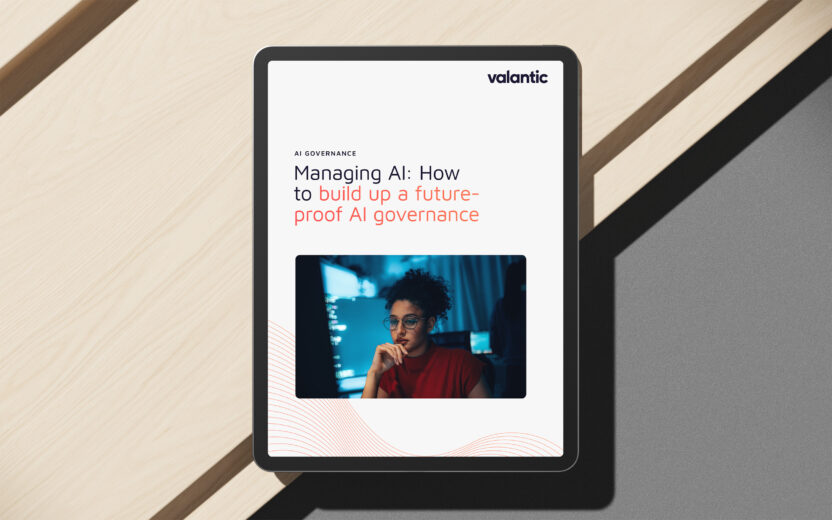
AI governance is key to creating a strong foundation for future competitiveness, enabling responsible adoption and scalable innovation. This whitepaper presents a practical, future-proof approach to integrating AI governance into existing processes, roles and tools, following valantic's principle of "no new governance".
Download Managing AI: How to build up a futureproof AI governance
Study
The new study "Digital Excellence Outlook 2026: AI at Scale" shows how companies can strategically anchor AI and use it sustainably.
Learn more Learn more
Service
valantic accompanies SMEs and corporations through every step of the Claude implementation. Regardless of whether you are just exploring the first use cases or planning company-wide scaling.
Learn more Learn more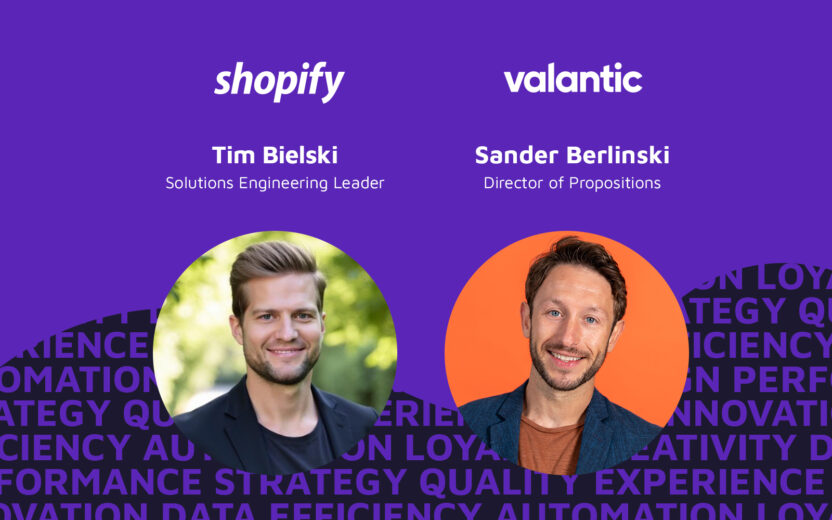
Event · October 15, 2026
A new kind of customer journey is emerging: In the age of Agentic Commerce, shoppers increasingly rely on LLMs like ChatGPT and Claude to discover products, compare options, and make purchase decisions. Sander Berlinski (valantic) and Tim Bielski (Shopify) explore how AI agents change commerce, which challenges merchants face in visibility, GEO und customer data, and how Shopify helps brands become LLM-ready. Watch the K5-Session on demand now.
Register Agentic Commerce and the New Customer Journey: Is Your Retail Brand Ready?
Press
Combining the performance of international hyperscalers with central sovereignty criteria: This is a strategic goal that many companies in Germany are currently pursuing. They want to expand their IT infrastructure in Europe and thus become…
Learn more New valantic study: Sovereign hypercloud
White paper
This white paper provides you with a practical guide that takes you concisely from ideation to a successful AI use case.
Learn more Learn moreReady to move from experimentation to program?
Most engineering organizations already have developers using AI coding tools. The question is whether that usage is adding up to something, or staying fragmented. The AI Code Factory is for teams that want consistent standards, measurable productivity, and AI-assisted code that actually makes it to production.

Rasmus Korsager Ørtoft
Senior Partner, Advisory and Solutions
VENZO – a valantic company