Highlight

Successful together – our valantic Team.
Meet the people who bring passion and accountability to driving success at valantic.
Get to know usSeptember 17, 2024

Efficient data management is crucial to an organization’s success, as data initiatives serve as the driving force behind successful implementation. However, efforts often fail due to a lack of business relevance, operational challenges, and technical limitations.
The valantic data-to-value framework offers a structured approach to help businesses transition from data novices to data masters. It emphasizes three core areas of control: data strategy, information governance, and system architecture.
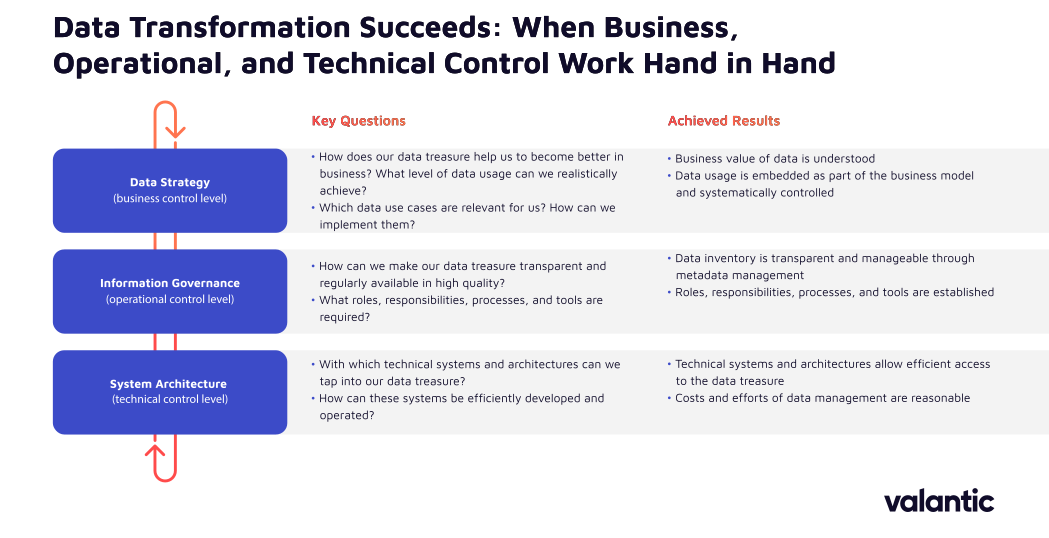
Without a doubt, successful data transformation is attainable when business, operational, and technical control work hand in hand. That’s why our team at valantic places particular emphasis on the three key control levels: data strategy, information governance, and system architecture.
Establishing a clear data strategy on a business control level is the first step toward successful data transformation. It ensures that the benefits of data are recognized and systematically pursued, making data utilization an integral part of the business model. Additionally, defining the desired level of data utilization is crucial before embarking on the data transformation journey.
Key questions when defining the data strategy:
Well-thought-out information governance enables the accurate, reliable, and transparent digital mapping of the physical world. Metadata management plays a crucial role on the operational control level, serving as a key instrument in this process.
These measures create transparency across the entire data repository, facilitating seamless data management and the automation of data processes.
Clearly defining roles, responsibilities, and processes is equally important. The result is a systematic implementation of data- and information-specific tasks, covering areas such as quality, security, risk and compliance management.
Key questions when establishing information governance:
A robust system architecture, embodied in a company-wide IT roadmap, enables flexible and efficient data utilization. Establishing and adhering to IT standards and guidelines provides vital support for your enterprise’s data transformation efforts. These measures play a crucial role in facilitating the agile use of data, from rapid provisioning to exploratory applications.
The IT roadmap serves as your digital blueprint, detailing the current state of the business, application, infrastructure, interface and security architecture. It provides an ideal framework for creating a focused, harmonized, and sustainable IT landscape across the entire organization, ensuring that IT standards are implemented with maximum synergy and longevity.
Key questions for a successful system architecture:
For a successful data transformation, the three control levels – data strategy, information governance, and system architecture – must work in unison. When these elements are integrated, they ensure effective data utilization and deliver quantifiable business value.
As the creators of the data-to-value framework, our team at valantic are experts in the field of data thinking. We are always happy to answer any questions and are here to offer our support.

Sebastian Reiss
Principal
valantic


Artificial Intelligence October 16, 2026
Autonomous Enterprise Journey: How AI value engineering creates measurable business value
How can the ROI of AI initiatives be reliably assessed and measured? How can companies identify the biggest levers and key processes for AI? Katrin Luft, Senior Expert at valantic and co-developer of the “Autonomous Enterprise Journey,” provides answers and recommendations in a conversation with Darya Basarhina, Vice President of Sales & Marketing and Manufacturing Practice Lead at valantic.
Autonomous Enterprise Journey: How AI value engineering creates measurable business value
Customer Experience September 18, 2026
From webshop to virtual try-on: how AI is making its way into retail stores
Digital interfaces such as smart mirrors turn AI in the store into a tangible business case. What potential does this hold for the customer experience and in-store personalization? Matthias Vollmer explains how the retail industry can combine the best of both worlds and turn physical touchpoints into an intelligent part of the omnichannel journey.
From webshop to virtual try-on: how AI is making its way into retail stores
Customer Experience August 27, 2026
Interview: How manufacturing stays digitally visible and AI-relevant
In the manufacturing sector, purchasing decisions are increasingly being made before the sales team is even involved. Designers, planners, maintenance technicians, and buyers conduct online research—and are increasingly receiving AI-generated responses. How can marketing teams at manufacturing companies ensure digital visibility and AI relevance? Answers and recommendations from the Manufacturing Practice.
Interview: How manufacturing stays digitally visible and AI-relevantDon't miss a thing.
Subscribe to our latest blog articles.