Highlight

Successful together – our valantic Team.
Meet the people who bring passion and accountability to driving success at valantic.
Get to know usSeptember 18, 2026
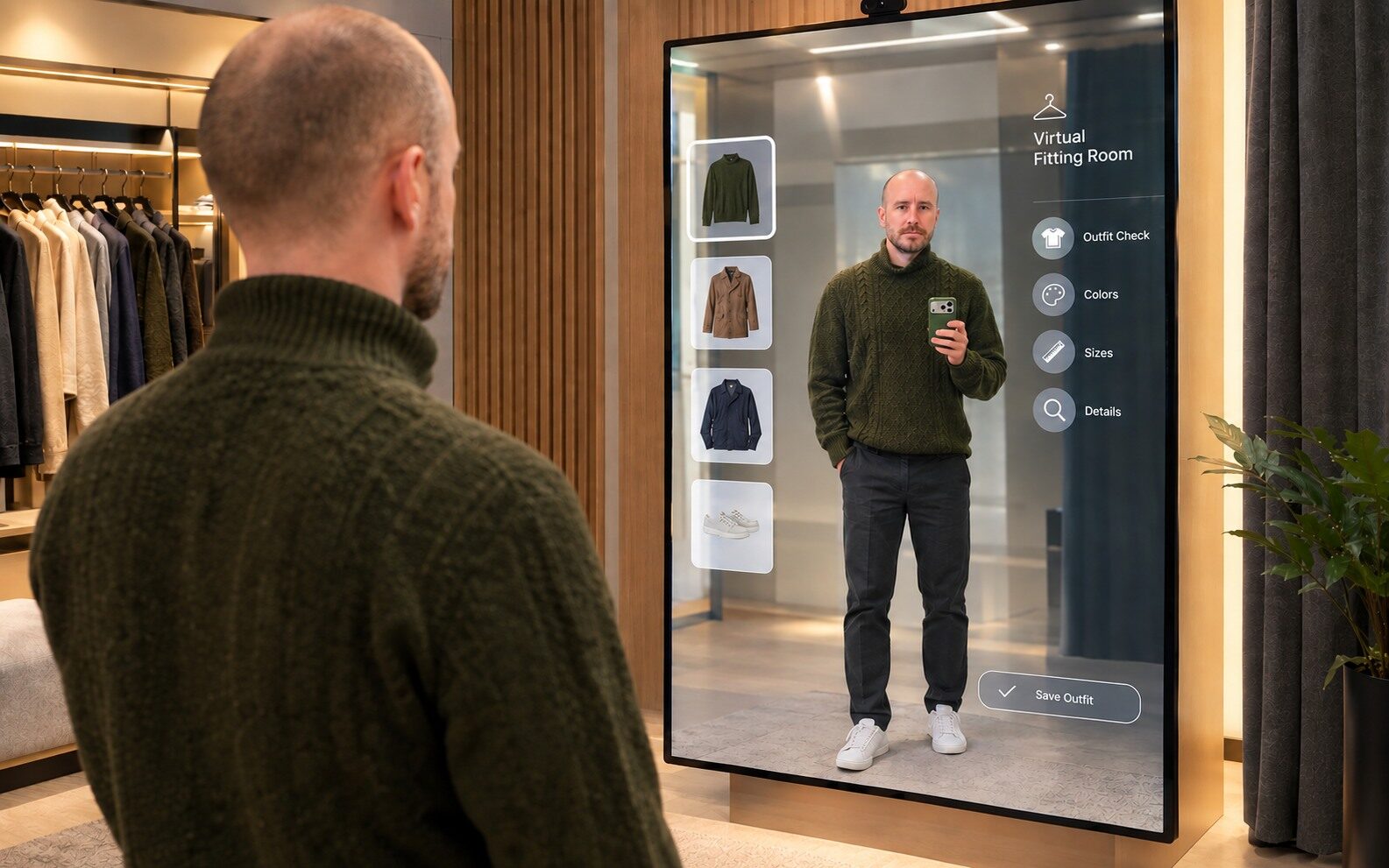

This summer, I attended Shopify dot.dev in Toronto. It was two days packed with innovation, product ideas, and discussions about what commerce might look like in the coming years. As expected, most of the focus was on the digital world. But what really stuck with me were two AI-powered applications for brick-and-mortar stores that we might start seeing more often in retail soon:
First, during a Realtime Fit Check, I could select different pieces of clothing and try them on instantly in a live video image of myself. A camera captured me in front of the screen, while the AI projected the selected outfits onto my body in real time. The experience feels similar to augmented reality, but here it’s powered by an AI model for virtual try-on.
The even bigger “aha” moment came in front of a Smart Mirror: Here, the garments weren’t simply superimposed on my reflection. The virtual outfit adapted to every pose in real time and followed my movements as if I were actually wearing it.
Admittedly, smart mirrors and other virtual try-on concepts have been around for several years. However, the experience in Toronto had a whole new dimension for me. And it raised a question that’s likely to become relevant for many retailers in the coming years:
What does it mean for the customer experience when Artificial Intelligence moves beyond e-commerce and into the sales floor as well?
In online retail, AI has long shaped our habits: Search queries are increasingly made using natural language and complete sentences. Recommendations take context and past behavior into account. Content and offers are personalized and tailored to individual customers. In physical stores, most of these mechanisms barely function yet.
Brick-and-mortar retail has other strengths:
People advise people. Products can be touched and tried out. Brands can create experiences through spaces, materials, and personal interactions that an online store can hardly replicate.
Those who combine these strengths with the technologies and possibilities of the digital world can achieve a new level of personalization in-store – and thus a new quality of customer experience.
We’ve also been talking about omnichannel for years. The focus is usually on processes: click-and-collect, unified inventory, loyalty programs, returns, or cross-channel customer accounts.
With AI, digital interfaces are added as another layer: These can be available right where customers see, touch, and try out products—at physical touchpoints.
The smart mirror itself is one possible example. It will make sense in some retail formats, while in others it will play hardly any role at all. Whether retailers need technical innovations in their sales areas—and, if so, which ones—is determined primarily by the question:
What creates a better customer experience across all touchpoints, and thus also in-store?
Let’s imagine this: A customer tries on a blazer that she likes right away. But is the blazer available in other colors? Which pants would go well with it? Are other sizes available?
The online store usually has answers to these questions faster than the physical store. What’s more, most retailers’ online selections offer a much wider range of products and variations that can’t be displayed in-store simply because of limited floor space.
The in-store customer experience has a lot to offer, but it has some catching up to do when it comes to digitalization.
The reason: Data sources, systems, and processes aren’t designed to consolidate information from different channels and data points during a store visit and make it quickly accessible to both customers and employees.
AI-powered interfaces such as smart mirrors are still far from solving this problem, but they offer a glimpse of how information can be integrated directly into the in-store customer experience in the future and how the benefits of digital technology can be applied to the physical point of sale (POS).
Concepts for virtual try-ons and smart in-store interfaces have been around for years. However, implementing them cost-effectively has proven difficult so far. While an impressive showcase can be built quickly, a broad rollout—especially in retail—requires more:
I found one aspect of the Fit Check demo in Toronto particularly interesting: A single product photo can serve as the starting point for the virtual rendering, and the underlying AI model handles a significant portion of the visual work. That changes the scalability of the application, and with it, its potential.
From a retailer’s perspective, it’s ultimately less important whether ten selected garments look impressive in an AI application. It only becomes interesting and profitable when a comprehensive, growing, or frequently changing product range can be integrated and continuously updated.
If these conditions are met, I believe smart mirrors and AI in-store have far-reaching potential. The digital touchpoint expands the existing sales floor, and the technology becomes part of the consultation process.
Which retailers stand to gain tangible value from smart mirrors and other in-store AI applications comes down, in my view, to three questions:
The wow effect is fleeting.
That’s why the use case and its concrete benefits come first. An AI application must make the in-store experience easier, more convenient, or more relevant. In the fashion sector, this can mean discovering different styles and trying out new looks more quickly. In boutiques with limited floor space, digital interfaces can make a wider selection visible. In the fitting room, the selection expands to include additional colors, sizes, cuts, and combinations.
A smart mirror isn’t much use if the product information behind it is missing.
Inventory, sizes, variants, product data, recommendations, and—ideally—even customer data must be available, reliable, and up to date. This quickly brings us back to the same issues that determine the quality of the customer experience in e-commerce: data architecture, integrations, and platform compatibility. The visible part is the mirror. The vast majority of the work happens behind the scenes.
Every new technology has to prove itself in day-to-day operations.
In retail, for example, this means: Are conversion rates and average cart values increasing? Does the application help employees provide advice? Can products and product lines be offered that would otherwise require additional shelf space?
Only when such questions can be clearly answered with “yes” will a trial AI application become a viable, long-term component of the store concept.
When retailers proactively integrate product data, e-commerce platforms, customer data, and AI, physical stores can access capabilities that we’ve previously encountered mainly in digital journeys. Recommendations become more context-specific. Sales consultations can be supported by additional information. Customers can discover significantly more products and variants.
Shopify gave me a pretty good idea in Toronto of how far such applications have come and how they can enhance the in-store customer experience. Retailers need to evaluate and prioritize which technologies make sense for their business model, CX strategy, and in-store product assortment—and how they can combine the best of both worlds.

Knowing what will shape retail in 2026
Retail stands to gain especially from digital innovations such as agentic commerce, GenAI, and hyperpersonalization. Retailers who use these trends strategically unlock profit potential and compete more efficiently.

Matthias Vollmer
Manager Strategic Partnerships
valantic
As Manager of Business Development & Strategic Partnerships at valantic, Matthias Vollmer focuses on digital business models in retail and e-commerce. His work centers on strategic technology partnerships, commerce ecosystems, and the question of how new technologies such as AI can be translated into concrete customer experiences and scalable business models.

Customer Experience July 16, 2026
From segments to individual 1:1 relevance: What Hyperpersonalization means in retail
Personalization is high on the retail industry’s agenda, but so far, it has been viewed primarily as a technical capability. AI is currently changing both expectations for personalized experiences and the technical means of delivering true one-to-one relevance. That is what hyperpersonalization ultimately comes down to: personality and context that build trust, credibility, and loyalty.
From segments to individual 1:1 relevance: What Hyperpersonalization means in retail
Customer Experience June 10, 2026
Agentic Commerce: Why the next 18 months will decide the next ten years
Agentic AI is changing the rules of the game in digital commerce. Where do retailers from the DACH region stand, what do global markets have ahead of them and how can companies become fit for agentic commerce? A personal assessment from retail practice with specific recommendations for action.
Agentic Commerce: Why the next 18 months will decide the next ten years
Customer Experience June 4, 2026
Digital Payment in Agentic Commerce: AI buys – who pays?
Agentic AI changes who clicks on "Pay". For merchants and payment service providers, this means that for the first time, the checkout has to deal with someone who is neither human nor a traditional interface. What role does digital payment play in agentic commerce and how will payment services become future-proof?
Digital Payment in Agentic Commerce: AI buys – who pays?Don't miss a thing.
Subscribe to our latest blog articles.