Highlight

Successful together – our valantic Team.
Meet the people who bring passion and accountability to driving success at valantic.
Get to know usSeptember 10, 2024

Efficient data transformation begins with understanding your company’s current level of data utilization. At valantic, we categorize companies into four distinct levels, providing you with a comprehensive overview and a clear roadmap for your future data utilization.
From data novice to data master: Evaluating your current control levels – such as data strategy, information governance, and system architecture – is essential for successful data transformation.
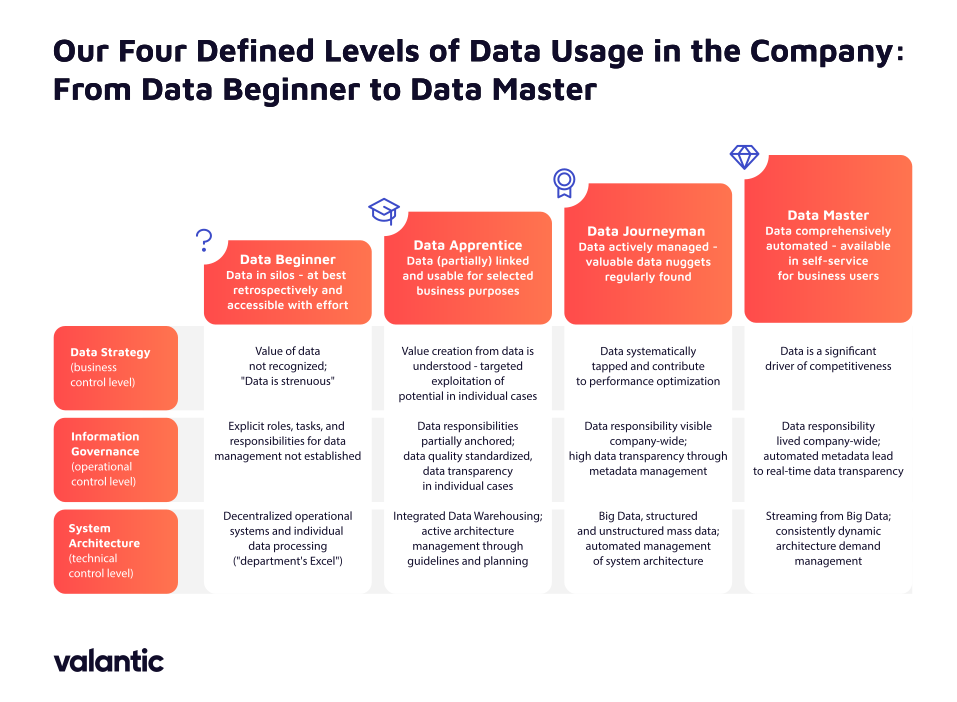
To assess your current data utilization, we thoroughly evaluate each control level. By analyzing the specific characteristics of these levels, we can gauge the level of data utilization – a vital insight for planning your data transformation.
Does your company view data in isolated silos, struggling to access it after the fact? If so, your company might be a data novice.
Does your company use data selectively to support business operations? If so, you’re likely a data apprentice.
Does your company actively manage data and regularly uncover valuable insights? If so, you’re probably a data journeyman.
Is your data fully automated and readily available for business use on-demand? If so, you’ve reached the pinnacle of data utilization: You’re a data master!
We’ve found that data initiatives can notably enhance your company’s level of data utilization. With our guidance, you can transition from a data novice to a data master!

Sebastian Reiss
Principal
valantic


Artificial Intelligence October 16, 2026
Autonomous Enterprise Journey: How AI value engineering creates measurable business value
How can the ROI of AI initiatives be reliably assessed and measured? How can companies identify the biggest levers and key processes for AI? Katrin Luft, Senior Expert at valantic and co-developer of the “Autonomous Enterprise Journey,” provides answers and recommendations in a conversation with Darya Basarhina, Vice President of Sales & Marketing and Manufacturing Practice Lead at valantic.
Autonomous Enterprise Journey: How AI value engineering creates measurable business value
Customer Experience September 18, 2026
From webshop to virtual try-on: how AI is making its way into retail stores
Digital interfaces such as smart mirrors turn AI in the store into a tangible business case. What potential does this hold for the customer experience and in-store personalization? Matthias Vollmer explains how the retail industry can combine the best of both worlds and turn physical touchpoints into an intelligent part of the omnichannel journey.
From webshop to virtual try-on: how AI is making its way into retail stores
Customer Experience August 27, 2026
Interview: How manufacturing stays digitally visible and AI-relevant
In the manufacturing sector, purchasing decisions are increasingly being made before the sales team is even involved. Designers, planners, maintenance technicians, and buyers conduct online research—and are increasingly receiving AI-generated responses. How can marketing teams at manufacturing companies ensure digital visibility and AI relevance? Answers and recommendations from the Manufacturing Practice.
Interview: How manufacturing stays digitally visible and AI-relevantDon't miss a thing.
Subscribe to our latest blog articles.