Highlight

Successful together – our valantic Team.
Meet the people who bring passion and accountability to driving success at valantic.
Get to know usOctober 17, 2024

Just like any other customer-focused industry, pharma and life sciences companies are constantly looking for ways to improve their services and provide superior experience to their ‘customers’. HCP’s, patients and any other health care stakeholder are also just human beings, who are used to the seamless experiences they get from the services they use in their personal lives, and they have similar expectations towards the service and experience they can get professionally, or medically. For pharma companies, being able to deliver upon these expectations used to be a competitive differentiator. Now its just an essential part of doing business.
However, the use of technology in pharma can still make a significant difference. By providing sales, marketing, service and all other customer or patient engaging functions with the right tools and with access to all relevant and up-to-date data, they can be equipped to go the extra mile towards the customer.
At the center of a Customer Excellence strategy is having a single and unified view of the customer, across all touchpoints, all channels, all services. Knowing the customers’ history, their needs and their preferences is by far the most important ingredient to moving towards a customer excellence mindset. To do this, existing functional or geographical data silos must be broken down and replaced with an open, collaborative and cross-functional data environment, obviously within the boundaries of privacy and regulatory constraints.
This is where customer master data management comes in: the technology, processes and governance to ensure up-to-date and high-quality customer data across the company. If implemented well, this capability allows us to stitch together all information related to a single customer across all functions and systems, avoiding the many different views about the same customer that we are historically used to.
And depending on the type of customers or stakeholders, this can be further augmented with externally managed customer data, like IQVIA OneKey or Veeva OpenData, taking away the need for customer-facing staff to manually keep customer data up to date.
The 360 view of the customer has been the north star for most companies for many years. Unfortunately, with limited success. What was considered ‘360’, was in most cases limited to only a subset of the available customer information, typically with data from sales, marketing and service still separated in their own 360 view.
With the help of the single definition of the customer, through the MDM, it becomes much easier to combine these separate customer views into one. A true 360 view, merging the data from CRM, marketing automation, websites, apps, webinars… but also from medical, customer support, ecommerce, order intake, pricing.
Technology has evolved a lot over the last years in this space. Where this consolidation of data used to happen in large data stores and data lakes, the next generation of solutions allows us to do this much more virtually. With tools like Salesforce Data Cloud, it is perfectly possible to build such 360-customer view while keeping the data in their source system.
Once this complete picture of the customer is available, it offers many new opportunities, like
And ultimately, the ability for anyone that is in touch with the customer to speak with the same voice and act as one company to the customer.
Finally, this vast amount of information about the customer also allows us to build up additional insights into their needs and preferences. More and more pharma companies leverage all the available data, together with advanced analytics, or even AI to anticipate the needs of the customers through Next Best Actions and content recommendations.
Customer relevance is an important element of Customer Excellence. Providing relevant information and services allows to stay engaged with the customer, in an environment where access to customer has become more and more difficult.

Customer Excellence Transformation in Pharma, Healthcare & Life Sciences
More information about our pharma & life sciences offering


Artificial Intelligence October 16, 2026
Autonomous Enterprise Journey: How AI value engineering creates measurable business value
How can the ROI of AI initiatives be reliably assessed and measured? How can companies identify the biggest levers and key processes for AI? Katrin Luft, Senior Expert at valantic and co-developer of the “Autonomous Enterprise Journey,” provides answers and recommendations in a conversation with Darya Basarhina, Vice President of Sales & Marketing and Manufacturing Practice Lead at valantic.
Autonomous Enterprise Journey: How AI value engineering creates measurable business value
Customer Experience October 8, 2026
Interview: From PIM to Data Spine – How companies prepare their data for AI
AI is changing the requirements for data, governance, and processes. Where should companies start, and what skills do they need? In this interview, Dietmar Rietsch, CEO of Pimcore, and Timo Huguet of valantic discuss the importance of clean data, the concept of the “Data Spine,” and the changing role of humans in the age of agentic AI.
Interview: From PIM to Data Spine – How companies prepare their data for AI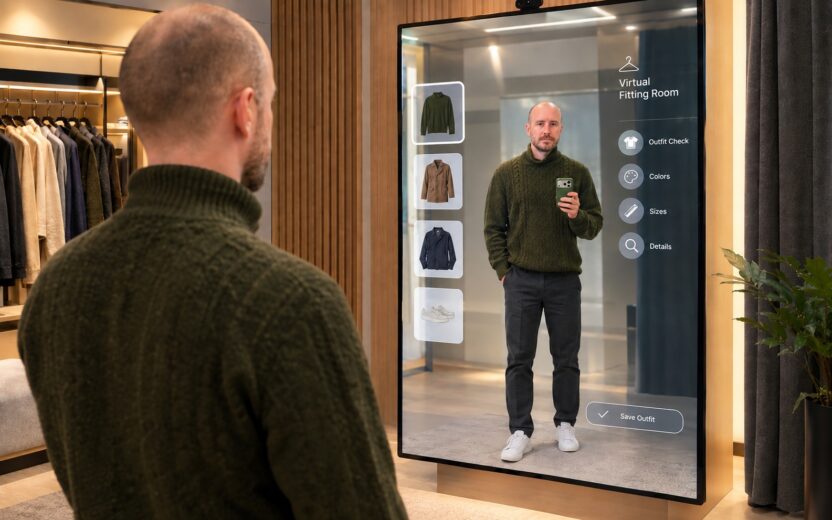
Customer Experience September 18, 2026
From webshop to virtual try-on: how AI is making its way into retail stores
Digital interfaces such as smart mirrors turn AI in the store into a tangible business case. What potential does this hold for the customer experience and in-store personalization? Matthias Vollmer explains how the retail industry can combine the best of both worlds and turn physical touchpoints into an intelligent part of the omnichannel journey.
From webshop to virtual try-on: how AI is making its way into retail storesDon't miss a thing.
Subscribe to our latest blog articles.