Highlight

Successful together – our valantic Team.
Meet the people who bring passion and accountability to driving success at valantic.
Get to know usOctober 8, 2026

Artificial intelligence is changing the requirements for data structures, governance, and processes. Virtually every company is currently faced with the task of rethinking its data and system landscape and adapting it to these new requirements.
What’s the best way to approach this, and which capabilities are needed?
In this interview, Dietmar Rietsch, CEO of Pimcore, and Timo Huguet, Partner at valantic, discuss the importance of a clean database, the concept of the “Data Spine,” and the changing role of humans in collaboration with Agentic AI.
Dietmar, Agentic AI is everywhere. From your perspective, what’s changing for companies?
Agentic AI isn’t just about individual technologies or functions. It’s transforming processes across all areas of business and in every industry. Whether in retail, manufacturing, automotive, or other industries, AI agents will take on tasks everywhere. This makes the ability to make data available in a structured and reliable manner a crucial factor for business development.
This brings us to the topic of data management: What role does a PIM system like Pimcore play for Agentic AI?
PIM systems address a challenge that many companies have faced for a very long time: product data, customer data, commerce data, and transaction data are stored in different systems. Data sources have been built separately over the years and therefore often do not integrate with one another. A PIM system lays the foundation for consolidating data from these various sources and making it usable for AI.
At Pimcore, you no longer refer to a traditional PIM system, but rather to a “Data Spine.” What do you mean by that?
We introduced the term “Data Spine” at Pimcore earlier this year to describe a kind of backbone for data management. Essentially, it refers to a system that consolidates information, provides context, structures it, and makes it reliably and centrally accessible—for marketing and commerce as well as for internal applications. The PIM system becomes a data hub through which all teams and departments can access consistent information, edit it, enrich it, and distribute it across various channels.
Why does a “Data Spine” become so important with AI?
AI is capable of a great deal, but it only works if its data foundation is sound. If an AI agent works with incorrect, contradictory, or incomplete information, even the best model cannot deliver reliable results. A “data spine” clarifies which information is correct and the context in which it appears.
Does that mean data management will largely be taken over by AI in the future?
I strongly believe that many processes and tasks that currently still have to be done manually will soon be automated. This is likely to have a major impact and lead to significant advances in data maintenance, data quality, and the speed at which information can be delivered.
And where does that leave humans in this development?
Humans remain indispensable, especially when it comes to data governance. They orchestrate, monitor, and set the framework. The guiding principle remains “human in the loop.” And that’s very important:
When humans work with data, there are control mechanisms or an intuitive understanding of when something doesn’t add up. When processes are automated, an overlooked error can spread very quickly. Conversely, this means that especially when machines use, translate, or enrich data, it must be ensured that the context is correct and the information is accurate.
How should companies get started to prepare their systems and data for AI?
Especially in large corporations and growing medium-sized companies, we often see that data silos and a lack of data flow are the underlying problems. No one knows exactly where to find specific information, whether it’s up to date, or whether it’s even accurate in the broader context. That’s why the first step is to clean up the “data mess” and, in a second step, ensure smooth data flows. In short: A reliable database must be created that is linked to all relevant data sources and systems.
What do you recommend to ensure these first steps are successful?
Especially when it comes to the disruptive changes that AI undoubtedly brings, we need people who can contribute knowledge, guidance, and practical experience. At Agentic AI, it’s not just about installing software or introducing new technology—it’s about change management, interdisciplinary expertise, and collaboration. In my view, complex transformation projects will always require partners and people who understand your business, provide holistic advice, and guide you every step of the way.
How will Pimcore position itself in this shift?
Our roadmap will continue to evolve. At the same time, we want to stay true to our core principles. Open Core, for example, remains an important part of Pimcore. Control and ownership play a particularly important role when it comes to critical business data. Companies should be able to decide for themselves how they manage their data.
Finally, a personal assessment: How do you see the future with Agentic AI?
I think there’s a lot we can’t even foresee yet. We’re only just seeing the beginning of a trend in which more and more tasks no longer need to be performed by humans. The implications will be far-reaching. No one can predict with certainty just how far-reaching they’ll be. However, technological change is happening much faster than previous industrial transformations. This makes it all the more important for companies to address these rapid developments right now in order to anticipate new requirements and build the necessary capabilities.
Thank you for these insights and your perspectives, Dietmar!


Is your database ready for Agentic AI?
From PIM to Data Spine: Learn how data quality, governance, and AI readiness all come together with Pimcore.

Timo Huguet
Partner
valantic
As a partner at valantic, Timo Huguet is responsible, together with Uwe Tüben, for the overall success of the CX Division and has helped shape the company’s development since 2015 through numerous phases of growth. His work focuses on how digital experiences help companies sustainably expand their business and how valantic can continuously evolve to support this.

Dietmar Rietsch
Partner
valantic Division Customer Experience
As a co-founder and Managing Director of Pimcore, Dietmar Rietsch has been working in the field of data and experience management for more than 15 years and has extensive expertise in PIM, MDM, DAM, CDP, and DXP. As an entrepreneur and technology expert, he is driving the further development of Pimcore by leveraging the capabilities of AI and machine learning.

Customer Experience April 16, 2026
Agentic AI Use Case: How a Data Agent creates the basis for Digital Commerce
Together with ZEG and Pimcore, valantic realized an Agentic AI use case in which AI automatically structures product data and makes it usable. Why clean data, governance and controllable processes are crucial for Agentic AI and how AI data management creates the basis for digital sales channels: In this interview, the project participants share their insights.
Agentic AI Use Case: How a Data Agent creates the basis for Digital Commerce
Customer Experience March 21, 2025
Unlocking the Power of PXM and PIM: A Holistic Approach with Pimcore
Explore the synergy between Product Information Management (PIM) and Product Experience Management (PXM) in this blog. Discover how Pimcore revolutionizes digital transformation by enhancing customer experiences, streamlining data management, and leveraging its global ecosystem for innovation and growth.
Unlocking the Power of PXM and PIM: A Holistic Approach with Pimcore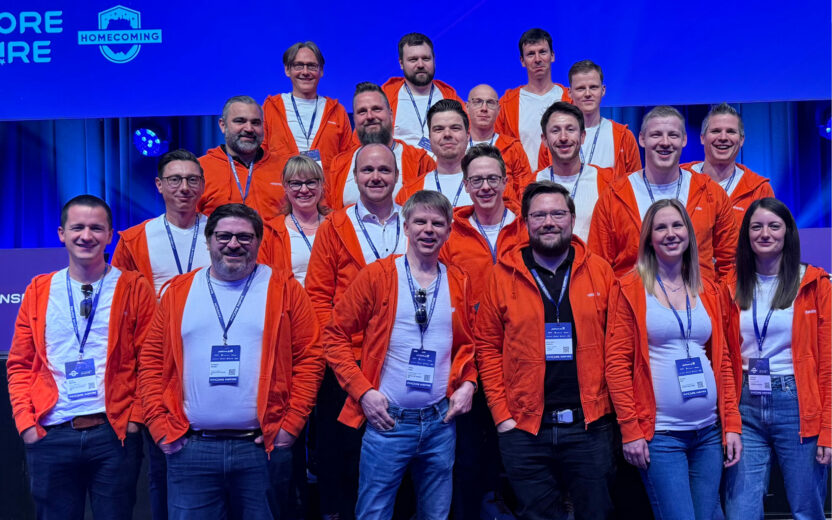
Customer Experience May 8, 2025
Pimcore Inspire 2025: Pimcore Homecoming – Back to the roots and off into the future
Pimcore Inspire 25 once again delivered with many useful insights, interesting talks and a clear path into the exciting future of Pimcore as the central PXM solution. As Pimcore Global Partner, we were on site to gather all relevant information, hold a PXM-related masterclass and get in touch with technology experts to discuss current developments.
Pimcore Inspire 2025: Pimcore Homecoming – Back to the roots and off into the futureDon't miss a thing.
Subscribe to our latest blog articles.