Highlight

Successful together – our valantic Team.
Meet the people who bring passion and accountability to driving success at valantic.
Get to know usDecember 10, 2024

Developers are spoiled for choice when it comes to extensions in the SAP environment. The growing importance of cloud technologies and the clean-core approach mean that they have access to many new development techniques. In addition, there is a fundamental rethinking in terms of system adaptations. Instead of integrating extensions directly into the core, today they are implemented outside the core to ensure that it will be possible to maintain and upgrade the software for the long term. The SAP Business Technology Platform provides support for the development, integration, and operation of such side-by-side extensions.
The SAP Application Extension Methodology (SAP AEM) helps organizations keep track of the many expansion options by providing orientation and structure. It is a procedure for implementing adaptations in a targeted, strategic, and future-proof manner. SAP AEM consists of the following three phases:
Companies can use SAP AEM to develop an expansion strategy tailored to their needs. This is particularly important for S/4HANA systems, as there is a very large number of possible development techniques. For example, either classic ABAP-based user interfaces or modern Fiori and BTP cloud solutions can be used to develop new interfaces.
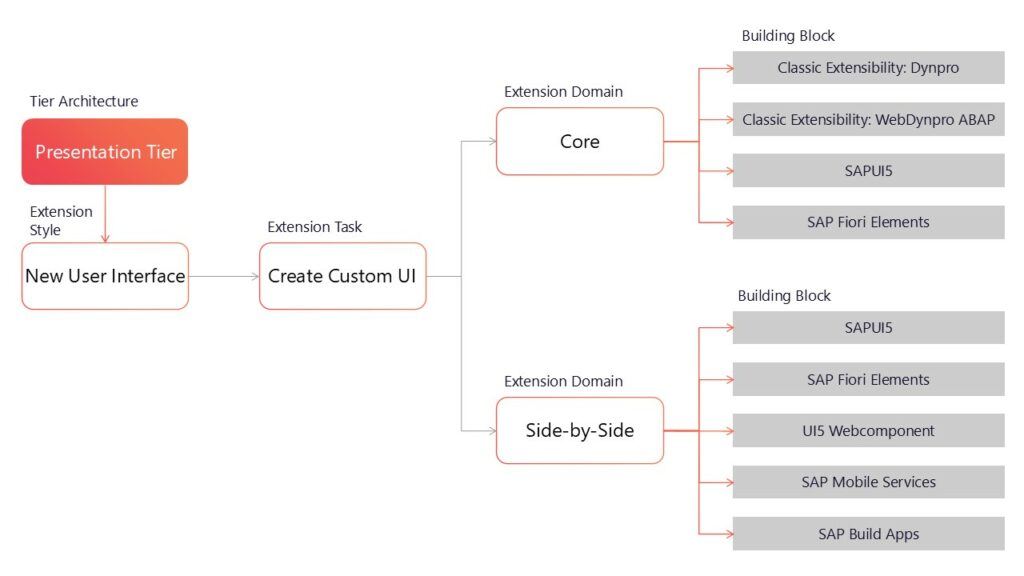
To create an individual extension strategy, SAP AEM offers a template that shows various expansion tasks and the associated technical expansion modules. This template can be used to evaluate any existing and potential expansion technology based on customer-specific criteria, such as clean core, expertise, or license costs. A categorization by traffic light colors helps to prioritize techniques and select them based on transparent criteria.
This could look like this:
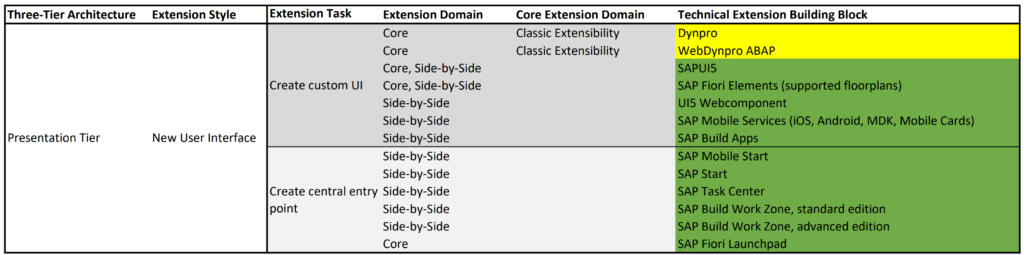
The color coding provides orientation and thus helps make strategic decisions for the right extension techniques. This way, companies can establish an expansion strategy that not only protects the clean core and implements adaptations efficiently, but also keeps their SAP systems flexible and future-proof.
Using SAP AEM as a strategic foundation for clean-core expansion protects the system in the long term and promotes cost-effective upgrades. The SAP Application Extension Methodology also ensures that everyone involved knows which extension techniques can be used. Our project experience shows that S/4HANA launches in particular benefit from such an expansion strategy – regardless of whether they will use the greenfield, brownfield, or hybrid project approach. A clean-core expansion strategy also offers great benefits for companies with existing S/4HANA systems. We will be happy to help you develop and successfully implement this strategy.

Side by side extensions with SAP BTP
Are SAP system enhancements and process adjustments an issue for you? In the Expert Talks with IT-Onlinemagazin, our expert Timo Rüb explains the tools and methods. (In German)

SAP Services September 17, 2026
The SAP BDC handbook: An interview on Business AI and data culture
Five valantic consultants wrote the SAP Business Data Cloud handbook. In this interview, they explain why SAP BDC is the enabler for business AI and why this book is a must-read.
The SAP BDC handbook: An interview on Business AI and data culture
Artificial Intelligence August 4, 2026
Joule Studio 2.0: Shaping the Autonomous Enterprise with SAP AI Agents
In the third part of our blog series on the Autonomous Enterprise, we turn our attention to AI agents. With Joule Studio 2.0 and industry-specific Industry AI, SAP enables the transition from AI assistants to autonomously acting AI agents—including open development with n8n and Vercel, as well as integrated governance in the SAP AI Agent Hub.
Joule Studio 2.0: Shaping the Autonomous Enterprise with SAP AI Agents

Artificial Intelligence July 15, 2026
Homework for the Autonomous Enterprise: Architecture, Data, and Processes
SAP Sapphire has refined the vision of the Autonomous Enterprise—now it’s time to put it into practice. Part 2 of our blog series highlights four key building blocks: transparent architecture and agent governance with LeanIX, the path to the cloud, a solid data foundation in the SAP Business Data Cloud, and processes made visible through process mining.
Homework for the Autonomous Enterprise: Architecture, Data, and ProcessesDon't miss a thing.
Subscribe to our latest blog articles.