Highlight

Successful together – our valantic Team.
Meet the people who bring passion and accountability to driving success at valantic.
Get to know usJuly 15, 2026


In the first part of this blog series, I described why the Autonomous Enterprise has become tangible after SAP Sapphire 2026. The vision is set. But there’s something essential that lies between a powerful keynote and real business value: the homework. Autonomous agents are only as good as the architecture, data, and processes on which they run. And that’s exactly what this follow-up article is about—not the destination, but the journey to get there.

Introducing: Autonomous Enterprise
What does “Autonomous Enterprise” mean? In the first part of our blog series, you learn how Joule Assistants orchestrate connected agents that independently handle routine tasks across SAP and non-SAP systems.
You can’t manage what you can’t see. And before long, many companies will have hundreds of agents running—from SAP, Microsoft, Google, or their own frameworks. Without an overview and clear rules, this will quickly turn into a new shadow IT problem—only with significantly more autonomy. Governance in the Autonomous Enterprise is therefore not an optional extra, but the first essential task.
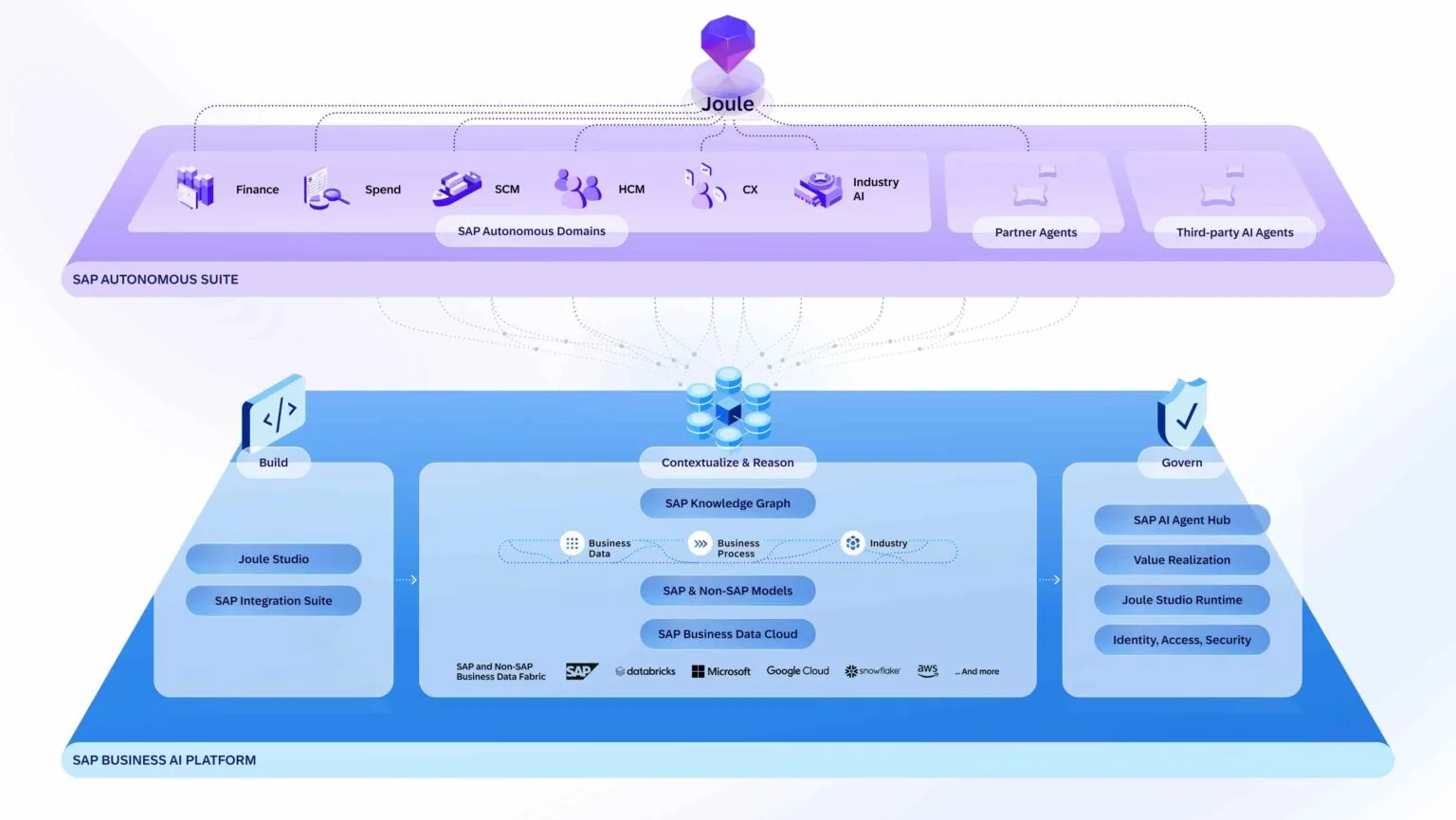
Technically, this is addressed by the SAP AI Agent Hub, which is built on SAP LeanIX: a vendor-agnostic system of record for every agent—regardless of who built it. The SAP AI Agent Hub inventories agents, links them to applications and business capabilities, guides them through a clear lifecycle from “proposed” to “decommissioned,” gives each one its own identity with defined access rights, and ensures that only verified agents run in production.
The fact that SAP is including it in the SAP Business AI Platform at no extra cost (General Availability, GA, scheduled for Q3 2026) and that the EU AI Act will take full effect in August 2026 makes one thing clear: There’s no getting around governance—especially in finance, HR, and procurement processes.
However, the tool alone isn’t enough; the work behind it is organizational. There are two specific things you should address now:
In short: Create transparency regarding architecture and agents, define approval and authorization rules that can scale with your needs, and take inventory of your agent portfolio today.
Most new AI features are “cloud-first.” This changes the business case for transformation: It’s no longer just about the end of support in 2027 or cost avoidance, but about access to AI capabilities—a much stronger argument. Cloud ERP is thus less of an IT project and more of a ticket to autonomy, making it a key element of the Autonomous Enterprise.
The key is the “how”: Don’t migrate via “lift and shift”; instead, modernize with a Clean Core so that extensions coexist seamlessly with the standard and don’t block upgrades. On-premises solutions generally offer the same capabilities for integrating your own AI agents. The crux of the matter is the availability and functionality of the standard interfaces. This leads to an often-underestimated task: Make your key OData services Clean Core-compliant so that your own data fields and custom logic from SAP BTP can also be accessed seamlessly.
SAP CEO Christian Klein summed it up at this year’s SAP Sapphire: “No AI agent can compensate for a broken data model.” That is precisely why the SAP Business Data Cloud (BDC) is at the heart of the preparation. It creates a semantic data layer that spans SAP and non-SAP data—no silos, no data sprawl. And before an agent outputs anything, it verifies identity and access rights.
The SAP Knowledge Graph provides the managed ontologies that enable agents to understand processes, relationships, and context. It is this context alone that transforms a plausible agent into a correct one. The task at hand is uncomfortable but unavoidable: Consistently align your data strategy with the capabilities and growing importance of the BDC—ensure data quality, clarify data ownership, and reliably connect your data products. Those who cut corners here are building agents on sand.
Before you automate, you need to know what you’re automating. Process mining with SAP Signavio reveals how processes actually work—including the deviations that are often overlooked.
On the path to the Autonomous Enterprise, the key task is to prioritize correctly. Don’t look for processes where AI could be applied; instead, look for where the need is greatest. Where are error rates the highest? Where is scaling impossible due to staff shortages? Where are long turnaround times costing you actual revenue? That’s where the first agents come in—not with the most exciting use case.
Once the agents are running, you need to monitor them: Agent Mining reveals their behavior, compliance, and business value. Give each agent its own identity, clear access rights, and measurable KPIs right from the start. This way, governance isn’t a roadblock—it’s the prerequisite for deploying agents in critical processes.
The above-mentioned tasks may lack glamour, but… may lack glamour, but they have a lot of substance—because they determine success or failure. My clear recommendation: don’t start with the most spectacular use case, but with the foundation. First, ensure transparency regarding architecture and agents; then move to the cloud, establish a clean data foundation in SAP BDC, and implement a governance model that’s in place from the very beginning. These are precisely the steps our valantic experts guide you through—from enterprise architecture and data strategy to processes and agent governance. The vision is set. Now it’s all about who does their homework.
In the next part of our blog series on the Autonomous Enterprise, we take a closer look at AI Agents & SAP Joule 2.0. Stay tuned!
Discover the most important information about the SAP Autonomous Enterprise in the valantic glossary.

Explore the Autonomous Enterprise
The Autonomous Enterprise represents a new vision for how businesses operate: AI agents execute processes autonomously, while people set the direction and maintain control.

On-Demand Webinar: SAP AI Agents in Practice
Learn from specific use cases how AI automation—all the way up to autonomous AI agents—can be implemented.


Artificial Intelligence June 9, 2026
SAP Sapphire 2026 – the way into the Autonomous Enterprise
SAP Sapphire 2026 marks the mindshift from assistant to agent: In the Autonomous Enterprise, Joule Assistants orchestrate networked agents that perform routine work independently across SAP and non-SAP systems. They are based on Joule Work and Joule Studio, the SAP Business Data Cloud and the Business AI Platform - provided that the data, cloud setup and culture are in sync.
SAP Sapphire 2026 – the way into the Autonomous Enterprise
SAP Services March 24, 2026
AI makes the difference: Efficient SAP S/4HANA data migration
Migration to SAP S/4HANA is considered complex and error-prone—especially when dealing with large amounts of data. A project with our customer shows how AI significantly speeds up the process, detects duplicates, processes unstructured data, and improves data quality. The result: less manual effort, shorter runtimes, and a reliable foundation for the new system.
AI makes the difference: Efficient SAP S/4HANA data migration
Artificial Intelligence May 28, 2026
How AI agents solve specific business problems
At the DSAG Technology Days 2026 in Hamburg, innovation was not just discussed but actively developed: Together with valantic, the German-Speaking SAP User Group (DSAG) organized a hackathon where seven teams of students and young professionals presented their ideas for AI agents.
How AI agents solve specific business problemsDon't miss a thing.
Subscribe to our latest blog articles.