Highlight

Successful together – our valantic Team.
Meet the people who bring passion and accountability to driving success at valantic.
Get to know usSeptember 17, 2026
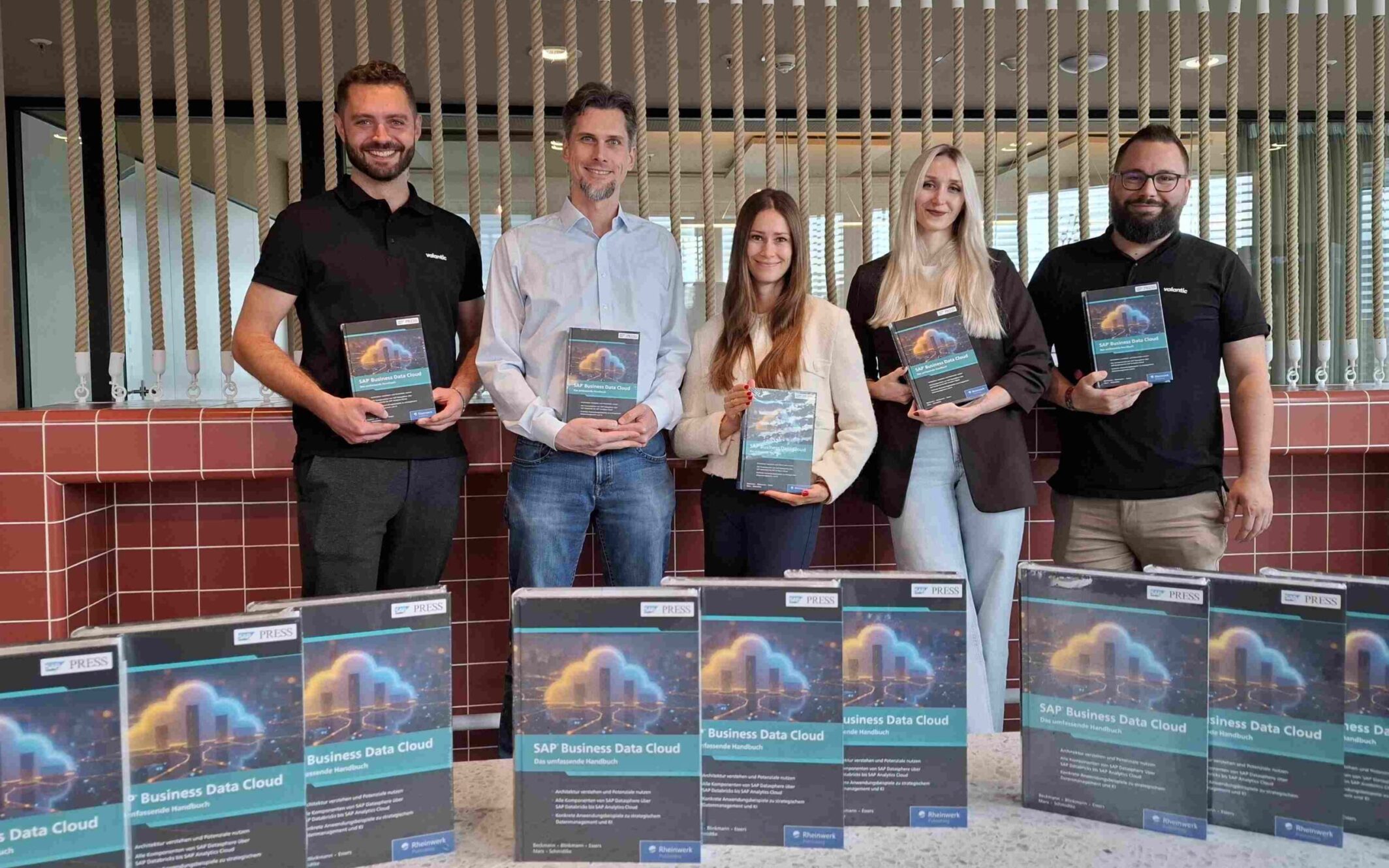
Five SAP Analytics consultants from valantic co-authored the book “SAP Business Data Cloud – The Comprehensive Handbook,” recently published by SAP Press (Rheinwerk Verlag): Marcel Beckmann, Head of SAP BDC; Stefan Blinkmann, Head of SAP Analytics; Manuel Essers, SAP Analytics Manager & CoE Lead of SAP Planning & Analytics; Victoria-Sophie Marx, SAP Analytics Consultant; and Jessica Schmidtke, SAP Analytics Consultant.
In this interview, the team of authors explains why SAP BDC is transforming the world of analytics right now, what inspired them to write the book, and how readers can specifically benefit from it.
Stefan, you’ve been involved in SAP Analytics projects for many years. What was the deciding factor for you in deciding to write a book?
Stefan Blinkmann: IT managers like to say,“We don’t need the data in IT; we’re only responsible for the IT landscape.” But from our perspective, data, data quality, and data culture form a team that can only lead to success when working together. We’ve encountered this very issue of responsibility time and again in our projects, long before SAP BDC existed. This book is our attempt to share that experience in a structured way.
Marcel, you helped get this book off the ground. What motivated you to write a 600-page book about SAP BDC?
Marcel Beckmann: I realized that it takes more than just better technology. It requires a cultural shift. The SAP Business Data Cloud is the technical foundation for this book. But this transformation will only work if architects, consultants, and companies understand that they can’t simply apply their old ways of thinking to new cloud tools. They need to question their basic assumptions about data architecture. That sounds provocative, maybe even heretical. But that’s exactly the point: without this shift, BDC remains just another platform among many.
Let’s turn to the key question we’re currently encountering in nearly every client meeting at valantic: Why is SAP BDC the key enabler for Business AI right now?
Victoria-Sophie Marx: Because Business AI requires three things that BDC addresses first and foremost: high data quality, a clearly defined business context, and robust data governance processes. Without this foundation, every AI project remains a pilot. We see this time and again in projects: Poor data quality is rarely a technical problem. It’s a matter of processes and accountability. That’s exactly where BDC comes in.
Marcel Beckmann: And with the concept of data products, BDC provides something that was previously missing: it links the technical provision of data to a clear business context. A data product is not just a table, but an object with context, accountability, and quality standards. This is the foundation upon which Business AI can operate consistently at all. Without a robust data foundation and shared semantics, no Business AI scenario can function sustainably, no matter how good the language model behind it is.


A solid data foundation: A prerequisite for agent-based systems
Discover how SAP BDC drives your company toward the Autonomous Enterprise.
Marcel, you have a lot of experience with migrations from existing SAP BW environments. What do companies struggle with the most in that area?
Marcel Beckmann: The question of when a migration is even worth it. Many companies have invested in SAP BW 7.5, BW/4HANA, or Embedded BW over the years, and the systems are up and running. The real challenge is the architectural decision: on-premises, cloud, or hybrid—and which approach to take: lift, shift, or innovate. In the book, we provide specific decision-making criteria rather than a blanket recommendation, because the right answer depends on the specific system landscape.
Manuel, you’re featured prominently in the book when it comes to topics related to SAP Analytics Cloud. What does SAP BDC mean for day-to-day reporting and planning?
Manuel Essers: Instead of complex interfaces, Excel merges, or isolated data silos, operational data is consolidated, harmonized, and semantically enriched in SAP BDC. Reporting in SAP Analytics Cloud is thus based on integrated, consistent, and up-to-date data. Planning also draws on a current and complete data foundation that enables forecasting at any time. This makes scenarios and simulations more realistic—and the data foundation enables extensions through ML and AI use cases.
Jessica, one chapter is dedicated to AI-driven master data harmonization. Why is this particularly relevant in the context of BDC?
Jessica Schmidtke: Because master data is the silent foundation of every business AI initiative. No matter how well a model is trained, if customer or material master data is maintained differently across three systems, it will lead to incorrect conclusions. Today, AI methods help identify duplicates and group and map master data much faster than earlier rule-based approaches. But even that doesn’t replace clear accountability for data maintenance.
Back to the book concept: What makes your approach different from simple product documentation?
Manuel Essers: We translate typical challenges from real, anonymized customer projects into realistic use cases: a mature best-of-breed analytics landscape, Excel-based planning that’s reached its limits, an established SAP BW 7.5 system in need of modernization, or an existing Databricks setup. For each scenario, we present concrete decision-making criteria for migration, architecture, and governance, offering actionable recommendations rather than marketing promises.
Victoria-Sophie Marx: The book is being written during the early market phase of SAP BDC. We therefore also classify announced features and provide an outlook on how the platform is evolving as a data foundation for business AI. This combination of architectural knowledge and hands-on project experience—beyond individual client references—is what five SAP Analytics consultants from valantic have compiled here.
One last question for all of you: What should readers take away from this?
Stefan Blinkmann: That data quality isn’t just an IT task—it’s a shared responsibility. Anyone who internalizes that has already met the most important prerequisite for Business AI.
Marcel Beckmann: And that SAP BDC only works if you factor in the cultural shift. A new platform with old ways of thinking—that just doesn’t work.
Jessica Schmidtke: Ideally, our readers will take away both guidance and concrete solution strategies that will help them implement SAP BDC strategically and effectively within their own companies.
Victoria Marx: Readers should definitely recognize that SAP BDC has everything it takes to holistically connect and manage corporate data and make it usable for AI and analytics.
Manuel Essers: The SAP Business Data Cloud will realize its full potential when companies simultaneously formulate a clear data strategy and establish governance with well-defined roles (e.g., product owners for data products) that regulate and promote close collaboration between IT and business units.
Thank you all five of you for these exciting insights!
Key facts about the book
SAP Business Data Cloud – Das umfassende Handbuch
Marcel Beckmann, Stefan Blinkmann, Manuel Essers, Victoria-Sophie Marx, Jessica Schmidtke (all from valantic)
SAP PRESS / Rheinwerk Verlag, hardcover or as an e-book
ISBN 978-3-367-11371-2

Marcel Beckmann
Head of SAP BDC
valantic

Artificial Intelligence August 4, 2026
Joule Studio 2.0: Shaping the Autonomous Enterprise with SAP AI Agents
In the third part of our blog series on the Autonomous Enterprise, we turn our attention to AI agents. With Joule Studio 2.0 and industry-specific Industry AI, SAP enables the transition from AI assistants to autonomously acting AI agents—including open development with n8n and Vercel, as well as integrated governance in the SAP AI Agent Hub.
Joule Studio 2.0: Shaping the Autonomous Enterprise with SAP AI Agents
Artificial Intelligence July 15, 2026
Homework for the Autonomous Enterprise: Architecture, Data, and Processes
SAP Sapphire has refined the vision of the Autonomous Enterprise—now it’s time to put it into practice. Part 2 of our blog series highlights four key building blocks: transparent architecture and agent governance with LeanIX, the path to the cloud, a solid data foundation in the SAP Business Data Cloud, and processes made visible through process mining.
Homework for the Autonomous Enterprise: Architecture, Data, and Processes
Artificial Intelligence June 9, 2026
SAP Sapphire 2026 – the way into the Autonomous Enterprise
SAP Sapphire 2026 marks the mindshift from assistant to agent: In the Autonomous Enterprise, Joule Assistants orchestrate networked agents that perform routine work independently across SAP and non-SAP systems. They are based on Joule Work and Joule Studio, the SAP Business Data Cloud and the Business AI Platform - provided that the data, cloud setup and culture are in sync.
SAP Sapphire 2026 – the way into the Autonomous EnterpriseDon't miss a thing.
Subscribe to our latest blog articles.