Highlight

Successful together – our valantic Team.
Meet the people who bring passion and accountability to driving success at valantic.
Get to know usOctober 21, 2024

Author: Bernd Frey, Business Development Manager at Orianda Solutions AG – a valantic company
How to assess the risks of your technical assets and adapt an optimal maintenance strategy accordingly.
It pays to take a strategic approach to maintenance. Only then can operators of technical assets be sure that they are using their resources such as budget, team and materials in a way that has the greatest impact. Once you have found the optimal mix of reliability & safety, availability and costs, you will get the most out of your technical assets.
We show which method leads to a solid maintenance strategy and what support SAP can provide.
In order to achieve the best possible result with limited resources, companies need a mix of different maintenance strategies that suit the respective technical assets. The first step is a risk assessment. It is best to look at the assets one by one and assess typical, important risks, such as risks to production or safety risks.
The first consideration is what impact the failure of the asset will have on production. The individual context is decisive here: A welding robot that is used daily and for which there is no replacement on site can bring production to a standstill. On the other hand, a machine tool that is easy to maintain and can be quickly replaced is not a major problem. A rarely used system for special paints can be dispensed with for two weeks, but not the only forklift truck in the high-bay warehouse.
Know-how from the store floor: It is advisable to use the experience of production employees and maintenance technicians in the analysis. In turn, the specific costs of a breakdown can be calculated from a business perspective.
A breakdown, accident, malfunction – all of these can affect the safety of employees, customers and the environment. In the case of an aircraft engine, the consequences of an accident are obvious and everyone would intuitively rely on maximum maintenance and redundant systems. But how much damage is even possible in the event of a machine failure or malfunction?
Here, too, it depends on the assessment of the experts on site: What failure, what consequences are possible according to experience and how likely? Are the valves inside the system designed with redundancy or could dangerous gases or liquids escape as soon as material fatigue occurs?
The individually assessed risks 1 and 2 must now be translated into figures in order to make the risks calculable and comparable. To this end, factors for the level of damage in production (the financial risk) and their probability of occurrence are defined for technical assets. The same applies to the potential level of damage in terms of safety.
A scale from 0 to 10 has proven to be useful here. A manual assessment with scoring could then look like this:
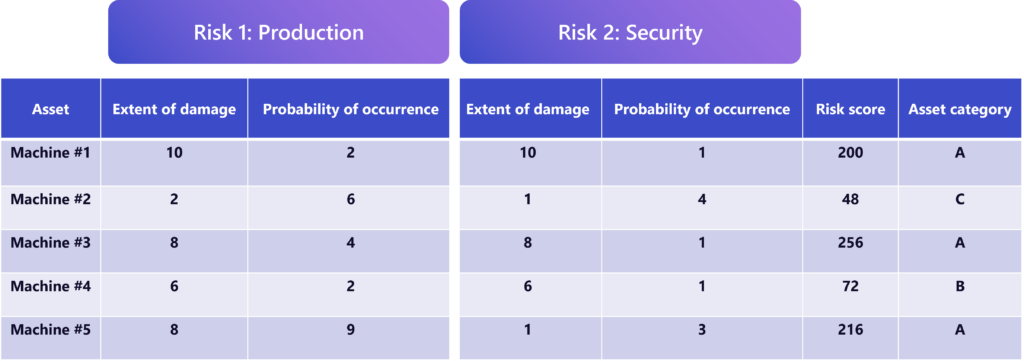
These steps can be used to identify all technical assets whose failure would have particularly critical consequences. In our example, machines #1, #3 and #5 were given the highest score, which qualifies them as A assets and therefore becomes the focus of reliability engineering.
A risk assessment as described in Level 1 already brings you closer to a justifiable and suitable maintenance strategy. This is because the maintenance mode, for example, essentially depends on the asset category: Is a predictive parts replacement worthwhile or is a corrective repair sufficient? The same applies to spare parts management and the stocking of critical components.
For critical technical assets in category A, it is advisable to carry out further assessments. Well-known methods include FMEA (Failure Mode and Effects Analysis) and RCM (Reliability Centered Maintenance). These help to identify potential errors/failures and their causes. Experts from business and technology work together to do this. The effort is usually worthwhile for critical technical assets. FMEA is used in aviation, for example, and for other high-value, cost-intensive assets such as railroads and mining.
Once the possible damage patterns have been recorded, their effects and causes are analyzed in order to assess them and prevent them in the future. Possible countermeasures include improving or better protecting components and increasing maintenance cycles. RCM is similar to this approach, but focuses on what needs to be done to ensure that a technical asset continues to fulfill its function in an operating environment. The method also provides a predefined decision tree to help define the appropriate maintenance strategies.
Ultimately, the assessments are used to define which maintenance strategies are to be used at which level (asset / systems / components) in order to allocate the available maintenance budget to the technical assets in a targeted manner.
The connection of digital components and IoT sensors makes the current status of technical assets transparent (condition monitoring) and enables valid forecasts to detect potential failures before they occur. This is quite complex, as companies not only invest in hardware and software, but will also train AI models to react in good time to certain vibration frequencies that indicate the failure of a component, for example.
This maintenance strategy is particularly suitable for Category A technical assets, such as in the pharmaceutical industry, where no fan in the cold room should fail unnoticed and it therefore pays to monitor anomalies in the sensor data, for example. The sensors required for this are used for condition monitoring and condition-based maintenance. On the other hand, the continuously recorded data also forms the basis for new predictive and AI-based maintenance models.
Recurring measures in maintenance cycles are typically suitable for category B and C technical assets. They are often also relevant for certain systems / components of category A assets. In most cases, the cycles are time and/or performance-based according to manufacturer specifications, for example after every 500 operating hours, after 200 units produced, at the end of the work shift, etc. Adjustments are usually made according to the experience of the production staff.
Corrective (also known as event or condition-based) maintenance is carried out by technicians as soon as a malfunction occurs. This can affect all categories of technical assets. However, as an exclusive mode, corrective maintenance is only suitable for low-classified category C assets whose failure causes little or no costs and damage.
You do not have to rely on Excel spreadsheets to assess, define and implement your maintenance strategy. SAP Asset Performance Management (APM) supports you with functions for assessing and documenting your strategy. Templates help you to define criteria, weightings, limit values and scoring for the risk analysis. The FMECA and RCM models support you in the assessment. SAP APM obtains the asset master data directly from your SAP S/4HANA. The scoring can also be reported back there.
Recommendations for improvements can be recorded from the assessments and implemented in SAP S/4HANA. You are now supported here by various integration options. You can link existing routings or create new routings. The same applies to maintenance plans and maintenance items.

With the asset master data, SAP APM extends the functions of your SAP Enterprise Asset Management (EAM). This enables a closed loop for the definition of maintenance strategies, implementation of recommendations and the execution and monitoring of optimal asset maintenance. The data fed back from maintenance shows the asset performance under changing maintenance conditions and over the lifecycle of the asset, so that you continuously approach the best balance of reliability & safety, availability and costs. Is high availability of machine X perhaps possible with less effort? The data will tell you.

Do you need support with your asset performance management with SAP?
Our team of experts is at your disposal! Arrange a free consultation today and find out how we can help you make your asset performance management more efficient.
SAP Services September 17, 2026
The SAP BDC handbook: An interview on Business AI and data culture
Five valantic consultants wrote the SAP Business Data Cloud handbook. In this interview, they explain why SAP BDC is the enabler for business AI and why this book is a must-read.
The SAP BDC handbook: An interview on Business AI and data culture
Artificial Intelligence August 4, 2026
Joule Studio 2.0: Shaping the Autonomous Enterprise with SAP AI Agents
In the third part of our blog series on the Autonomous Enterprise, we turn our attention to AI agents. With Joule Studio 2.0 and industry-specific Industry AI, SAP enables the transition from AI assistants to autonomously acting AI agents—including open development with n8n and Vercel, as well as integrated governance in the SAP AI Agent Hub.
Joule Studio 2.0: Shaping the Autonomous Enterprise with SAP AI Agents

Artificial Intelligence July 15, 2026
Homework for the Autonomous Enterprise: Architecture, Data, and Processes
SAP Sapphire has refined the vision of the Autonomous Enterprise—now it’s time to put it into practice. Part 2 of our blog series highlights four key building blocks: transparent architecture and agent governance with LeanIX, the path to the cloud, a solid data foundation in the SAP Business Data Cloud, and processes made visible through process mining.
Homework for the Autonomous Enterprise: Architecture, Data, and ProcessesDon't miss a thing.
Subscribe to our latest blog articles.