Highlight

Successful together – our valantic Team.
Meet the people who bring passion and accountability to driving success at valantic.
Get to know usNovember 4, 2025

Service portals – often also referred to as user hubs – are rapidly evolving into a cornerstone of digital customer experiences in B2B commerce. By integrating sales, service, and communication into one platform, they enhance both efficiency and customer engagement. In this interview, Maria Kern, Senior Frontend Architect at valantic, discusses how modern service portals differ from traditional online shops and why IoT and AI are driving forces behind this transformation
Maria Kern: An online shop primarily focuses on purchasing and order processing. A service portal, however, goes far beyond that. It functions as a central hub for all customer interactions. In addition to placing orders and accessing documents, customers can manage devices and contracts, create support cases, book maintenance services, or communicate directly with the provider. This creates a seamless and integrated customer experience that extends well beyond traditional shopping.
Both sides benefit equally from user hubs. Customers enjoy 24/7 access to relevant information and services, while companies gain valuable insights into customer behavior and needs. By integrating with CRM and ERP systems, processes can be automated and response times significantly reduced.
Another major advantage is that all stakeholders can work within a single, centralized platform, eliminating the need to switch constantly between shop systems, emails, support tools and CRM platforms. Most importantly, a user hub supports the entire customer lifecycle – from initial contact to after-sales and maintenance – fostering stronger customer loyalty and lowering support costs.
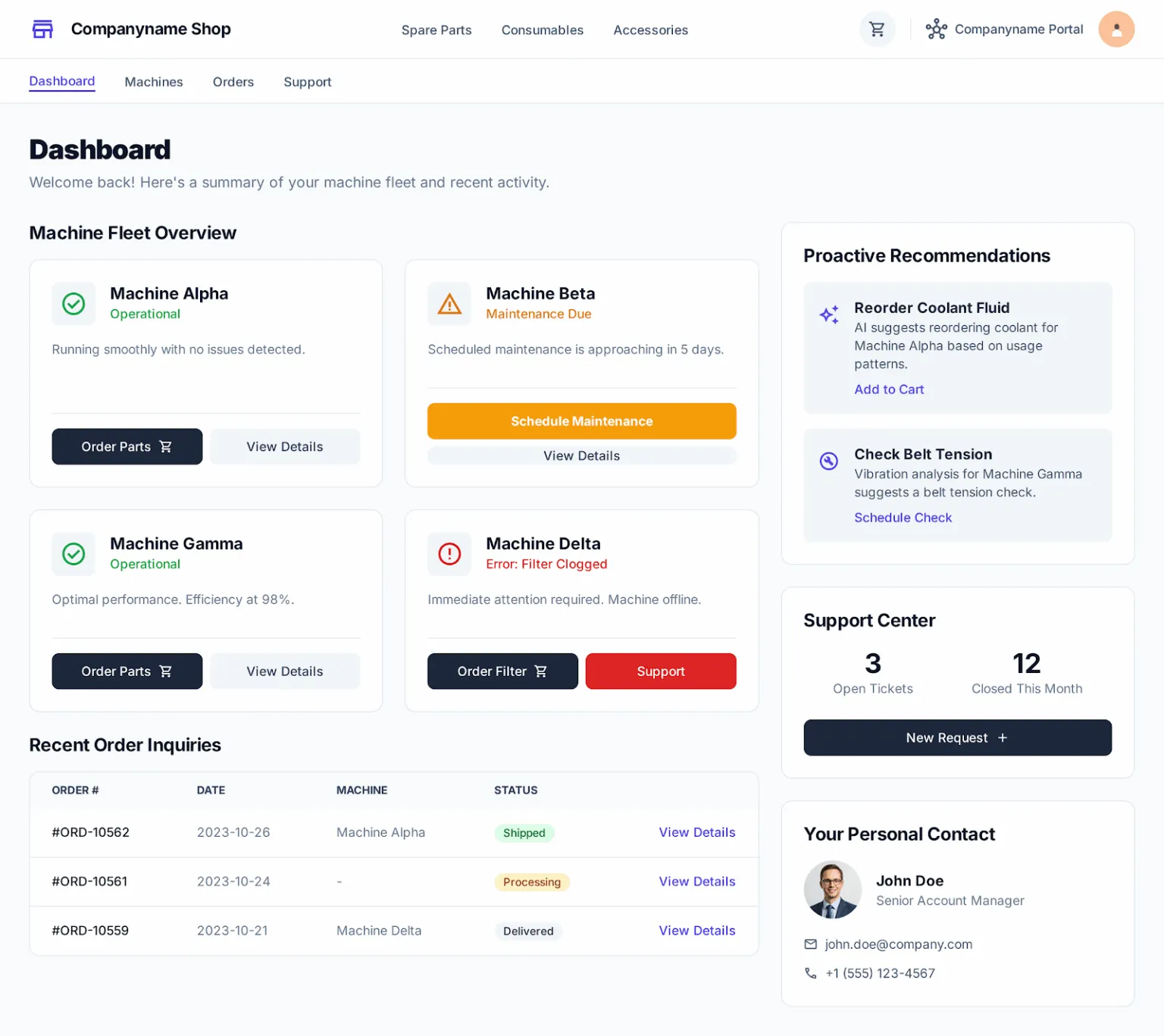
Service portals provide significant advantages in industries with complex, long-lasting products, such as mechanical and plant engineering or medical technology. Through the portal, customers can order spare parts, check maintenance schedules or access documentation without lengthy inquiries. This not only reduces the workload for service teams but also increases customer satisfaction. Software providers also benefit by enabling customers to conveniently renew, customize or manage licenses via the platform. Overall, a user hub improves transparency, strengthens customer retention and unlocks new revenue potential through additional data-driven services.
The Internet of Things (IoT) connects machines and devices directly to service portals, delivering real-time data on their usage and condition. Customers can instantly see when maintenance is due, receive alerts from their machines within the portal or order the right replacement parts – fully digital and automated. Artificial intelligence (AI) takes this a step further: It analyzes usage patterns, identifies patterns and recommends suitable solutions.
AI-powered chatbots – equipped with customer history and detailed product knowledge – can handle support requests or route them intelligently. In this way, the user hub becomes a learning platform that anticipates customer needs before they are even voiced. Service portals are thus evolving from reactive tools into proactive partners throughout the entire customer journey.
A stable, scalable platform is key. Solutions like Adobe Commerce provide robust B2B capabilities and can be seamlessly integrated into existing IT environments. This allows for the mapping of customer-specific pricing structures, user roles and product catalogs, as well as smooth connections to CRM and ERP systems. Data protection and security are of central importance, particularly when IoT data or AI functionalities are involved. It must be ensured that all sensitive information is processed in a secure and private environment.
Moreover, the system architecture should be flexible and future-proof, enabling the easy integration of AI or new service features as business needs evolve.
Success largely depends on seamless integration and well-defined processes. Data must be consistent, systems must be compatible, and roles and responsibilities need to be clearly established. Companies should begin with a focused scope – implementing key functionalities first – and then gradually expand the portal. This iterative approach reduces complexity, minimizes risks and enables continuous improvement based on user feedback. This way, the user hub evolves organically in line with business needs and customer expectations.
Service portals are evolving into the central hub for all customer interactions. In combination with IoT and AI, they are becoming intelligent platforms that act proactively, automating maintenance cycles, anticipating needs and delivering personalized recommendations. Companies that invest today are building the foundation for long-term customer loyalty and innovative, data-driven business models. The transition from traditional online shops to intelligent user hubs represents the next stage of digital evolution – one that drives true customer centricity and measurable operational efficiency.
Thank you for the interview, Maria!
Connect with our Digital Experience Architects to learn how IoT and AI can drive predictive services, smarter workflows, and stronger customer relationships in your B2B portal.
Don't miss a thing.
Subscribe to our latest blog articles.