Highlight

Successful together – our valantic Team.
Meet the people who bring passion and accountability to driving success at valantic.
Get to know usDecember 2, 2025

Do you know how visible your brand is in Large Language Models (LLMs) such as Google AI Overviews, ChatGPT, and Perplexity, and how it’s being represented there? With the LLM Tracker Dashboard, valantic offers a lean tool that helps companies measure their AI visibility and brand performance, and improve them in a targeted way. Read on to find out why we built this LLM tool, how it works, and who should definitely give it a try.
Advanced language and search models are now everywhere, making it increasingly important for companies to understand how visible their brand, products, and content are online. One thing is clear: existing SEO and keyword optimization tools are no longer enough to meet today’s requirements. Several SaaS solutions have since entered the market. The reason we didn’t simply want to use one of them comes down to their typical limits and constraints:
For us, it made sense to develop our own LLM tool—one that is scalable, efficient, and data-driven. This not only means lower costs and complete control over data (thanks to storage in BigQuery), but also a solution that can be tailored to our customers’ specific needs.
The LLM Tracker Dashboard provides a clear overview of how often your brand is mentioned in LLMs such as ChatGPT, Google AI Overviews, and other AI models. While traditional SEO tools focus primarily on search results, the LLM Tracker shows where and how often your brand appears in AI-generated responses.
Specifically, with the LLM tracking tool, you can:
In short: The tracking dashboard not only provides a score but also uses individual analyses to help you draw conclusions about how your brand stacks up against the competition, how you can improve your digital visibility, and how you can strengthen your brand presence.

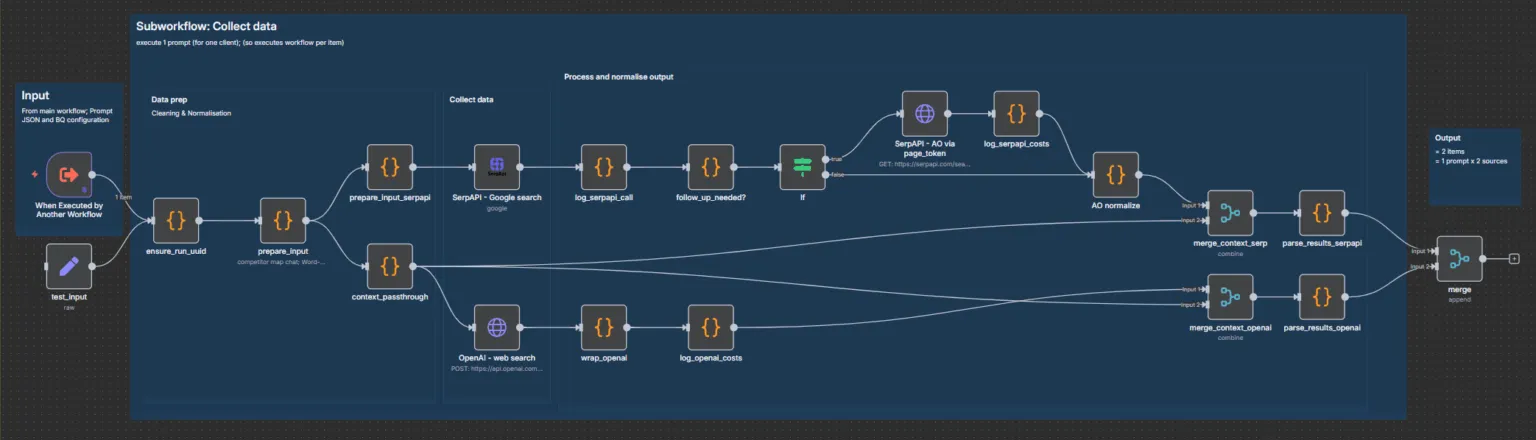
The system was set upon our server as a pilot version using N8N and enables parallel processes for data collection from AI Overview and ChatGPT (scraping versus a direct LLM API connection). Normalization, transformation, evaluation, and other necessary steps are performed via JavaScript code nodes. You use a table to specify which competitors and prompts should beincluded . The results are then writtento BigQuery to ensure full ownership and control.
LLM tracking step by step:



The LLM Tracker Dashboard was built for brands and retailers who want to measure, compare, and improve their visibility in AI-driven search models. We recommend the tool for companies with annual revenue of at least €50 million, since we know these organizations get the most value from the insights it provides. Given their size and often extensive product catalogs, the LLM Tracker can help these companies not only better understand their current situation, but also take targeted action to improve their online visibility and competitive position.
How about trying our tool for free and finding out how your brand comes across in AI models? We’re currently looking for retailers and brands to help us thoroughly test the LLM Tracker Dashboard. Curious?
Just drop us a message and we’ll figure out when to get started:

Customer Experience July 10, 2025
Navigating the SEO AI Jungle – How companies gain visibility for ChatGPT & Co.
AI-based search systems such as ChatGPT and Google SGE are changing how content is found and read. What does this mean for your SEO strategy? Our article shows you how classic SEO measures can be specifically supplemented in order to optimally prepare content for generative AI. Find out what is behind terms such as LLMO and GEO and stay visible in the digital transformation.
Navigating the SEO AI Jungle – How companies gain visibility for ChatGPT & Co.
Digital Marketing July 7, 2026
Digital visibility is created through connected systems
AI is fundamentally changing digital visibility: Customer journeys are becoming more dynamic, platforms more complex, and structured information more important. Learn why companies need to connect content, data, and systems more closely to stay relevant.
Digital visibility is created through connected systems
Artificial Intelligence October 16, 2025
Adobe LLM Optimizer: Optimize your content for better AI visibility
Adobe LLM Optimizer helps companies make their content ready for generative AI and boost its visibility in AI responses. It analyzes agentic traffic, delivers optimization insights, and integrates seamlessly with existing content platforms.
Adobe LLM Optimizer: Optimize your content for better AI visibilityDon't miss a thing.
Subscribe to our latest blog articles.