Highlight

Successful together – our valantic Team.
Meet the people who bring passion and accountability to driving success at valantic.
Get to know usOctober 15, 2024

The “customers” from any industry are human beings that have adapted to the evolution of digital channels, and with that to a variety of new channels that have been added to the existing ones or sometimes replacing them. These human beings are all different with their own history, age, culture, context and environment.
Pharma and Life Sciences industries are no different to other industries when it comes to interacting with their audience, humans with their differences and preferences. The need for added-value interactions with Health Care Professionals, patients, patient associations and caregivers is a given that calls for personalized and customized approaches. The good news is that with the range of online and offline channels and their specific advantages are giving companies many options to play with.
The question is, how can a Pharma company move from a historically strong sales driven face-to-face push communication model, into a customer-centric, data-driven, real-time personalized omnichannel interactive model? It is like trying to change the direction of a container carrier quickly and make it as agile as a speed boat.
Transformation needs time, 5 to 7 years, and it needs alignment of all elements, People, Processes, Technologies and Data, to create outstanding personalized experiences that adapt to the needs of the human beings that the companies interact with. The change is first internal, the technological choices and connections, aligned with Data flows go first before the matching new processes and onboarding, followed by training and adoption of the people.
It is crucial for companies to adopt integrated technological solutions and Data flows. Envision a system where all teams within the company have access to unified, real-time customer data. The second step is the design of internal processes that facilitate the use of the technologies for all internal profiles in contact with the customers. Omnichannel is also internal, it is tightly linked to change management in making the new technologies and processes used by all teams in an agile way.
The cornerstone of achieving true customer centricity lies in the utilization of comprehensive, up-to-date data to inform all interactions. A 360-degree view of the customer ensures that every team member has access to the same information, enabling them to pick up where others left off without missing a beat. This approach not only improves customer relations but also internal efficiencies.
An effective omnichannel strategy in pharma and life sciences does not stop at merely gathering data—it’s about leveraging this data to enhance engagement across all platforms. Whether it’s the integration of analytics to predict and meet healthcare professional needs before they arise or the use of AI to personalize interactions based on past behaviors, the goal is to make every touchpoint count.
The benefits of this approach are numerous—from increased engagement and satisfaction among healthcare professionals to improved patient outcomes. Furthermore, by ensuring that all customer interactions are informed by a single, comprehensive view of the customer, pharma companies can present themselves as a single, cohesive entity, significantly enhancing trust and reliability in the eyes of their clients

Transforming Pharma, Healthcare & Life Sciences with Customer Excellence
More information about our pharma & life sciences offering


Artificial Intelligence October 16, 2026
Autonomous Enterprise Journey: How AI value engineering creates measurable business value
How can the ROI of AI initiatives be reliably assessed and measured? How can companies identify the biggest levers and key processes for AI? Katrin Luft, Senior Expert at valantic and co-developer of the “Autonomous Enterprise Journey,” provides answers and recommendations in a conversation with Darya Basarhina, Vice President of Sales & Marketing and Manufacturing Practice Lead at valantic.
Autonomous Enterprise Journey: How AI value engineering creates measurable business value
Customer Experience October 8, 2026
Interview: From PIM to Data Spine – How companies prepare their data for AI
AI is changing the requirements for data, governance, and processes. Where should companies start, and what skills do they need? In this interview, Dietmar Rietsch, CEO of Pimcore, and Timo Huguet of valantic discuss the importance of clean data, the concept of the “Data Spine,” and the changing role of humans in the age of agentic AI.
Interview: From PIM to Data Spine – How companies prepare their data for AI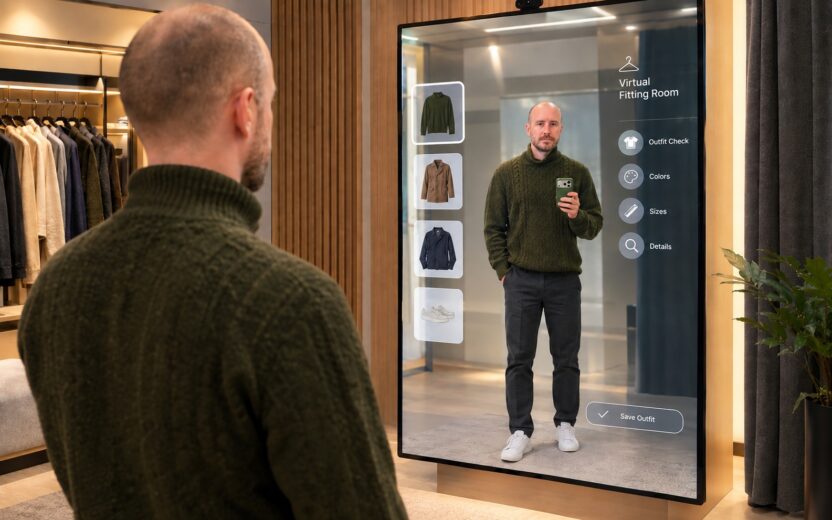
Customer Experience September 18, 2026
From webshop to virtual try-on: how AI is making its way into retail stores
Digital interfaces such as smart mirrors turn AI in the store into a tangible business case. What potential does this hold for the customer experience and in-store personalization? Matthias Vollmer explains how the retail industry can combine the best of both worlds and turn physical touchpoints into an intelligent part of the omnichannel journey.
From webshop to virtual try-on: how AI is making its way into retail storesDon't miss a thing.
Subscribe to our latest blog articles.