Highlight

Successful together – our valantic Team.
Meet the people who bring passion and accountability to driving success at valantic.
Get to know usMay 28, 2026

At the DSAG Technology Days 2026 in Hamburg, innovation was not just discussed but actively developed: Together with valantic, the German-Speaking SAP User Group (DSAG) organized a hackathon where seven teams of students and young professionals presented their ideas for AI agents.
The challenge: Using the proven valantic Agent Framework, participants were tasked with developing multimodal AI agents that combine speech and text and can be directly integrated into SAP related processes. The focus was clearly on one goal: creating real business value—not just technological gimmicks.
The teams had three days to develop their use cases, during which they received support from both the valantic expert team and DSAG. This was followed by a dynamic presentation of the results: three minutes for the pitch, three minutes for critical questions from the jury, one minute for evaluation, and three minutes for the final scoring. Evaluation was based on key criteria such as clarity, degree of innovation, and feasibility. The result was concise presentations by students and young professionals that consistently focused on the benefits of the solutions. The range of the ai agents impressively demonstrated how versatile AI agents can be today—especially when integrated with existing business processes.
The team behind ConnectaAI addressed a classic challenge in IT service: the efficient processing of incoming tickets. The solution automates the entire process—from ticket receipt through intelligent assignment to AI-powered responses. Skills, availability, and context are taken into account to assign tickets in a targeted manner. The added value is clear: faster processing, fewer misassignments, and a noticeably higher quality of service.
Another team addressed the very area where many processes remain inefficient today: the gap between meetings and implementation. Ticket AI automatically converts unstructured meeting notes or transcripts into structured ticket proposals. Titles, descriptions, responsibilities, and deadlines are generated directly—but remain verifiable before final creation. This solves a frequently underestimated problem: information loss and manual rework. At the same time, the transition to operational systems like Asana is significantly accelerated.
A particularly practical approach came from the logistics and production sector. The team developed a solution for the automated processing of delivery notes in goods receiving. Instead of manual entry and reconciliation, an AI agent handles the processing, identifies items and quantities, and integrates the data directly into existing systems. The results are measurable: several hours of time saved per day, reduced error rates, and a clearly quantifiable economic benefit.
Process Pilots focused on a frequently underestimated bottleneck in sales: unstructured order entries received via email. Their ai agent creates an “intelligent bridge” between free-text data and the ERP system. AI extracts relevant information, structures it, and transfers it directly into the process. The result: less manual work, higher data quality, and better scalability in sales.
The other teams also presented exciting approaches—ranging from AI governance solutions and process optimization to SAP-integrated assistance systems. Together, it became clear: The focus is increasingly shifting from isolated tools to integrated, process-oriented ai agents.
First place went to Team Tjaro with a solution for supply chain management. At its core is the ability to identify risks early on and respond to them. The solution combines predictive risk analysis, autonomous decision support, and a human-in-the-loop approach to safeguard the process flow. Especially against the backdrop of increasingly volatile supply chains, the team struck a chord—and impressed the jury both in terms of content and concept.
The DSAG Hackathon 2026 has impressively demonstrated the direction we are heading: AI agents are no longer isolated applications, but are evolving into integral components of end-to-end processes. The ai agents presented illustrate that the greatest value is created where AI is directly embedded into existing system landscapes—with a clear focus on efficiency, quality, and scalability.
For valantic, as a partner of the hackathon, one thing is clear: The combination of technological expertise and practical use cases will be crucial to successfully guiding companies into the next phase of digital transformation.


Discover SAP Business AI with valantic
Find out more about our expertise in SAP Business AI!

Customer Experience September 18, 2026
From webshop to virtual try-on: how AI is making its way into retail stores
Digital interfaces such as smart mirrors turn AI in the store into a tangible business case. What potential does this hold for the customer experience and in-store personalization? Matthias Vollmer explains how the retail industry can combine the best of both worlds and turn physical touchpoints into an intelligent part of the omnichannel journey.
From webshop to virtual try-on: how AI is making its way into retail stores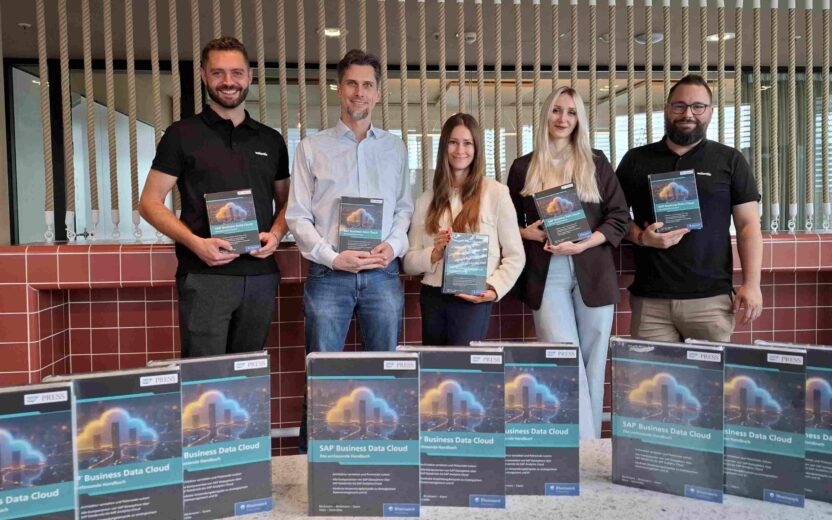
SAP Services September 17, 2026
The SAP BDC handbook: An interview on Business AI and data culture
Five valantic consultants wrote the SAP Business Data Cloud handbook. In this interview, they explain why SAP BDC is the enabler for business AI and why this book is a must-read.
The SAP BDC handbook: An interview on Business AI and data culture
Customer Experience August 27, 2026
Interview: How manufacturing stays digitally visible and AI-relevant
In the manufacturing sector, purchasing decisions are increasingly being made before the sales team is even involved. Designers, planners, maintenance technicians, and buyers conduct online research—and are increasingly receiving AI-generated responses. How can marketing teams at manufacturing companies ensure digital visibility and AI relevance? Answers and recommendations from the Manufacturing Practice.
Interview: How manufacturing stays digitally visible and AI-relevantDon't miss a thing.
Subscribe to our latest blog articles.