Highlight

Successful together – our valantic Team.
Meet the people who bring passion and accountability to driving success at valantic.
Get to know usOctober 28, 2026


Most AI model lineups look the same: a flagship at the top, a solid mid-tier option, and something small and fast at the bottom, roughly 10x apart in price. Almost every team defaults to the flagship and stays there.
The habit is understandable. The flagship is the one in the announcement, and it’s the safe pick, since nobody gets criticized for choosing the strongest model available. So high-volume, low-ambiguity work like classification, tagging, extraction, and routing ends up running through the most expensive reasoning system on the market. That’s the procurement equivalent of using a sledgehammer to crack a nut. It works, but it’s absurd overkill for the job.
A better question is: what’s the smallest, cheapest model that reliably clears this bar? The answer changes for every workload, so it has to be an architecture decision instead of a one-time pick. Route most requests to small, fast models, run a confidence check, and escalate only the uncertain cases to the expensive model, where its extra capability is worth paying for.
In our projects, AI cost optimization through routing has cut costs in half with no measurable drop in quality. Context discipline has a similar effect. When an orchestrator hands each agent only the context its step needs, instead of reprocessing an entire conversation history in one long chat, token use drops by more than half and reliability goes up. Batch processing comes with a flat 50 percent discount that most organizations never bother to claim.
The same logic applies before you reach for a language model at all. A stable, well-labeled classification problem is usually a job for traditional machine learning, which delivers the same outcome at a fraction of the per-call cost. A scanned invoice is a document AI problem, and a defect on a production line is a computer vision problem. None of that needs a frontier model reasoning about it from scratch.
Before any new use case, it’s worth running through a short sequence of questions. Is this a software problem? A rules or arithmetic problem? A classical ML problem? Does it need a specialized model, or does it really need generative AI, and if so, what’s the smallest model that clears the bar? Most projects skip straight to “which chatbot” and never ask the earlier questions.
Using a frontier model to solve a deterministic problem is architectural laziness with a monthly invoice attached. The interesting design work, and where a good implementation partner earns their keep, is knowing when a much smaller model, or no model at all, gets the job done just as well for a lot less.

Artificial Intelligence October 21, 2026
Your AI Bill Isn’t About the Price Per Token
AI inference prices have fallen by around 90%, yet most companies aren’t seeing lower bills. The reason: costs depend on more than token prices. Usage volume, model choice, context size, and repeated agentic workflows all drive spending. To control AI costs, organizations need to understand not just how much they spend, but what drives that spend in the first place.
Your AI Bill Isn’t About the Price Per Token
Customer Experience September 18, 2026
From webshop to virtual try-on: how AI is making its way into retail stores
Digital interfaces such as smart mirrors turn AI in the store into a tangible business case. What potential does this hold for the customer experience and in-store personalization? Matthias Vollmer explains how the retail industry can combine the best of both worlds and turn physical touchpoints into an intelligent part of the omnichannel journey.
From webshop to virtual try-on: how AI is making its way into retail stores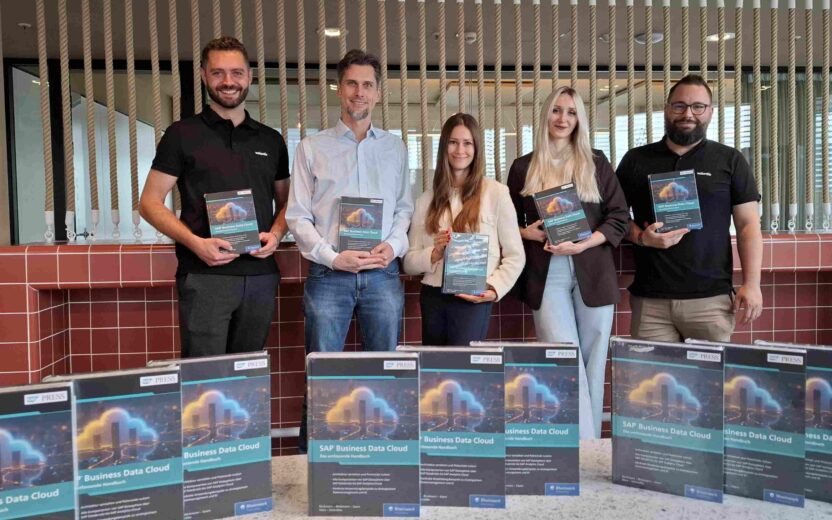
SAP Services September 17, 2026
The SAP BDC handbook: An interview on Business AI and data culture
Five valantic consultants wrote the SAP Business Data Cloud handbook. In this interview, they explain why SAP BDC is the enabler for business AI and why this book is a must-read.
The SAP BDC handbook: An interview on Business AI and data cultureDon't miss a thing.
Subscribe to our latest blog articles.