Highlight

Successful together – our valantic Team.
Meet the people who bring passion and accountability to driving success at valantic.
Get to know usJuly 9, 2026

According to McKinsey, customer-oriented companies achieve twice as much sales growth as their competitors. However, only a good 15 percent of all companies systematically incorporate customer knowledge into their decisions. Those who invest in customer centricity with foresight can exploit differentiation potential and strategic competitive advantages.
However, companies in the manufacturing sector face a double challenge: on the one hand, their customers’ expectations in terms of speed, transparency and digital services are increasing. On the other hand, internal processes and systems are often not designed to meet these expectations.
This is where many manufacturing companies fail:
If you want to meet rising customer expectations, you have to overcome these hurdles and consider customer centricity from the outset.
When we talk about customer centricity, it’s not just about a better user experience. It’s about really understanding customer needs and translating them into strategies, processes and technologies. Customer centricity must be visible at every step of the value chain.
What customer centricity means in concrete terms for manufacturing companies can be defined by three principles:
Our practical tips show how these principles can be put into practice and how customer centricity can be sustainably anchored in the company:
Introduce voice-of-customer (VoC) programs, e.g. structured interviews, NPS surveys and systematic evaluation of service and complaint data. The combination of customer segmentation with detailed journey mapping makes it possible to identify key interactions and optimize pricing and services in a targeted manner.
Integrate sales, service and production into the analysis of all touchpoints – from inquiry to aftersales. Cross-departmental collaboration is crucial for the success of journey management initiatives.
Integrate CRM, ERP and product data into a central platform to create the basis for personalization in B2B sales and in the customer portal. A live connection to ERP systems improves data quality and creates transparency – both internally and externally.
Enable personalized offers, e.g. through individual product configuration, customer-specific price models, project folders and proactive service and product recommendations based on usage data.
Link webshop, field service, B2B customer portal and support to create a “human-plus-digital model”: digital touchpoints can take over routine interactions, while human touchpoints focus on specific advice and problem solving.
Define customer-centric KPIs (e.g. customer effort score, time-to-resolution) at management level and link these to remuneration models and team targets.
Divide the transformation strategy into digital use cases – with an ambitious vision but pragmatic implementation. Start with a clearly defined area (e.g. aftersales or a product segment), measure the impact and scale what works.
One example of successful customer centricity in the manufacturing industry and the return on investment (ROI) of customer-centric initiatives is the project at Elementar Analysensysteme GmbH. The leading provider of high-quality analytical devices faced similar challenges to many other companies in its sector:
The solution: Together with valantic, Elementar developed an internationally focused B2B portal that consistently focused on the needs of its customers.
In order to understand users’ expectations in detail and depth, Elementar and valantic carried out targeted customer surveys as a first step. The feedback formed the basis for the strategic direction and development of the B2B portal and helped to concretize core requirements for the new service platform. This allowed central criteria to be prioritized, including
During implementation, the B2B portal was tailored precisely to the customer’s needs and optimized for their requirements:
Thanks to its consistent customer focus, Elementar has recorded measurable successes from the project:
”Digitalization is only sustainable if it takes customer needs seriously. We didn't want to create an isolated solution, but a B2B portal that connects processes, systems and customer requirements. That's exactly what valantic achieved for us.“
The success of digital transformation projects in the manufacturing industry is not just a question of technology. It requires a holistic strategic rethink – away from siloed solutions and towards data-driven approaches that consistently focus on the customer. Companies that align their strategy, processes and technologies with the customer with foresight will not only create a better user experience, but will also measure quantifiable effects in terms of efficiency, scalability and growth.

How customer-centric is your company?
With our CX services, we help organizations in the manufacturing industry to better understand their customers and create personalized B2B experiences. Find out how customer centricity can give you a competitive advantage.

Gülay Güvemli
Senior Product Owner
valantic
With almost ten years of professional experience in project management, Gülay advises and supports companies in the implementation of complex digital transformation projects. As a Product Owner at valantic, she not only knows the challenges and success factors of customer-centric initiatives, but also their impact on profitable B2B relationships.


Artificial Intelligence October 16, 2026
Autonomous Enterprise Journey: How AI value engineering creates measurable business value
How can the ROI of AI initiatives be reliably assessed and measured? How can companies identify the biggest levers and key processes for AI? Katrin Luft, Senior Expert at valantic and co-developer of the “Autonomous Enterprise Journey,” provides answers and recommendations in a conversation with Darya Basarhina, Vice President of Sales & Marketing and Manufacturing Practice Lead at valantic.
Autonomous Enterprise Journey: How AI value engineering creates measurable business value
Customer Experience October 8, 2026
Interview: From PIM to Data Spine – How companies prepare their data for AI
AI is changing the requirements for data, governance, and processes. Where should companies start, and what skills do they need? In this interview, Dietmar Rietsch, CEO of Pimcore, and Timo Huguet of valantic discuss the importance of clean data, the concept of the “Data Spine,” and the changing role of humans in the age of agentic AI.
Interview: From PIM to Data Spine – How companies prepare their data for AI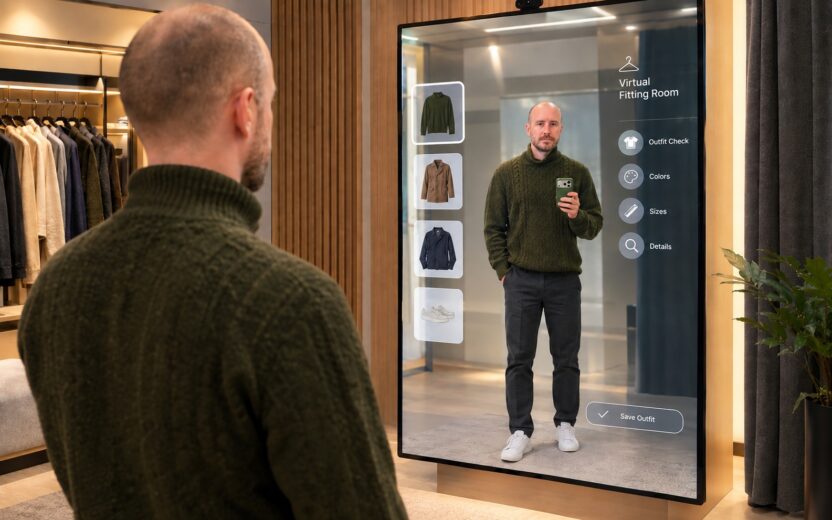
Customer Experience September 18, 2026
From webshop to virtual try-on: how AI is making its way into retail stores
Digital interfaces such as smart mirrors turn AI in the store into a tangible business case. What potential does this hold for the customer experience and in-store personalization? Matthias Vollmer explains how the retail industry can combine the best of both worlds and turn physical touchpoints into an intelligent part of the omnichannel journey.
From webshop to virtual try-on: how AI is making its way into retail storesDon't miss a thing.
Subscribe to our latest blog articles.