Highlight

Successful together – our valantic Team.
Meet the people who bring passion and accountability to driving success at valantic.
Get to know usSeptember 16, 2025

Anyone working closely with customer data today knows: it’s no longer just about collecting – it’s about understanding. Customer Relationship Management (CRM) has evolved significantly. From a simple address and purchase history database, it has become an intelligent, adaptive system – one that listens, analyzes, and improves its understanding of customers with every interaction.
Our world is constantly changing – and so is consumer behavior. People no longer expect generic newsletters or interchangeable product recommendations. They want offers that fit their style, their needs, and their timing. Learning CRM doesn’t just record what someone bought – it tracks how they react to content, which touchpoints they use, and what questions they ask. From this, a dynamic customer profile emerges, enabling personalized experiences in real time.
Customer feedback is especially valuable as it represents a key form of zero-party data – information that customers voluntarily and proactively share, such as ratings, survey responses, or direct service feedback. Unlike third-party data, this information is given willingly, is immediate, and highly relevant.
Businesses that tap into this feedback gain deeper insights into customer behavior, expectations, motivations, and preferences. In doing so, feedback becomes a strategic resource that enables stronger, more meaningful customer relationships.
Direct-to-consumer (D2C) brands – particularly in fashion – have vast potential here. If a brand knows a customer values sustainable materials, tends to order on weekends, and interacts frequently via Instagram, it can tailor its outreach accordingly. This isn’t magic – it’s the logic of learning systems. But it only works when feedback is treated not as a one-way street, but as an invitation to meaningful dialogue.
For this approach to work, technology alone isn’t enough. A learning CRM isn’t a plug-and-play solution. It requires an interplay of systems, processes, and mindset. It must be deeply anchored across the organization – from marketing and sales to customer service. Only when everyone is willing to listen, learn from data, and act quickly can CRM realize its full potential.
CRM in the age of learning isn’t just a fancy add-on – it’s a gamechanger. It brings companies closer to their customers, and customers closer to what they really want. For fashion brands, this means: less one-size-fits-all, more true customization. That’s where the future of customer relationships lies.

Customer engagement is our strength
We connect teams, data, technology, and CRM to create meaningful customer experiences.


Artificial Intelligence October 16, 2026
Autonomous Enterprise Journey: How AI value engineering creates measurable business value
How can the ROI of AI initiatives be reliably assessed and measured? How can companies identify the biggest levers and key processes for AI? Katrin Luft, Senior Expert at valantic and co-developer of the “Autonomous Enterprise Journey,” provides answers and recommendations in a conversation with Darya Basarhina, Vice President of Sales & Marketing and Manufacturing Practice Lead at valantic.
Autonomous Enterprise Journey: How AI value engineering creates measurable business value
Customer Experience October 8, 2026
Interview: From PIM to Data Spine – How companies prepare their data for AI
AI is changing the requirements for data, governance, and processes. Where should companies start, and what skills do they need? In this interview, Dietmar Rietsch, CEO of Pimcore, and Timo Huguet of valantic discuss the importance of clean data, the concept of the “Data Spine,” and the changing role of humans in the age of agentic AI.
Interview: From PIM to Data Spine – How companies prepare their data for AI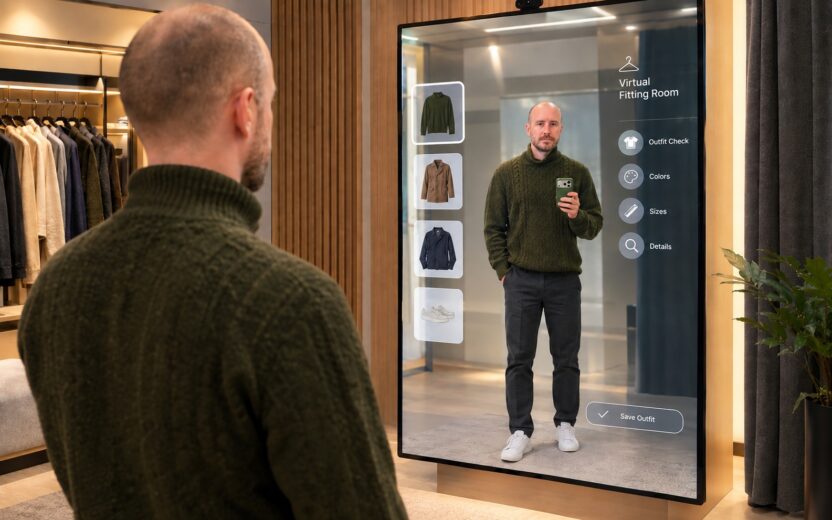
Customer Experience September 18, 2026
From webshop to virtual try-on: how AI is making its way into retail stores
Digital interfaces such as smart mirrors turn AI in the store into a tangible business case. What potential does this hold for the customer experience and in-store personalization? Matthias Vollmer explains how the retail industry can combine the best of both worlds and turn physical touchpoints into an intelligent part of the omnichannel journey.
From webshop to virtual try-on: how AI is making its way into retail storesDon't miss a thing.
Subscribe to our latest blog articles.