Highlight

Successful together – our valantic Team.
Meet the people who bring passion and accountability to driving success at valantic.
Get to know usOctober 3, 2024

Composability promises to be the solution to many challenges in the e-commerce and digital industry. However, anyone aiming for a MACH architecture and wanting to be successful with the concept of composable commerce needs more than a modular tech stack. In our series, experts shed light on the potential and often overlooked hurdles of composable commerce projects from a business, user and technology perspective.
Part 1: From buzzword to business strategy
Part 2: Why composable commerce projects fail
Part 3: Quality assurance for long-term composable commerce success
Part 4: Composable Architecture x AI: Enabler for Optimization & Innovation
In the fifth edition, you will read about how design systems support a composable architecture, create new opportunities for designing unique customer experiences, and promote digital accessibility.
Composable architecture is widely recognized for its benefit, allowing companies to select the optimal components for their IT infrastructure. This flexibility enables digital services to be easily tailored and scaled according to diverse needs.
From a UX design perspective, the concept of Composability describes an equally flexible approach to the design of websites, apps, and online stores. This approach is implemented through what is known as a design system: a framework with clear guidelines and reusable components for design and development processes. The smaller units of a design system can be created, tested, and exchanged independently of each other – quite similar to how a modular tech stack operates with decoupled functions and API-based services.
A well-known example is the Atomic Design Framework, where the user interface (UI) is broken down into five essential building blocks:
How does a design system support a Composable Architecture?
Suppose a company wants to redesign its website. By using a design system, experience designers break down product pages, checkout processes, and user profiles into smaller, standalone components. These can be reassembled as needed to meet various design requirements and user preferences. Combined with the modular services and functions of a Composable Tech-Stack, a design system thus provides the flexible foundation for a user-centered, adaptable customer experience (CX).
Additionally, it improves efficiency, speed, and consistency in the design process: By breaking down into smaller components, content and user interfaces can be more flexibly designed and managed independently from the delivery channel. For example, a single product image can be utilized in different layouts and contexts without needing to be uploaded repeatedly or significantly altered.
With the additional technical integration, experience designers can add, edit, update, or remove individual user interface components without having to overhaul the entire user interface. This allows existing designs to be easily optimized for different user groups and experiences to be adjusted to meet new customer expectations.
By utilizing custom components, unique frontends are created that distinguish websites and stores from competitors and contribute to a consistent brand presence. The appearance, navigation, and range of functions across the entire platform can be more precisely tailored to customer needs. This leads to increased engagement, a higher conversion rate, and stronger customer loyalty.
In combination with a Composable Architecture, a design system allows for the seamless integration of multiple independent systems and services. In this unified shopping environment, customers no longer need to switch between different services – a key requirement for a consistent and smooth customer experience.
Customizable UI elements simplify the creation and integration of personalized content. For instance, based on customers’ preferences and behaviors, relevant content can be displayed, such as special offers or guidance articles and how-to videos that match the searched or purchased products.
By dividing into smaller, independent units, a design system can enhance the performance of the entire e-commerce architecture. Even with increasing complexity and size of the platform, better performance, availability, and stability of all applications are achieved.

The flexibility and composability that a design system offers for design and development processes also hold potential for the accessibility of digital platforms – a topic that is particularly current and urgent with the upcoming enforcement of the European Accessibility Act (EAA). Accessibility plays a crucial role in the implementation of the new regulations:
With a design system, digital environments can be designed and adapted to be visible and usable for people with various abilities. By enabling keyboard navigation, providing alternative text, and integrating additional features, a broader range of user abilities is accommodated. This allows a greater number of potential customers to access the platform and make use of the digital offerings.
B2B companies can also benefit from the composability of a design system and the resulting accessibility it achieves: Improved usability lowers the barriers to use for all users, increases the conversion rate, and has a positive impact on SEO performance.

Harness the Potential of an Accessible Experience (AX)
Join us in exploring the opportunities an Accessible Experience (AX) can offer for your online business and how you can capitalize on them.
What it takes to make the entire customer journey more adaptable and accessible are the right experts. Are you still looking for the right levers to create unique digital experiences? Let’s talk!

Your Contact Person
Adam Machtelewski
Creative Director
+49 173 7439902
adam.machtelewski@cec.valantic.com

Customer Experience October 8, 2026
Interview: From PIM to Data Spine – How companies prepare their data for AI
AI is changing the requirements for data, governance, and processes. Where should companies start, and what skills do they need? In this interview, Dietmar Rietsch, CEO of Pimcore, and Timo Huguet of valantic discuss the importance of clean data, the concept of the “Data Spine,” and the changing role of humans in the age of agentic AI.
Interview: From PIM to Data Spine – How companies prepare their data for AI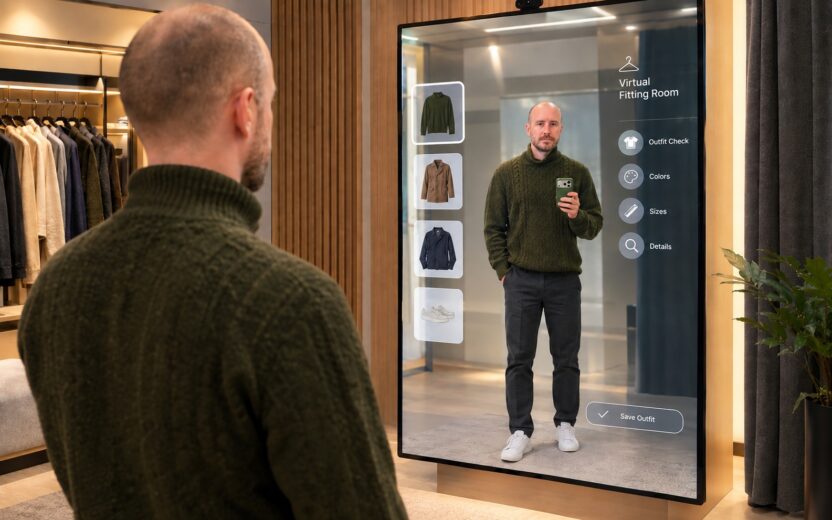

Customer Experience September 18, 2026
From webshop to virtual try-on: how AI is making its way into retail stores
Digital interfaces such as smart mirrors turn AI in the store into a tangible business case. What potential does this hold for the customer experience and in-store personalization? Matthias Vollmer explains how the retail industry can combine the best of both worlds and turn physical touchpoints into an intelligent part of the omnichannel journey.
From webshop to virtual try-on: how AI is making its way into retail stores
Digital Marketing September 3, 2026
ChatGPT Ads: a new touchpoint in the customer journey
ChatGPT Ads bring advertising to a new stage of the customer journey. We explain how the new ad format works, where its strengths lie, and what role it could play alongside Google Ads, paid social, and organic AI visibility.
ChatGPT Ads: a new touchpoint in the customer journeyDon't miss a thing.
Subscribe to our latest blog articles.