Highlight

Successful together – our valantic Team.
Meet the people who bring passion and accountability to driving success at valantic.
Get to know usJanuary 22, 2024

Decoupled frontend, MACH, best of breed, PBCs, microservices, APIs, and now composable commerce – the digital industry has never been short of buzzwords. However, the term composable commerce signifies more than just a new technological hype. It is, in fact, a highly relevant strategic initiative that acts as a kind of bracket for the aforementioned terms. Let’s explore together how composable commerce enables your business to respond more quickly to market requirements and create individual customer experiences.
Composable commerce represents a philosophy of modularity and flexible adaptability in response to an ever-changing and accelerating market environment in which rigid monolithic structures are increasingly becoming a strategic risk. However, companies have been striving to increase their responsiveness to anticipate changes in consumer behavior or new market opportunities and address them faster than the competition, long before the term composable commerce came into existence. A good example of this is the hype around the topic of microservices, which has now given way to a certain disillusionment.
So, what is new about composable commerce? The essential difference from purely tech-driven initiatives is the multidimensional and integrated approach. It goes without saying that a successful e-commerce business also requires an adequate technology stack. However, composable commerce is a comprehensive corporate paradigm, in which a modular architecture and flexible technologies only fulfil the function of an enabler if flexible business processes and the corresponding mindset are present within a company to truly leverage technology-induced advantages. Excellent technology components alone are thus no guarantee for sustainable business success in e-commerce. Nonetheless, the adaptability (composability) of the underlying system landscape and architecture is a crucial key to long-term e-commerce success, as a company’s reaction speed should not be restricted by technology-related framework parameters. A high degree of composability, therefore, enables companies to continuously expand and adapt their technological infrastructure to remain competitive in the long term. A positive side effect: The more flexible and modular an infrastructure, the less dependency on individual vendors.
Just as the development of a composable commerce strategy represents a paradigm shift of varying degrees depending on the company, the question of what type or degree of composability to aim for cannot be answered universally. The respective business model plays a crucial role in terms of flexibility of such important parameters as business processes, organizational structure, or tech stack. For example, companies that trade commodities in the market will have different composable capabilities critical to success than companies with highly individualized products.
In the course of developing a forward-looking composable commerce strategy, the following questions should therefore be central:
Do you need support in identifying strategically relevant composable capabilities and developing a future-oriented composable commerce strategy? At valantic CX, we combine strategic thinking with business know-how and tech expertise, making us the ideal partner for companies that want to take the next step in digital commerce.
Your company deserves a tailored solution. Let’s talk if you want to discover and strategically advance your composable potential.

Contact: Dr. Philipp Hoberg
Get in touch with us today!


Artificial Intelligence October 16, 2026
Autonomous Enterprise Journey: How AI value engineering creates measurable business value
How can the ROI of AI initiatives be reliably assessed and measured? How can companies identify the biggest levers and key processes for AI? Katrin Luft, Senior Expert at valantic and co-developer of the “Autonomous Enterprise Journey,” provides answers and recommendations in a conversation with Darya Basarhina, Vice President of Sales & Marketing and Manufacturing Practice Lead at valantic.
Autonomous Enterprise Journey: How AI value engineering creates measurable business value
Customer Experience October 8, 2026
Interview: From PIM to Data Spine – How companies prepare their data for AI
AI is changing the requirements for data, governance, and processes. Where should companies start, and what skills do they need? In this interview, Dietmar Rietsch, CEO of Pimcore, and Timo Huguet of valantic discuss the importance of clean data, the concept of the “Data Spine,” and the changing role of humans in the age of agentic AI.
Interview: From PIM to Data Spine – How companies prepare their data for AI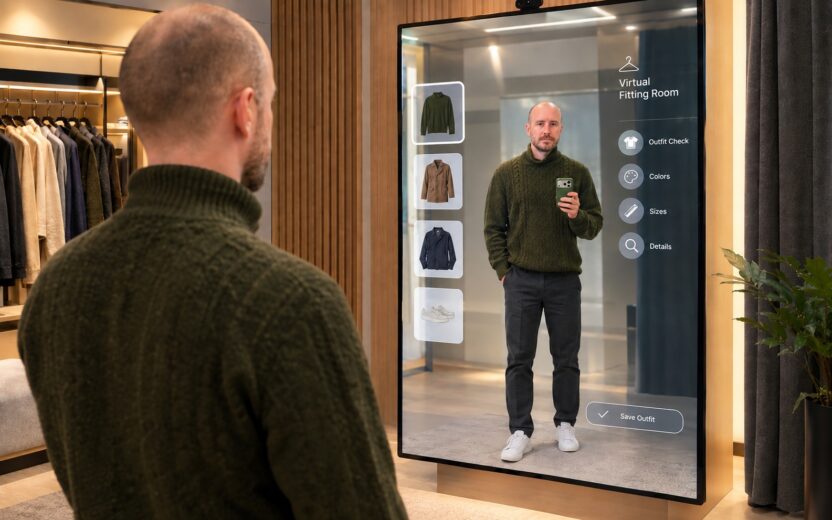
Customer Experience September 18, 2026
From webshop to virtual try-on: how AI is making its way into retail stores
Digital interfaces such as smart mirrors turn AI in the store into a tangible business case. What potential does this hold for the customer experience and in-store personalization? Matthias Vollmer explains how the retail industry can combine the best of both worlds and turn physical touchpoints into an intelligent part of the omnichannel journey.
From webshop to virtual try-on: how AI is making its way into retail storesDon't miss a thing.
Subscribe to our latest blog articles.