Highlight

Successful together – our valantic Team.
Meet the people who bring passion and accountability to driving success at valantic.
Get to know usOctober 1, 2024

The key to an optimized external communication is a streamlined and aligned internal way of working. When contrariwise each department operates with a tunnel vision of its own objectives and metrics, the result is a fragmented customer approach. And the Health Care Professional (HCP), receives mixed signals from the same company. Sales attempt to secure face-to-face meetings to promote products, while marketing takes a broader stroke with brand awareness campaigns, and medical reps provide scientific support. This disjointed effort often leaves the HCP with a confusing brand experience, as if different factions, not a single unified entity, were engaging with them.
The key to dissolving these entrenched silos lies in shared data and integrated technology processes. Data is the potential equalizer, the common denominator that could realign all departments toward a shared goal: the customer. Yet, many companies find themselves caught in the inertia of a push communication with a product or service-focused mindset, unable to pivot towards a customer-centric approach where one and the same customer 360° view is used by all teams.
Companies must recognize who their customers are across all functions and align their strategies accordingly. Whether it’s the HCP, the patient, or the payer, each requires tailored yet consistent communication. This is where the power of data comes in—by harmonizing insights, teams can synchronize their strategies and present a united front to the customer.
Breaking down silos isn’t instantaneous; it’s a progressive journey requiring the simultaneous evolution of people, processes, technology, and data. A customized maturity framework can help to break down these silos and enable these elements to grow in harmony. By aligning teams around a unified understanding and roadmap where application of data, can create cohesive strategies that serve the customer experience first and foremost.
Processes and technology must follow suit, enabling internal teams to deliver exceptional external experiences without being hindered by cumbersome, outdated internal processes that were created with an inside-out mindset. Simplification and standardization of customer-centric processes, underpinned by real-time data, is essential.
In conclusion, the road to customer excellence in pharma and life sciences is paved with collaborative efforts, grounded in data, and led by technology. By breaking down silos and fostering an aligned environment through processes, companies can enhance the customer experience and move closer to the ideal of customer excellence—a goal that benefits everyone, from the patient to the provider.

Customer Excellence in Pharma
More information about our pharma & life sciences offering


Artificial Intelligence October 16, 2026
Autonomous Enterprise Journey: How AI value engineering creates measurable business value
How can the ROI of AI initiatives be reliably assessed and measured? How can companies identify the biggest levers and key processes for AI? Katrin Luft, Senior Expert at valantic and co-developer of the “Autonomous Enterprise Journey,” provides answers and recommendations in a conversation with Darya Basarhina, Vice President of Sales & Marketing and Manufacturing Practice Lead at valantic.
Autonomous Enterprise Journey: How AI value engineering creates measurable business value
Customer Experience October 8, 2026
Interview: From PIM to Data Spine – How companies prepare their data for AI
AI is changing the requirements for data, governance, and processes. Where should companies start, and what skills do they need? In this interview, Dietmar Rietsch, CEO of Pimcore, and Timo Huguet of valantic discuss the importance of clean data, the concept of the “Data Spine,” and the changing role of humans in the age of agentic AI.
Interview: From PIM to Data Spine – How companies prepare their data for AI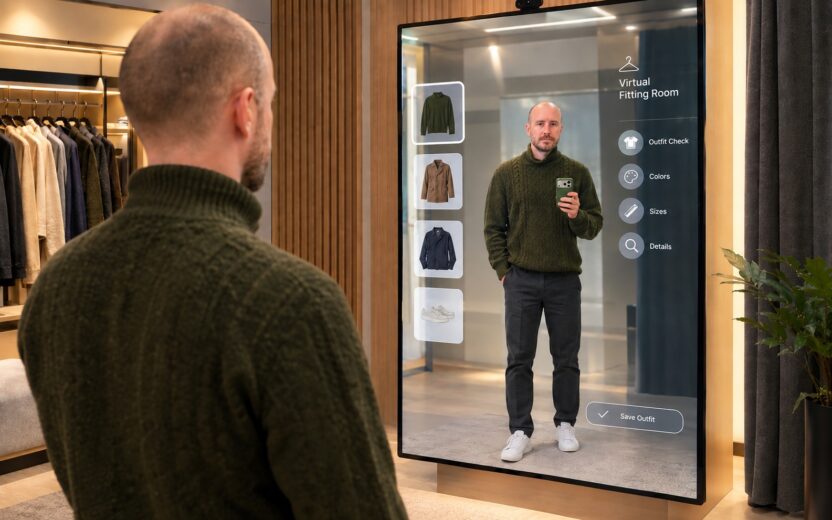
Customer Experience September 18, 2026
From webshop to virtual try-on: how AI is making its way into retail stores
Digital interfaces such as smart mirrors turn AI in the store into a tangible business case. What potential does this hold for the customer experience and in-store personalization? Matthias Vollmer explains how the retail industry can combine the best of both worlds and turn physical touchpoints into an intelligent part of the omnichannel journey.
From webshop to virtual try-on: how AI is making its way into retail storesDon't miss a thing.
Subscribe to our latest blog articles.