Highlight

Successful together – our valantic Team.
Meet the people who bring passion and accountability to driving success at valantic.
Get to know usJuly 24, 2025

As digitalization spreads across all areas of life and business, customer expectations for fast, reliable, and personalized interactions continue to rise. This is where AI agents come into play, becoming more advanced and versatile through platform solutions like Salesforce’s Agentforce. In the future, they are likely to go beyond handling basic support requests and act as continuous background companions – proactively suggesting improvements and communication strategies.
Picture a scenario where a customer has been inactive on an e-commerce site for several months. The agent detects this absence and knows which product categories the customer used to browse regularly. It automatically launches a personalized campaign, suggests alternative products or exclusive discounts, and even secures stock in case of renewed interest. For the marketing team, this means reduced manual planning and improved targeting quality.
The influence of AI agents isn’t limited to external customer interactions. Internally, future agents could act as “second-type employees.” For instance, an agent could prepare a weekly status meeting by aggregating project updates from all departments. It might identify obstacles marked in a project management tool and highlight them to the team lead. Rather than manually gathering data, leaders would gain an instant overview of priorities and action items.
This transformation also has a cultural dimension. Teams will need to adapt to AI agents taking initiative and more frequently assuming control – at least in routine contexts. The potential to relieve and support human colleagues is enormous. At the same time, clear guidelines must be established for when and how agents escalate issues or hand over sensitive topics to humans. Ethical standards, data protection, and responsibility must be clearly defined.
It’s becoming evident that AI agents will not replace humans, but rather expand the way we work. Human creativity and empathy remain essential for complex decisions and personal customer relationships. AI agents, meanwhile, take over repetitive tasks and ensure consistent data flows and operational efficiency. The result is a productive partnership where organizations become more agile, resilient, and customer-centric.
Looking ahead, it’s clear that those who explore AI agents today are preparing themselves for the next wave of digital transformation. While many industries already benefit from automation, the next stage will integrate human and artificial intelligence in entirely new ways. Salesforce’s Agentforce is more than just a tool – it’s a gateway to a working world where smart assistants handle routine tasks and humans are empowered to focus on innovation and empathy.
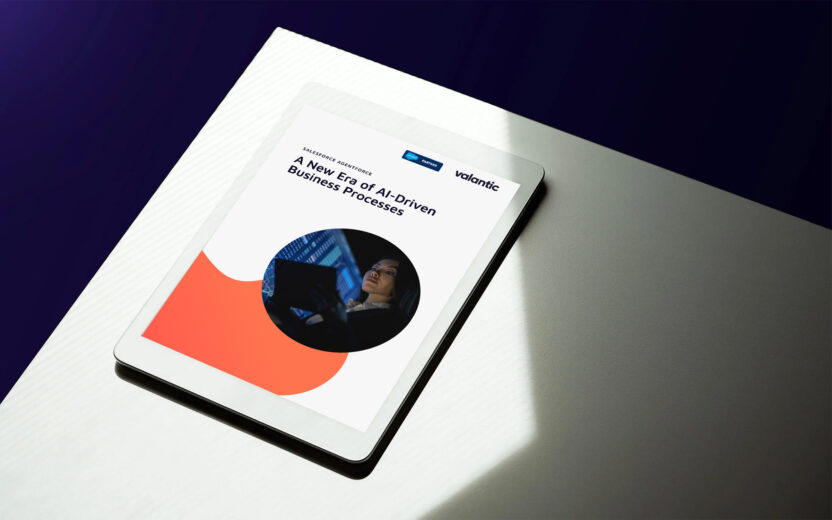
Salesforce Agentforce: A New Era of AI-Driven Business Processes
How AI agents are shaping the future of service, sales, and commerce – and why now is the perfect time for companies to get started.

Customer Experience October 8, 2026
Interview: From PIM to Data Spine – How companies prepare their data for AI
AI is changing the requirements for data, governance, and processes. Where should companies start, and what skills do they need? In this interview, Dietmar Rietsch, CEO of Pimcore, and Timo Huguet of valantic discuss the importance of clean data, the concept of the “Data Spine,” and the changing role of humans in the age of agentic AI.
Interview: From PIM to Data Spine – How companies prepare their data for AI

Customer Experience September 18, 2026
From webshop to virtual try-on: how AI is making its way into retail stores
Digital interfaces such as smart mirrors turn AI in the store into a tangible business case. What potential does this hold for the customer experience and in-store personalization? Matthias Vollmer explains how the retail industry can combine the best of both worlds and turn physical touchpoints into an intelligent part of the omnichannel journey.
From webshop to virtual try-on: how AI is making its way into retail stores
Digital Marketing September 3, 2026
ChatGPT Ads: a new touchpoint in the customer journey
ChatGPT Ads bring advertising to a new stage of the customer journey. We explain how the new ad format works, where its strengths lie, and what role it could play alongside Google Ads, paid social, and organic AI visibility.
ChatGPT Ads: a new touchpoint in the customer journeyDon't miss a thing.
Subscribe to our latest blog articles.