Highlight

Successful together – our valantic Team.
Meet the people who bring passion and accountability to driving success at valantic.
Get to know usJune 5, 2025

In many industries, artificial intelligence has long moved beyond the proof-of-concept stage and is now being actively used to accelerate workflows. While many companies are still experimenting with isolated chatbot solutions, Salesforce is taking a significant step further with Agentforce. Agentforce positions itself as a platform that seamlessly integrates AI-powered agents into existing systems across service, sales, and e-commerce.
But what does that mean in practice? Instead of relying on fragmented software modules, Agentforce consolidates all relevant company data in a unified environment. Salesforce relies on three core components to achieve this: the Einstein Trust Layer, the Data Cloud, and CRM 360. These elements ensure, first, security and compliance; second, an aggregated and continuously updated data foundation; and third, a holistic view of customers. On this foundation, AI agents can act intelligently without requiring complex system integrations.
An example is customer service, which plays a central role in many companies. Thanks to Agentforce, an AI agent can immediately detect whether an incoming service request relates to a common issue with an automated solution or whether human escalation is necessary. It reviews order details, past communications, and even warranty conditions—in a matter of seconds. This not only reduces processing times but also minimizes the number of manual steps involved.
Sales and marketing also benefit. An agent that analyzes CRM data related to campaigns and customer preferences can address customers with personalized messages, recommend relevant products, or suggest follow-up actions. Commerce functionalities enable the AI agent to control purchasing processes in real time: checking inventory, calculating prices, and identifying whether a cross-sell offer would be attractive for a particular customer.
With Agentforce, Salesforce is simplifying the path to an AI-powered enterprise: rather than implementing standalone tools for individual use cases, companies gain access to a centralized ecosystem that is strategically extended by AI agents. This keeps organizations agile and enables them to respond quickly to changing market conditions. There’s no need to settle for patchwork solutions—instead, companies benefit from an integrated platform that is scalable from day one.
This interplay of data, automation, and human expertise creates a leap in efficiency that ordinary chatbots rarely achieve. Agentforce offers a compact overview of how AI agents can be deployed on a platform level to modernize the entire value creation process from the first customer inquiry to successful deal closure.

Salesforce Agentforce: A New Era of AI-Driven Business Processes
Explore Salesforce Agentforce AI agents for the future of service, sales & commerce. Why is now the perfect time to get started?


Artificial Intelligence October 16, 2026
Autonomous Enterprise Journey: How AI value engineering creates measurable business value
How can the ROI of AI initiatives be reliably assessed and measured? How can companies identify the biggest levers and key processes for AI? Katrin Luft, Senior Expert at valantic and co-developer of the “Autonomous Enterprise Journey,” provides answers and recommendations in a conversation with Darya Basarhina, Vice President of Sales & Marketing and Manufacturing Practice Lead at valantic.
Autonomous Enterprise Journey: How AI value engineering creates measurable business value
Customer Experience October 8, 2026
Interview: From PIM to Data Spine – How companies prepare their data for AI
AI is changing the requirements for data, governance, and processes. Where should companies start, and what skills do they need? In this interview, Dietmar Rietsch, CEO of Pimcore, and Timo Huguet of valantic discuss the importance of clean data, the concept of the “Data Spine,” and the changing role of humans in the age of agentic AI.
Interview: From PIM to Data Spine – How companies prepare their data for AI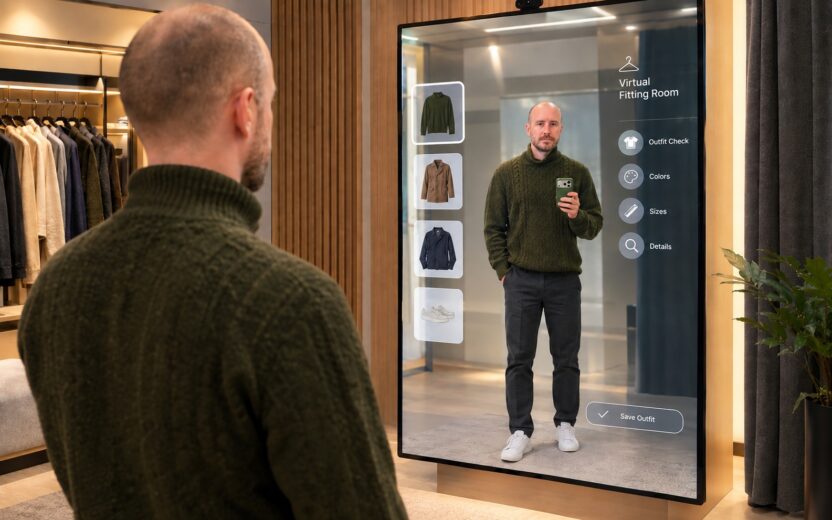
Customer Experience September 18, 2026
From webshop to virtual try-on: how AI is making its way into retail stores
Digital interfaces such as smart mirrors turn AI in the store into a tangible business case. What potential does this hold for the customer experience and in-store personalization? Matthias Vollmer explains how the retail industry can combine the best of both worlds and turn physical touchpoints into an intelligent part of the omnichannel journey.
From webshop to virtual try-on: how AI is making its way into retail storesDon't miss a thing.
Subscribe to our latest blog articles.