Highlight

Successful together – our valantic Team.
Meet the people who bring passion and accountability to driving success at valantic.
Get to know usAI-supported capacity planning and resource allocation for service and maintenance processes – towards autonomous resource planning.

The fast-paced nature of modern markets requires companies, now more than ever, to plan their resource allocation in an agile, transparent and precise manner. Only those who are able to respond flexibly to rapidly changing requirements can remain competitive in the long term.
With SAP FSA (Field Service and Asset Management), SAP is expanding the familiar functions of planning, scheduling, dispatching and the mobile execution of maintenance and service calls to include capacity planning, a stronger focus on maintenance processes and AI-driven support for these processes. FSA is the logical next step on from SAP Field Service Management (FSM) and, at the same time, takes over key planning functions previously covered by SAP Resource Scheduling (RSH) and SAP Multiresource Scheduling (MRS). This creates, for the first time, an end-to-end platform that serves product-centred, service-driven and asset-intensive companies alike – from the factory premises to the customer site.
Instead of using several separate solutions for internal plant maintenance and external customer service, customers will in future be able to benefit from a single platform – without any system or media discontinuities. AI agents and Joule provide end-to-end support: from the early detection of capacity bottlenecks, through automated appointment suggestions, to AI-generated briefings for technicians.
SAP FSA thus lays the foundation for proactive, automated and mobile resource planning – with the clear aim of maximising plant availability, increasing workforce productivity and significantly improving service delivery.

Are you looking for the perfect solution for your business?
We’ll support you not only in digitising your business processes, but also in actively optimising them and making them measurably more successful.

Existing SAP FSM customers do not need to make any changes for the time being. The new FSA functions will be integrated into the existing tenants in stages, initially under the ‘Planning and Dispatching’ tile.

SAP RSH will remain fully operational and will continue to be supported under the existing licence (Mainstream Maintenance in accordance with the underlying S/4HANA release). This marks the end of further development, not the end of support. An option to migrate to FSA is planned once functional parity has been achieved – scheduled for the second half of 2027.

SAP MRS – What will change for existing customers?
SAP MRS is already in maintenance mode (corrections only, no functional enhancements) and will be discontinued on 31 December 2030. For MRS customers using traditional dispatching at the individual technician level, the switch to SAP FSA is the path SAP recommends.
What can the new SAP tool do? An overview of six features of Field Service and Asset Management
The technical foundation is provided by SAP Cloud ERP, the Business Technology Platform and the Business Data Cloud – supplemented by Smartforms, Business Rules, workflows, the Query API and no-code/low-code extensibility.
Workload and capacity planning:
Real-time visibility of upcoming work, technician capacity and bottlenecks – across regions, work sites and time periods.
AI-powered appointment and scheduling optimisation:
AI agents suggest suitable technicians or teams for each job and optimise routes in real time.
Mobile Workforce Enablement:
Guided workflows, offline capability and AI-generated briefings support technicians directly on site.
Crowd Services & Networks:
Flexible deployment of external staff and subcontractors during periods of peak demand.
Analytics & Reporting:
Embedded analytics for the continuous improvement of maintenance and service processes.
Customer self-service:
Self-service functions for directly requesting and tracking service calls.
We will help you determine the right timing and migration path for your system landscape – regardless of whether you are currently using RSH, MRS or FSM.
A platform rather than isolated solutions:
Planning, scheduling and execution for internal asset management and external field service are being integrated for the first time – without handover points or data gaps.
Up to 30 per cent higher maintenance efficiency
and a noticeably higher utilisation rate of the workforce (manufacturer’s figure, indicative).
Planning certainty:
A clearly communicated roadmap for the transition from RSH and MRS to FSA, without existing customers having to take action at short notice.
Blog
Digital resource planning – a solution to the shortage of skilled maintenance staff
Finding qualified staff is one of the biggest challenges facing businesses. In this article, we outline how digital resource planning can be implemented in an SAP environment, using three specific solutions as examples.

Webinar: Resource Planning with SAP RSH & SAP FSM
Find out from our two experts how SAP SSAM and SAP FSA (formerly FSM) simplify mobile maintenance processes – from checklists and Smartforms to selecting the right solution.
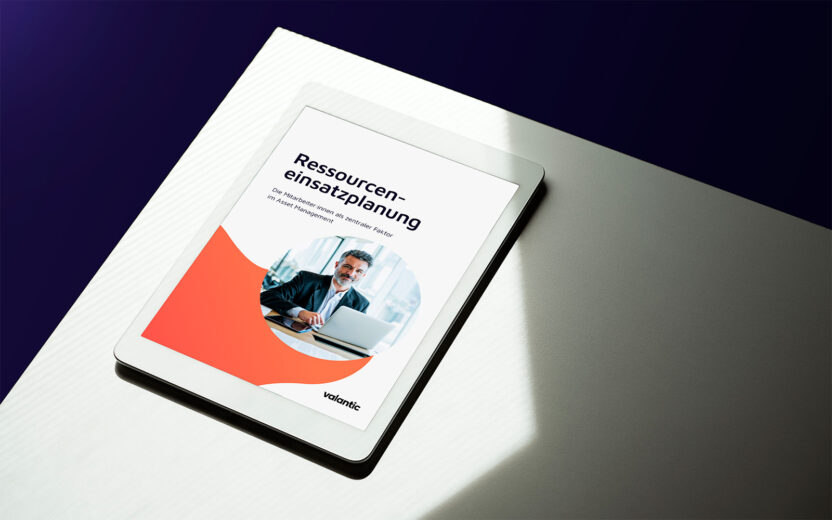
White paper: Resource Planning | Staff as a key factor in asset management
In our white paper, we show you how to establish an efficient planning process in asset management that puts people at the centre and minimises risks.
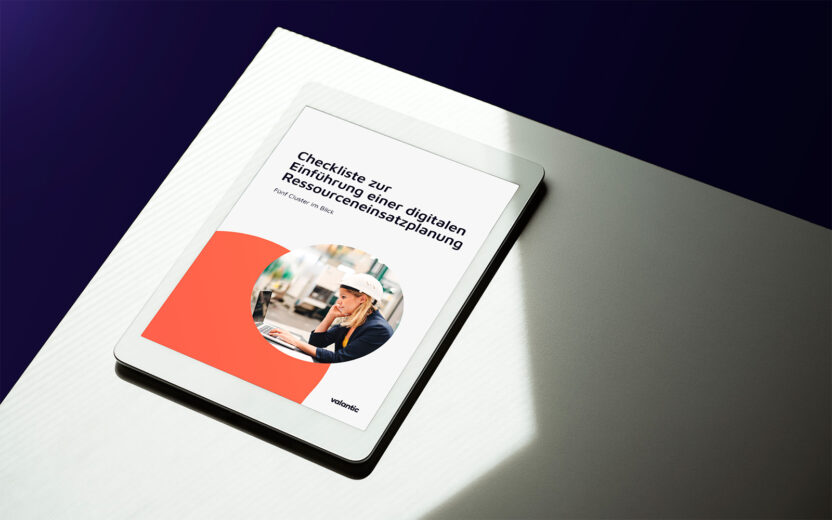
Checklist: Introduction to digital resource planning
When companies use innovative technologies to digitise their resource planning, they generate significant added value. Find out what you need to bear in mind in our checklist!