Highlight

Successful together – our valantic Team.
Meet the people who bring passion and accountability to driving success at valantic.
Get to know usThe SAP Autonomous Enterprise represents a new model of business management in which artificial intelligence independently executes complex business processes rather than simply providing information or automating individual tasks. At SAP Sapphire 2026, SAP presented the SAP Autonomous Enterprise as a vision for businesses. Our glossary entry answers the most important questions.
An Autonomous Enterprise is a company in which AI can independently handle an increasing portion of operational work. This includes, for example, analyzing information, selecting courses of action, and executing the process steps based on those decisions.
AI agents can pursue goals, evaluate information from various sources, prepare or make decisions, and derive actions from them. People retain responsibility for the overarching goals, rules, and control of the system.
The SAP Autonomous Enterprise approach combines Agentic AI, business data, process knowledge, SAP applications, and governance into an integrated model.
The key difference from conventional automation is that an agent does not need to have a preprogrammed sequence for every possible situation. It can draw on information and context, react to changes, and act within defined parameters.
People remain responsible for overall management and control.
SAP Autonomous Enterprise is a vision for companies, their organization, and the execution of business activities.
The central question is which decisions and activities will be carried out by humans, which by AI, and which jointly in the future. Depending on the process, an agent can, for example, consolidate information, prepare a decision, trigger a follow-up process, or coordinate multiple specialized agents.
The term “autonomous” refers to greater agent-driven execution within a defined scope of responsibility, not “without humans.”
An autonomous process requires three things: information, context, and options for action.
For example, an AI agent can analyze data from multiple business systems, identify relevant relationships, and derive the next logical process step from them. It can then trigger actions in the relevant systems via interfaces and processes.
For this to work reliably, data, processes, authorizations, and business rules must be interconnected. This is precisely where the architecture of the SAP Autonomous Enterprise comes into play, providing and supporting key elements for autonomous agent-based action—from the data foundation to the business context to agent control.
Joule Work is the central entry point into the Autonomous Enterprise and the interface for collaboration between people, businesses, and AI.
Work is completed across SAP and third-party systems, directly within the context.
The SAP Autonomous Suite makes core processes—finance, supply chain, human resources, spend, and customer experience—intelligent and autonomous.
Industry AI combines AI with industry-specific knowledge.
The SAP Knowledge Graph links data, processes, and relationships within the enterprise, enabling agents to draw conclusions and act.
Traditional automation is particularly well-suited for recurring processes with known rules. The process is defined and then executed with as few changes as possible.
Agent-based systems such as the SAP Autonomous Enterprise, on the other hand, can handle changing situations. They incorporate various pieces of information, evaluate the specific context, and can adjust their next steps accordingly.
So while automation requires a predetermined sequence, agents pursue a goal and choose the appropriate path to it within defined rules.
This makes autonomous approaches particularly interesting for complex processes with many dependencies and exceptions.
In the Autonomous Enterprise, people are in control and play a steering role. They determine which goals to pursue, what decisions an agent is allowed to make, what approvals are required, and when a human must intervene.
This principle is often referred to as “Human in the Loop”: People are an integral part of the system, not merely a downstream control authority. They define the framework, monitor execution, and intervene specifically when a decision deviates from the defined set of rules or has significant implications.
The operational execution of individual process steps is increasingly handled by agents. Human work is thus shifting from the manual processing of individual tasks to control, monitoring, exception handling, and strategic decision-making.
This is also the vision outlined in the SAP Autonomous Enterprise roadmap.
An AI assistant supports a person with a specific task, for example by processing information, answering questions, or preparing the next step in the workflow.
An AI agent can also perform actions independently and coordinate multiple steps toward a goal. For example, it can verify data, evaluate a deviation, make a decision, and then trigger a process in a business system.
In the context of the SAP Autonomous Enterprise, multiple agents can in turn be coordinated by higher-level assistants. SAP describes Joule Work as a work environment in which intentions are captured and the information, processes, and agents needed to achieve a result are then brought together.
At Sapphire 2026, SAP presented the Autonomous Enterprise as a vision for businesses and is providing a large portion of the technological building blocks required for autonomous business processes. These include, in particular, Joule, Joule Work, Joule Studio, SAP Business Data Cloud, SAP Knowledge Graph, SAP Business AI Platform, and SAP AI Agent Hub.
The advantage of SAP’s architecture lies in the existing business and process context: Agents can not only work with general AI models but also incorporate information from corporate data, processes in SAP, and their relationships.
At the same time, the concept is not limited to SAP’s own agents. The SAP AI Agent Hub is also designed to support the management and collaboration of agents from various providers.
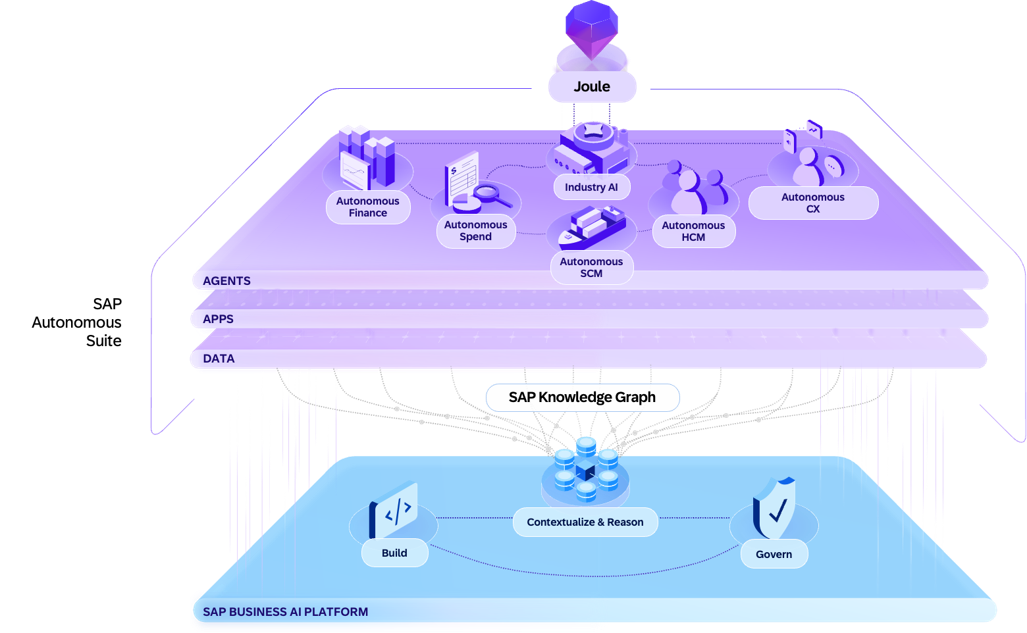
The Structure of the Autonomous Enterprise (Image: SAP)
Joule Work is the interaction and work environment for collaborating with AI in the SAP Autonomous Enterprise.
Instead of navigating through different applications for each step, a user can simply state their desired outcome or intent. Joule can then bring together relevant information, applications, processes, and agents.
This shifts the interaction from navigating through individual systems to results-oriented collaboration with AI. SAP describes Joule Work as a dynamic workspace that is guided by the user’s specific intent.
The SAP Knowledge Graph is the brain of the SAP Autonomous Enterprise. By connecting data, processes, and relationships within the company and linking them together, agents can draw conclusions and take action.
Here’s an example: To process a supplier complaint effectively, it must be linked to additional context and data. For instance, purchase orders, materials, contracts, and previous transactions may be relevant. The Knowledge Graph maps these relationships and meanings.
This provides agents with the semantic business context they need to draw reliable conclusions from enterprise data. SAP integrates the Knowledge Graph with SAP Business Data Cloud and Joule, among other systems.
Technology alone is not enough for the SAP Autonomous Enterprise. Autonomous agents are only as good as the architecture, data, and processes on which they run. First and foremost, companies must lay the foundation. These are:
For companies that want to implement the vision of the Autonomous Enterprise, a step-by-step transformation is recommended to complete the individual tasks.
Of particular interest are processes that involve consolidating large amounts of information, making decisions, and coordinating multiple follow-up steps. Such business processes can be found, among other places, in corporate divisions such as:
Once a suitable process has been identified, it does not necessarily need to be fully automated. It often makes more sense to first have agents support individual decision points or process stages and then gradually increase their autonomy.
Economic benefits arise primarily where AI improves the speed, quality, or scalability of business processes.
These may include:
The more tasks are delegated to artificial intelligence, the more important security, governance, and transparency become.
Risks can arise, for example, from:
That is why governance plays a central role in the SAP Autonomous Enterprise. Identity, permissions, monitoring, and control mechanisms must be considered before agents are developed. valantic also highlights these aspects in its current roadmap for the Autonomous Enterprise.
Control begins with a clearly defined agent identity and a limited scope of permissions. This determines which data and systems an agent is allowed to access and which actions it is permitted to perform.
In addition, there are rules for approvals, monitoring, and escalations. For particularly sensitive decisions, a human may still be required to grant approval.
In the SAP Autonomous Enterprise, the SAP AI Agent Hub supports the centralized management of agents and their governance, including cross-vendor agent landscapes.
The process does not begin with developing as many agents as possible. First, companies should understand their existing architecture, data, and processes, and identify the use cases where autonomy promises relevant business value.
Building on this foundation, data access, process logic, agent architecture, and governance can be developed. Individual solutions are then integrated, tested, and deployed.
The transformation thus takes place in stages: from the appropriate use case, through productive agents, to a networked system of autonomous processes. SAP refers to this approach as agent-based transformation.
Companies should develop a roadmap for this.
valantic supports companies at every stage of their transformation into an Autonomous Enterprise.
To this end, valantic possesses in-depth AI expertise, more than 30 years of experience with SAP projects, comprehensive knowledge of leading technologies, expertise in the areas of data and AI, extensive process and integration knowledge, and strong partnerships with AI providers such as Anthropic
The range of services extends from selecting suitable use cases for agents and defining the target architecture, through the integration and development of individual agents, to operations, security, and governance.
This involves not only the technical implementation of individual AI solutions but also embedding their use within the existing corporate and process landscape.
valantic supports the implementation of security architectures to ensure that agents always operate in accordance with corporate policies and legal requirements such as the EU AI Act.
The essentials of SAP Autonomous Enterprise at a glance
Definition: SAP Autonomous Enterprise is a new model of enterprise management in which AI independently executes complex business processes.
How it works: An AI agent, for example, selects data from systems, identifies relevant patterns, determines the next logical process step, and triggers actions in the systems involved.
Benefits: AI agents enhance the speed, quality, and scalability of processes, enabling companies, for instance, to respond more quickly to change.


Join valantic on the journey to the SAP Autonomous Enterprise!
We provide comprehensive support, ranging from architecture, database, and governance to agent development and operations.