Highlight

Successful together – our valantic Team.
Meet the people who bring passion and accountability to driving success at valantic.
Get to know usAI-Supported personalized Product Experiences
Shopping is no longer just about purchasing a product. It is about creating an engaging, intelligent experience.
Therefore, AI-supported Product Experience Management (PXM) is essential. As consumers navigate through various channels—whether online, in-store, or through mobile apps—they expect consistent, accurate, and context-aware product information at every touchpoint.
The key to elevating this shopping journey lies in AI-driven personalization and real-time content adaptation that resonates with each customer.
PXM requires a harmonious interplay of Customer Experience Design, robust AI-powered systems, and comprehensive data management. By integrating these elements with predictive analytics, generative content, and intelligent automation, businesses transform the traditional shopping journey into a seamless, emotionally intelligent, omnichannel experience.

Elevating the Shopping Experience: From Product Purchase to Personalized Journey
Product Experience Management (PXM) has emerged as a transformative approach in a competitive digital landscape, redefining how businesses interact with customers.Unlike traditional product management, PXM focuses on delivering a cohesive and personalized experience across all touchpoints, ensuring that each customer interaction is meaningful and engaging.
At its core, PXM aims to enhance customer satisfaction, increase engagement, and drive higher conversion rates. By aligning product content with individual preferences and needs, businesses can create unique experiences that resonate with their audience, fostering deeper connections and loyalty. Additionaly, delivering content that considers the customer’s current context, such as their environment, the device they are using, or current events, enhances the likelihood of customer engagement with the provided content. According to Gartner (Scale Digital Commerce With Product Experience
Management, August 2024), effective PXM can significantly elevate product content, augment revenue, and improve the overall customer experience by integrating product data from multiple systems into a unified Golden Record. For example, Pimcore is an ecosystem that manages any data, is adaptable across various industries, and delivers content through any channel.

To successfully deliver personalized and context-based product experiences, the following key elements are crucial:
Data
Collecting and analyzing customer data is essential to gaining insights and making informed decisions. Data is the key to personalizing and delivering context-driven content.
Systems
Robust PXM platforms and technologies are necessary to manage and analyze data. They enable the integration of various data sources and the automation of processes.
Customer Experience Design
A well-thought-out design of the entire customer journey, encompassing all touchpoints, is crucial. It ensures a consistent and engaging brand experience, strengthening customer loyalty.

PXM is the interface between systems, data and CX design.
Navigating the customer journey in a complex environment presents a myriad of challenges that can significantly impact a consumer’s experience and decision-making process. Understanding and addressing these challenges at each phase of the journey is crucial for businesses aiming to enhance customer satisfaction and loyalty.
Awareness Phase
In the initial awareness phase, customers often struggle with understanding product offerings and identifying solutions that truly meet their needs. This phase is characterized by information overload, where consumers are bombarded with a multitude of options and marketing messages. The challenge lies in AI-optimized messaging that cuts through the noise—dynamically highlighting unique value propositions using real-time behavioral data and predictive intent modeling.
Businesses must leverage AI-driven content personalization to deliver context-aware recommendations tailored to individual preferences, device, location, and browsing patterns—reducing confusion and guiding customers toward informed decisions with hyper-relevant product discovery.
Conversion Phase
As customers move into the conversion phase, they encounter new sets of challenges related to product comparison, customization, and completing transactions. In this critical phase, AI-powered comparison engines instantly surface feature, price, and review insights, eliminating friction and preventing abandoned carts.
Customers often face difficulty in finding reliable sources for comparison—AI resolves this with trusted, aggregated data and sentiment analysis. Moreover, the desire for customization adds complexity; AI-generated product configurators and generative design tools enable real-time personalization that matches exact tastes and requirements.
AI-optimized checkout flows with predictive fraud detection, smart payment routing, and one-click upsell recommendations ensure a seamless, secure experience. Businesses must prioritize AI-enhanced user interfaces and automated support (chatbots, co-pilots) to facilitate smooth transactions and reduce cart abandonment rates
Usage Phase
The journey doesn’t end at purchase; the usage phase introduces challenges centered on post-purchase support and AI-enhanced self-service. Customers expect instant, intelligent help for issues. AI-powered FAQs, predictive tutorials, and smart troubleshooting—delivered via chatbots or in-app guidance—empower users to resolve problems independently, boosting satisfaction.
For complex inquiries, AI-augmented support ensures faster, more accurate responses while human agents handle nuanced cases. Easy access to omnichannel support (chat, email, phone) remains key.
By solving challenges at every step with AI-supported Product Experience Management (PXM), businesses create seamless, data-driven interactions that exceed expectations, strengthen loyalty, and drive long-term success.

Content of use
Hyper-Personalization leverages advanced AI technologies to create highly tailored experiences for each user. This involves analyzing data in real-time and delivering content, product recommendations, and services that are uniquely suited to each individual’s preferences and behaviors.
With the power of AI, businesses can offer real-time personalized product content that enhances customer experiences. By analyzing customer data instantaneously, companies can provide tailored product recommendations and content that resonates with each individual. For instance, through Upselling and Cross-selling Supported by AI, businesses can suggest complementary products or higher-value alternatives that align with a customer’s previous purchases and preferences.
Hyper-Personalization takes product visualization to a new level by adapting media and content to individual tastes. Whether it’s personalized videos or customized text, the content is seamlessly tailored to align with user interests. For example, employing Personalized Media and Personalized Text ensures that every interaction feels unique and engaging. This personalization also extends to product offerings, where bespoke solutions are crafted based on real-time data analysis, meeting the customer’s specific needs.
Creating a personalized experience extends beyond the initial purchase. By using (Generative) AI to enhance after-sales services, businesses can provide ongoing support tailored to individual customers. Ticketing Supported by AI and Chat Supported by AI ensure that customer queries and issues are resolved efficiently, providing a robust support system that adapts to each customer’s history and preferences. Furthermore, AI-supported personal assistants offer a unique touch by providing personalized interaction and account management.
AI is serving as the catalyst that is igniting the future of product experience management (PXM) by transforming how companies create and deliver personalized, context-driven experiences. By leveraging AI’s capabilities in data analytics and automation, companies can seamlessly integrate systems, utilize data analytics and improve customer experience design. This powerful combination enables companies to offer customized product interactions, achieve higher conversion rates and reach unprecedented levels of customer satisfaction.
Increased Sales and Conversions
By providing relevant and timely recommendations, customers are more likely to make purchases.
Improved Customer Satisfaction
Tailored content and support create a more engaging and enjoyable user experience.
Greater Customer Loyalty
Personalized interactions foster stronger relationships and repeat business.
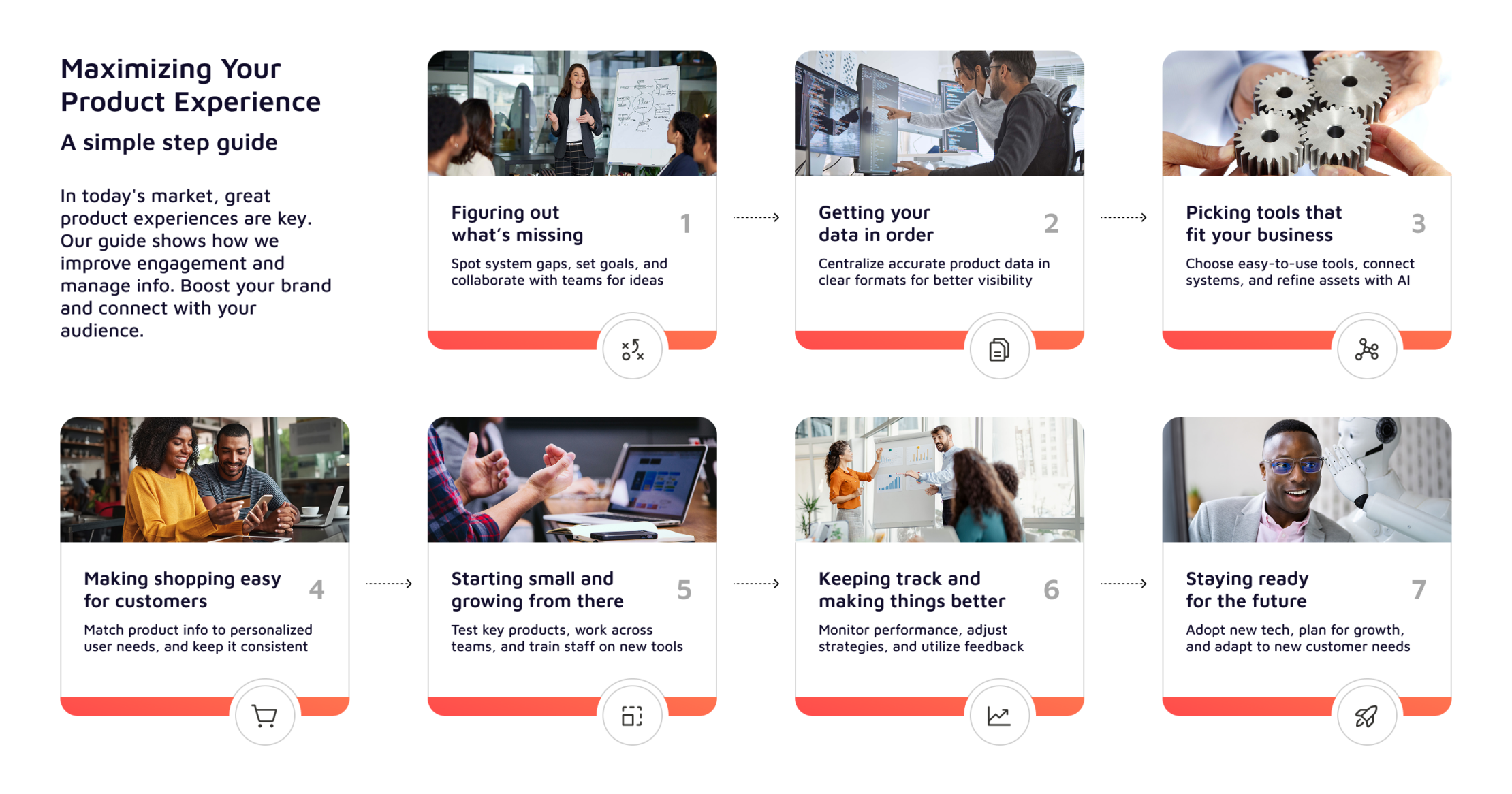
The valantic framework provides a robust and comprehensive guide for implementing the Product Experience Management (PXM) framework in e-commerce environments. These seven steps provide a comprehensive guide for the successful implementation of the PXM framework to create personalized and engaging product experiences.

Digital.Now Podcast: #32: Unlocking the Power of PXM and PIM
“On the path to meeting the expectations of the modern buyer, it’s no longer just about the product; it’s about crafting an experience.” Dietmar Rietsch, CEO of Pimcore, captures the…
Discover more successful projects with Pimcore – you can find all the details in our complete reference overview.