Highlight

Successful together – our valantic Team.
Meet the people who bring passion and accountability to driving success at valantic.
Get to know usDecember 2, 2025

In many industries, traditional product pages no longer suffice to convert customers. Personalization, transparency, and intuitive user experiences have become critical to the success of digital business models. Product configurators and digital advisors have become essential tools in modern e-commerce, particularly for complex or highly customizable product ranges.
In this interview, Maria Kern, Senior Frontend Architect at valantic, outlines how companies can strategically leverage these tools, the potential they unlock, and the technological trends currently shaping the market.
Maria: Today’s customers expect shopping experiences that are precisely tailored to their individual needs. A product configurator supports this by enabling real-time customization and visualization. This is especially valuable in the B2B sector, where complex products often require detailed explanations. When users can instantly see how their choices affect features like price and availability, it not only enhances their decision-making but also typically leads to a significant boost in conversion rates.
Product advisors are ideal entry points for users who aren’t yet sure what they’re looking for. They guide customers through the decision-making process by asking targeted questions and recommending suitable product variants based on the responses. While configurators focus on detailed, personalized customization, advisors act more like a smart guide. Combining both tools creates a highly user-friendly shopping experience and significantly reduces the risk of mispurchases.
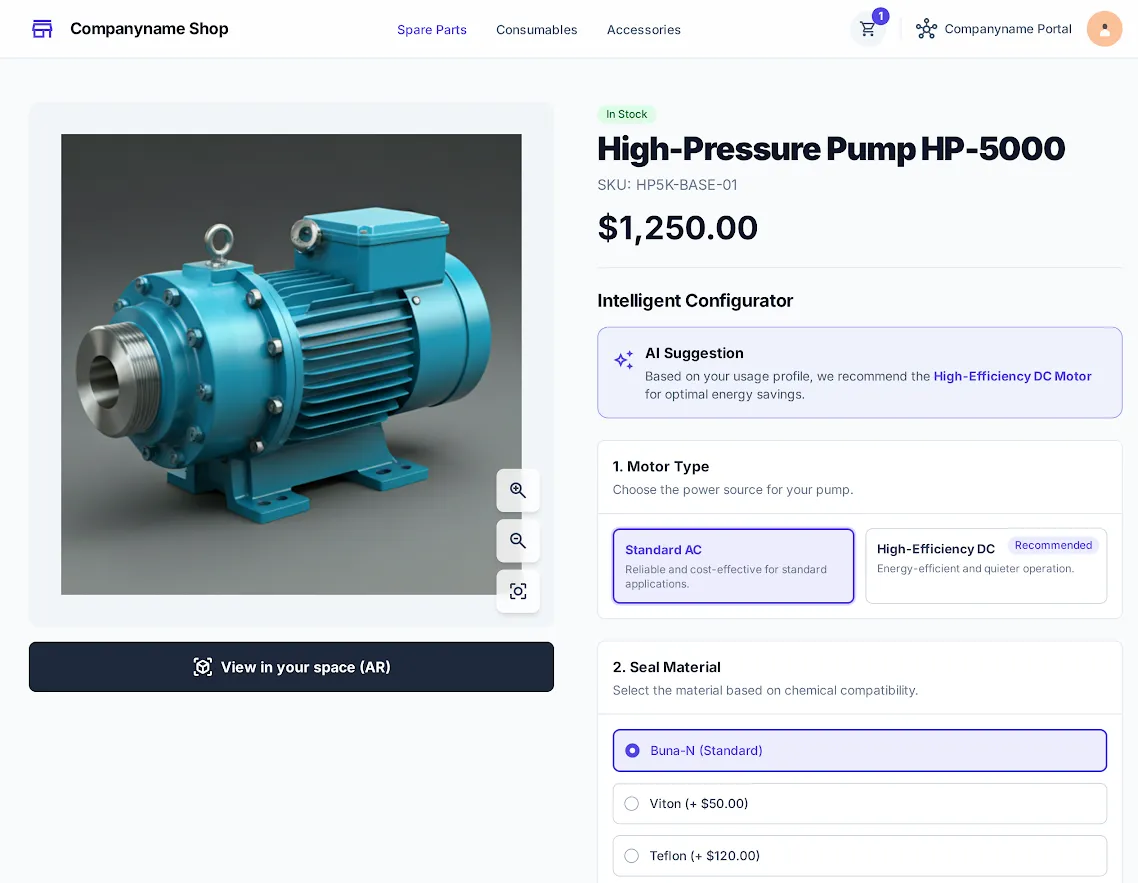
It all starts with understanding your target groups. Who are the buyers? How complex is the product? And what information do customers need to make a confident decision? Once those questions have been answered, a technical analysis follows: What systems are already in place? How well-structured is the product data? Only with this foundation can companies decide whether a simple rule-based configurator is enough or if a more advanced, highly visual solution is necessary – especially when features like 3D visualization or real-time price calculations are the goal.
At valantic, we always begin with a thorough requirements assessment phase. Together with the client, we define the use cases, determine user needs, and assess the available data sources. Based on this, we select a suitable type of configurator and start the technical conception process. Implementation then depends on the project. It might involve integrating existing configurator software or developing a custom solution. The configurator can be flexibly connected to existing systems or embedded directly into the shop platform.
Once built, we test the setup with real users, make refinements, and prepare everything for a smooth go-live. Post-launch, we use A/B testing to monitor user behavior and continuously optimize the solution.
The spectrum ranges from simple 2D images to dynamic 3D models and even photorealistic visualizations. Depending on the industry and product type, the right visual approach can strongly influence purchasing decisions. For instance, we developed a custom 3D configurator for an industrial client that integrates directly with their ERP system and visualizes complex product variants in real time. This not only streamlined internal processes but also led to a noticeable boost in customer satisfaction.
AI is set to fundamentally transform both product configurators and digital advisors. Configurators will become smarter by learning from user interactions and product data, allowing them to suggest suitable variants and offer increasingly realistic visualizations – from high-resolution 3D to AR experiences in real-world settings. With IoT integration, real-time data will also play a growing role, for instance, when a connected machine automatically recommends the right spare parts or settings.
At the same time, product advisors are evolving into intelligent, predictive assistants. They’ll anticipate customer needs based on behavior, dynamically narrow down product selections, offer dialogue-based guidance, and even support extended decision-making processes – seamlessly transitioning to human advisors when needed. Overall, digital purchase advice in e-commerce is becoming more personalized, visual, and context-aware.
Absolutely, because today’s customers expect guidance, transparency, and the confidence to make the right choices. Product configurators have moved beyond being a “nice-to-have” and are now a key element of successful digital commerce platforms. They enhance the user experience, speed up purchasing decisions, and provide a real competitive edge.
Combined with intelligent product advisors, AI-powered personalization, and immersive visualizations, they make even complex products easy to understand and deliver a shopping experience that builds trust. Companies that invest early in these integrated, interactive tools not only benefit from higher conversion rates but also gain long-term competitive advantages.


Artificial Intelligence October 16, 2026
Autonomous Enterprise Journey: How AI value engineering creates measurable business value
How can the ROI of AI initiatives be reliably assessed and measured? How can companies identify the biggest levers and key processes for AI? Katrin Luft, Senior Expert at valantic and co-developer of the “Autonomous Enterprise Journey,” provides answers and recommendations in a conversation with Darya Basarhina, Vice President of Sales & Marketing and Manufacturing Practice Lead at valantic.
Autonomous Enterprise Journey: How AI value engineering creates measurable business value
Customer Experience October 8, 2026
Interview: From PIM to Data Spine – How companies prepare their data for AI
AI is changing the requirements for data, governance, and processes. Where should companies start, and what skills do they need? In this interview, Dietmar Rietsch, CEO of Pimcore, and Timo Huguet of valantic discuss the importance of clean data, the concept of the “Data Spine,” and the changing role of humans in the age of agentic AI.
Interview: From PIM to Data Spine – How companies prepare their data for AI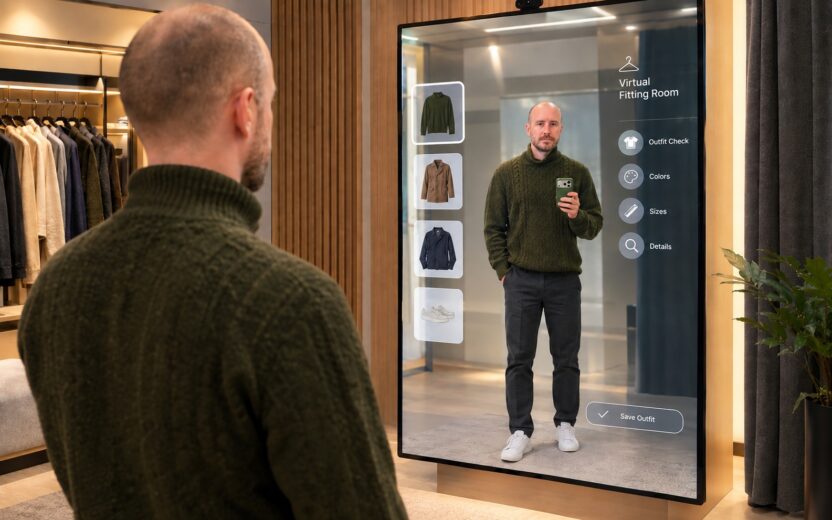
Customer Experience September 18, 2026
From webshop to virtual try-on: how AI is making its way into retail stores
Digital interfaces such as smart mirrors turn AI in the store into a tangible business case. What potential does this hold for the customer experience and in-store personalization? Matthias Vollmer explains how the retail industry can combine the best of both worlds and turn physical touchpoints into an intelligent part of the omnichannel journey.
From webshop to virtual try-on: how AI is making its way into retail storesDon't miss a thing.
Subscribe to our latest blog articles.