Highlight

Successful together – our valantic Team.
Meet the people who bring passion and accountability to driving success at valantic.
Get to know usDecember 11, 2025

The Optimizely OPAL AI Benchmark Report shows just how quickly AI is advancing in marketing. One clear trend is emerging: a shift away from standalone assistant features towards multi-agent systems that orchestrate entire workflows. This marks a move from incremental efficiency gains to a structural transformation across marketing organizations.
Classic AI tools usually handle a single isolated task, like text generation or data analysis. Multi-agent systems, by contrast, work in parallel, coordinated with each other, and role-based. One agent handles research, another writes content, and another plans experiments or summarizes results. Additional agents can support keyword analysis, variant creation, or campaign suggestions.
The result isn’t just more output, but a strategically more robust process that integrates seamlessly into existing marketing workflows.
Complex tasks are automatically structured end-to-end, from hypothesis generation and experiment planning to summarizing results. Teams benefit from clearer decision inputs and a significantly shorter time from idea to test to execution.
Specialized agents support market research, keyword analysis, and industry research. This enables content that is more relevant, better structured, and more closely tailored to target audiences. Longer engagement times help confirm this increase in quality.
While traditional marketing processes run sequentially, multi-agent systems work simultaneously. They deliver drafts, variants, or analyses before a human steps in. This reduces waiting times, alignment overhead, and internal bottlenecks, especially in larger teams.
More experiments, more campaigns, and more personalization become possible without expanding the team. Automating repetitive tasks frees up time for strategic and creative work. Companies can respond faster to market changes while increasing the number of active touchpoints.
The direction is clear:
This makes multi-agent systems a structural foundation for teams that want to increase quality, speed, and scalability in parallel.
Multi-agent systems mark the shift from AI as a point solution to a connected system that supports marketing processes intelligently and at scale. Companies that invest early in multi-agent architectures can secure a lasting advantage: faster decisions, higher quality, and greater agility in dynamic markets.



Artificial Intelligence October 16, 2026
Autonomous Enterprise Journey: How AI value engineering creates measurable business value
How can the ROI of AI initiatives be reliably assessed and measured? How can companies identify the biggest levers and key processes for AI? Katrin Luft, Senior Expert at valantic and co-developer of the “Autonomous Enterprise Journey,” provides answers and recommendations in a conversation with Darya Basarhina, Vice President of Sales & Marketing and Manufacturing Practice Lead at valantic.
Autonomous Enterprise Journey: How AI value engineering creates measurable business value
Customer Experience October 8, 2026
Interview: From PIM to Data Spine – How companies prepare their data for AI
AI is changing the requirements for data, governance, and processes. Where should companies start, and what skills do they need? In this interview, Dietmar Rietsch, CEO of Pimcore, and Timo Huguet of valantic discuss the importance of clean data, the concept of the “Data Spine,” and the changing role of humans in the age of agentic AI.
Interview: From PIM to Data Spine – How companies prepare their data for AI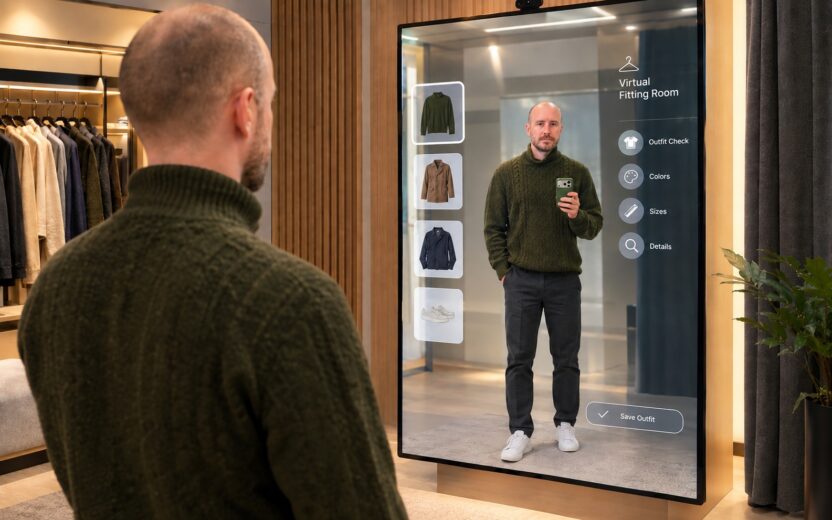
Customer Experience September 18, 2026
From webshop to virtual try-on: how AI is making its way into retail stores
Digital interfaces such as smart mirrors turn AI in the store into a tangible business case. What potential does this hold for the customer experience and in-store personalization? Matthias Vollmer explains how the retail industry can combine the best of both worlds and turn physical touchpoints into an intelligent part of the omnichannel journey.
From webshop to virtual try-on: how AI is making its way into retail storesDon't miss a thing.
Subscribe to our latest blog articles.