Highlight

Successful together – our valantic Team.
Meet the people who bring passion and accountability to driving success at valantic.
Get to know usMarch 13, 2025

Digital transformation is pushing marketing teams to navigate ever greater challenges. As competitive pressure increases, marketing planning becomes more complex, with companies grappling with fragmented workflows and inefficient processes.
Key obstacles include:
Inefficient collaboration often results in delayed market launches and rising costs. To counter this, companies are turning to intelligent software solutions intended to make their content strategies more efficient. One of the leading platforms in this space is Optimizely’s Content Marketing Platform (CMP), designed for holistic and data-driven marketing planning.
But how does Optimizely CMP actually work? And how does it drive efficiency in marketing operations? Let’s take a closer look!
Optimizely’s CMP is a centralized hub for planning, producing, collaborating on, and distributing content. It eliminates the inefficiency of scattered Excel spreadsheets, endless email chains, and manual workflows, replacing them with an intuitive, automated solution.
Four examples of how Optimizely CMP can enhance marketing efficiency:
Marketing teams often operate in disjointed systems, making coordination slow and inefficient. This is where Optimizely CMP comes in. It streamlines collaboration, enabling significantly faster content production through:
Traditional campaigns can take weeks or even months before they launch. With Optimizely CMP, businesses can significantly shorten the planning time through:
Manual workflows often slow down content production and increase the risk of errors. Optimizely CMP enhances speed and consistency with:
A common challenge in marketing is the lack of transparency regarding campaign performance. Optimizely CMP provides robust analytics and optimization features for better performance, including:
Efficiency is the cornerstone of successful marketing planning – and this is precisely where Optimizely’s CMP can help. By simplifying collaboration, automating workflows, and enhancing transparency, it eliminates time-consuming manual coordination and optimizes resource efficiency. When implemented effectively, businesses can streamline content production and significantly improve marketing performance.
However, to fully unlock the platform’s potential and drive measurable efficiency gains, proper implementation is crucial. Key considerations include assessing technical requirements, defining clear processes, and preparing employees for effective adoption. If internal technical or time resources are limited, seeking professional support from an external partner can be a worthwhile investment.

Optimized marketing planning with CMP
Practical solutions, streamlined workflows and powerful tools – discover how to enhance your marketing efficiency.


Artificial Intelligence October 16, 2026
Autonomous Enterprise Journey: How AI value engineering creates measurable business value
How can the ROI of AI initiatives be reliably assessed and measured? How can companies identify the biggest levers and key processes for AI? Katrin Luft, Senior Expert at valantic and co-developer of the “Autonomous Enterprise Journey,” provides answers and recommendations in a conversation with Darya Basarhina, Vice President of Sales & Marketing and Manufacturing Practice Lead at valantic.
Autonomous Enterprise Journey: How AI value engineering creates measurable business value
Customer Experience October 8, 2026
Interview: From PIM to Data Spine – How companies prepare their data for AI
AI is changing the requirements for data, governance, and processes. Where should companies start, and what skills do they need? In this interview, Dietmar Rietsch, CEO of Pimcore, and Timo Huguet of valantic discuss the importance of clean data, the concept of the “Data Spine,” and the changing role of humans in the age of agentic AI.
Interview: From PIM to Data Spine – How companies prepare their data for AI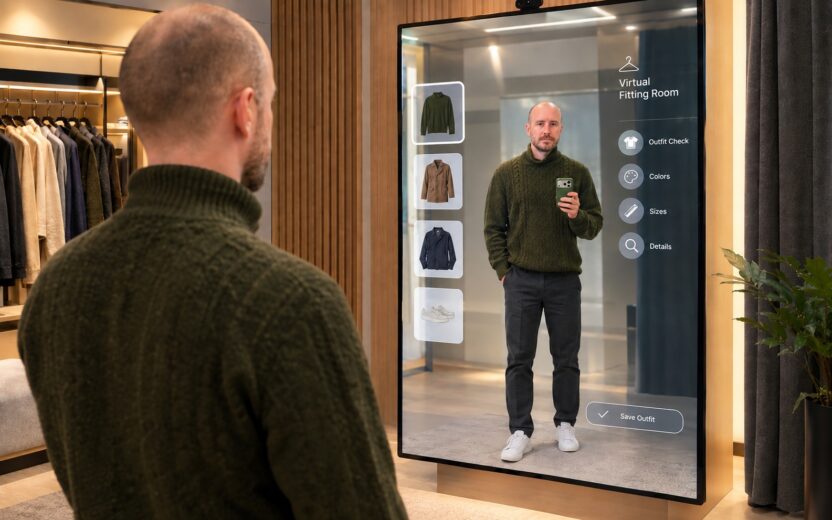
Customer Experience September 18, 2026
From webshop to virtual try-on: how AI is making its way into retail stores
Digital interfaces such as smart mirrors turn AI in the store into a tangible business case. What potential does this hold for the customer experience and in-store personalization? Matthias Vollmer explains how the retail industry can combine the best of both worlds and turn physical touchpoints into an intelligent part of the omnichannel journey.
From webshop to virtual try-on: how AI is making its way into retail storesDon't miss a thing.
Subscribe to our latest blog articles.