Highlight

Successful together – our valantic Team.
Meet the people who bring passion and accountability to driving success at valantic.
Get to know usFebruary 13, 2026

When was the last time you questioned the production lot sizes stored in the system or determined by your production planner’s gut feeling? If you want to produce at optimum cost, you should regularly review your production lot sizes.
This involves checking potential savings, free production capacity and possible reductions in stock levels. In order to break up a long-standing routine in the production area and introduce optimized batches, one thing is needed above all: facts, figures and data!
In production, a batch represents the quantity of products that are manufactured. Choosing the optimal batch size is crucial to ensure that production is efficient, taking into account all relevant cost points and operational restrictions. When determining this, the aim is to achieve a balance between inventory costs and set-up costs. Any batch size optimization should aim to improve the overall result of the company and not just take into account internal departmental concerns.
Smaller batch sizes are often associated with low stock levels, which is why they are a clear objective of logistics. However, frequent changeovers in such cases often lead to lower production efficiency, which is not in the interests of production.
Large batch sizes represent the opposite situation. In situations where the interests of logistics and production often conflict, the optimum batch size is crucial. The goal remains to achieve an overall optimum for the company.
The aim of batch size optimization is to produce at optimum cost, taking into account all relevant items. Two key cost drivers are the following factors:
Inventory costs in logistics for storing the produced item. These include
Set-up costs in production for inserting and placing the item in the production process. These include
The sum of inventory and setup costs is the total cost. The optimum batch size is the minimum total cost.
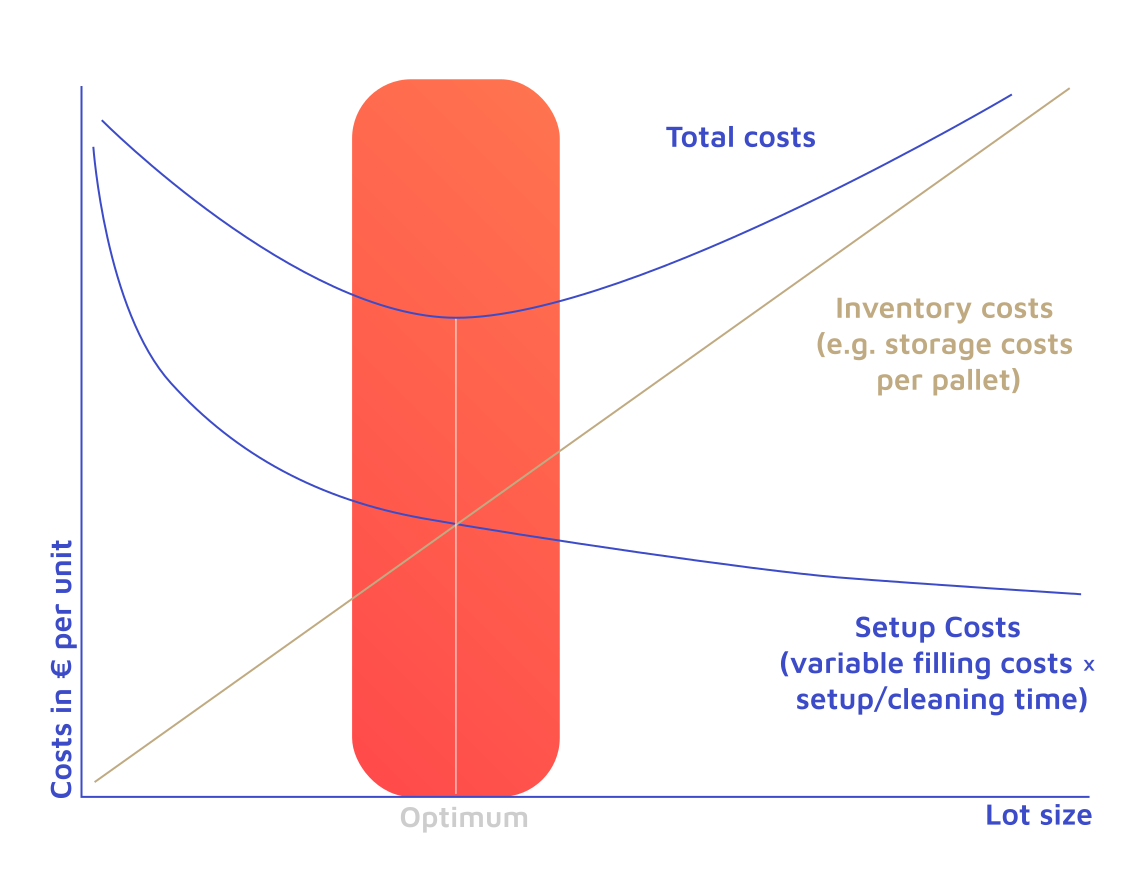
When determining an optimal batch size, it is necessary to differentiate between in-house production and external procurement. This is because the different procurement methods require different approaches depending on the requirements and circumstances of a company.
With in-house production, the focus is on optimizing production batch sizes in order to minimize the total costs of inventory and set-up costs. To this end, the inventory costs and set-up costs for production changeovers must be carefully weighed up. This is the only way to develop the most efficient production quantity.
In contrast, external procurement focuses on optimizing order lot sizes. The aim is to minimize the total costs of inventory and procurement costs. In this case, the costs for warehousing and procurement are taken into account to determine the most economical order quantities.
The procurement costs mentioned here represent the fixed ordering costs, which are made up of the following factors:
The choice of batch size also has a direct influence on throughput times and inventories in production control. This means that, in addition to minimizing costs, the lot size can also be optimized in terms of throughput time. The aim of this is to reduce the time required for a product to pass from order placement to completion.
For example, with a small batch size, the proportion of set-up time in the throughput time per part increases. With a large batch size, however, the waiting times increase, which also increases the throughput time. An optimal batch must therefore be created here, which helps to keep the throughput time as low as necessary.
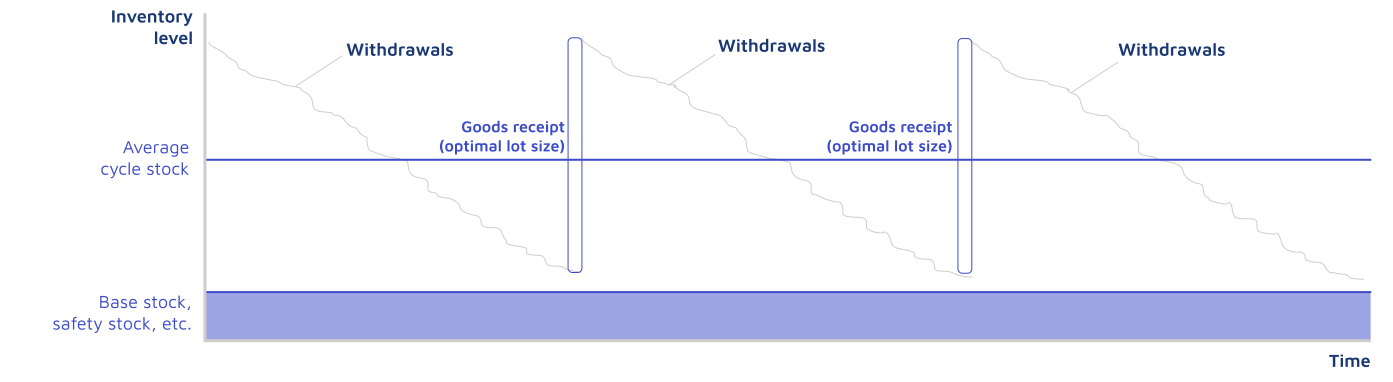
Depending on the result of the lot size optimization, the resulting lot size has a considerable influence on both the inventory and the costs of a company:
Result 1: Reduction of lots
By reducing the lot size inventory, storage costs can be reduced. However, this only applies if no minimum capacities have been agreed with warehouse service providers that are not reached.
Furthermore, a lower stock level usually requires additional setup processes, which would increase the setup costs incurred. In order to cope with this, free capacity must be available in production for both people and machines.
Result 2: Increase in batches
Increasing the batch size eliminates the need for set-up operations, which leads to lower set-up costs. However, savings are only achieved in such cases if the set-up costs can actually be minimized. A savings target usually presupposes a reduction in personnel, as there is less demand due to the elimination of set-up operations.
When presenting relevant lot-sizing methods, a distinction should be made between static and dynamic methods.
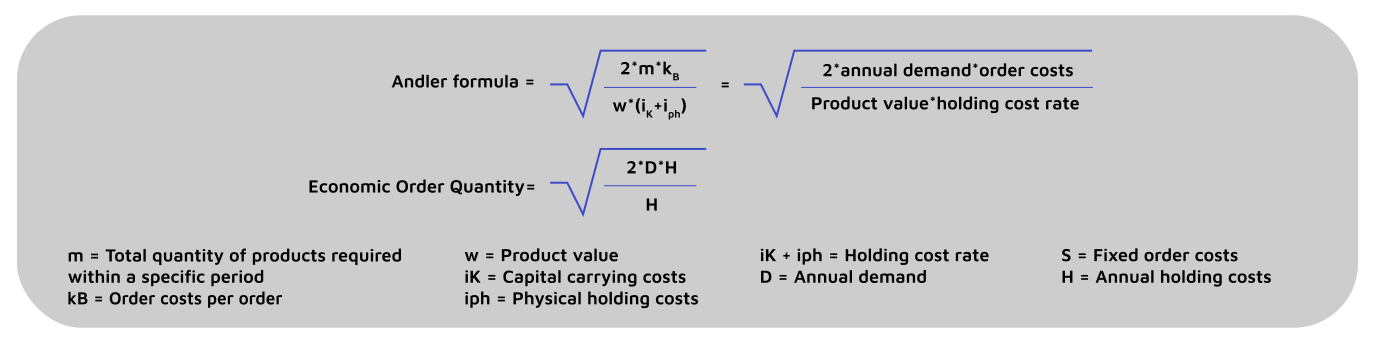
Static methods primarily refer to the total quantity required within a certain period of time and are therefore primarily used to roughly estimate the lot size. These methods include, for example, the Andler method. Andler’s formula for calculating the economic lot size is based on the minimum of the total cost curve. It is assumed that the total requirement quantity remains constant during the planning period, which is, however, difficult to achieve in practice.
Dynamic methods, also known as periodic lot-sizing methods, look at demand over a longer period of time. Based on this, the lot sizes are continuously recalculated. Such methods are more geared towards current demand and can adapt flexibly to changing conditions.
The corresponding approaches include, for example
The procedure only takes into account the costs for the part of the stock that is consumed during the procurement period. This makes it possible to adjust the order quantity more precisely to actual requirements. This is a clear advantage, especially in the case of irregular consumption.
This approach takes into account both storage costs and production changeover costs. The optimum production and order quantity is calculated on this basis, with particular attention paid to dynamic fluctuations in demand.
The procedure is based on the assumption that the material call-off fluctuates randomly within a certain period of time. The optimum batch size is determined taking into account potential uncertainties in the demand situation as well as storage and ordering costs.
Various complications can arise when determining the optimum batch size. These are as follows:
In the field of supply chain optimization, numerous formulas have been developed to determine the optimal batch size for production or ordering. These formulas are based on various assumptions and factors, but all aim to reduce costs.
Two relevant and commonly used formulas are shown in the following diagram.
Preparing the data required to calculate optimum batch sizes is a fundamental task. It should be coordinated and carried out with great care. Ideally, templates are created in advance and sent to the relevant departments as a template. This allows the project manager to consolidate all data packages in a structured form and prepare them for further processing.
Data is required from various areas of the company, such as
Your calculation model for determining the optimum batch size should have a high degree of automation from the outset. A clear structure and the subdivision of input data, data processing matrices and output data are elementary in order to be able to map a living product range.
This ensures that discontinued items can be easily removed and new items added. In addition, operational restrictions from production or other areas can be adapted over time. At the start of a batch size project, the additional effort can increase complexity. However, as part of a rolling review of the optimum batch sizes, the approach leads to a significant increase in efficiency.
As the classic batch size model only considers setup and inventory costs, not all relevant cost items are mapped. These must therefore be carefully identified and integrated into the calculation model.
For example, if the available storage capacities are at their limit, external storage costs must be taken into account. Process costs for retrieval, transportation and storage at the external storage service provider must also be included in the model. Furthermore, an increase in batch sizes can lead to increased disposal costs in some industries.
This applies in particular if stocks remain in the warehouse beyond the best-before date and cannot be sold off. Such a risk must also be anchored in the model via imputed items.
On the other hand, there are possible positive effects such as a reduction in subsequent delivery costs if a larger stock level reduces customer subsequent deliveries. Which specific cost items need to be taken into account when optimizing batch sizes must always be evaluated individually and should not be generalized.
A stringent subdivision of decision-relevant cost items into fixed and variable costs is essential for the correct determination of optimal batch sizes.
The relevance of flat-rate storage costs, for example, depends on the storage capacity.
If sufficient storage space is available, these fixed costs are initially not taken into account in the practice-oriented lot-sizing model. However, if the warehouse is already fully utilized, costs for renting or expanding additional space must be considered as variable components. As part of the lot size optimization, these are allocated to the production items proportionately according to space requirements. In such a case, originally constant storage costs become variable and therefore relevant to the decision.
In the case of variable costs, it is also important to divide them into quantity-induced and lot size-induced. Quantity-induced costs are driven by the pure production quantity and are therefore irrelevant for lot size optimization (for example, the pure production time of an item on a machine). Only the lot size-induced variable costs (e.g. set-up and cleaning times) are to be taken into account in the optimization model.
Every imputed batch size must be supplemented by operational restrictions based on production processes, logistics processes or shift models. A frequent case of such a restriction are specified minimum and maximum lot sizes, determined by tank or container multiples. In practice, these cannot be exceeded or fallen short of, even if a deviation would be advantageous from a mathematical point of view.
To ensure that no operational restrictions have been overlooked, the calculated results must be carefully checked. To this end, the optimum batch sizes should be discussed and scrutinized in interdisciplinary teams.
If the result of lot size optimization is the reduction of lots and lot size stock, this should be checked conclusively. It must be clarified whether the identified potential will also have an impact on the P&L. In the case of reducing lots, this is only possible if, for example, no minimum capacities have been agreed with a service provider in the warehouse. Such capacities should not be undercut by the optimization.
Furthermore, free production times and sufficient manpower must be available due to additional set-up processes in production. This is the only way to ensure that potential savings are not offset by reduced production volumes and lost sales.
If the result of batch size optimization is to increase the number of batches, potential savings can only be achieved if set-up costs can actually be reduced. As a rule, this is associated with a reduction in personnel, as set-up processes are no longer required.
In the final project phase, you should put all the calculated results to the test again and validate their practical feasibility. Who benefits from savings on paper if they are not reflected in the P&L at the end of the year?
This can be done by prioritizing the items. Calculate the savings potential per unit of measure for each item.
Start with items that have the highest relative savings potential and are considered less critical in terms of production.
The change over to optimum batch sizes should not be made across the entire portfolio in one fell swoop. Instead, a gradual implementation across different article categories makes sense in order to minimize risks and realize the overall potential step by step.
Finally, some good news: the Pareto principle or the 80-to-20 rule often also applies in the area of batch size optimization. In many cases, 80 percent of the identified savings potential can be realized with only 20 percent of the effort. This can be achieved by making relatively small adjustments to your production batch sizes.
Take advantage of this to convince critical colleagues with small changes to operational processes. In this way, you can demonstrate the effect of your project without major interventions. Depending on the difficulty of implementation in the operational production processes, it may make sense to forego the optimum result. In such cases, it is sufficient to be satisfied with the 80 percent mentioned above.
You should regularly review and calculate optimum batch sizes as part of your production processes. This is because product ranges, cost structures and operational restrictions are constantly changing in fast-moving markets. In practice, a large number of companies are still far from producing at optimum cost, meaning that significant savings potential remains untapped.
The optimum batch in your production cannot usually be identified at a glance and requires carefully prepared analyses. In many cases, the result of these efforts is a significant effect on your P&L. Depending on the industry and production process, savings in the six-figure range are possible.
In today’s dynamic business world, it is essential to regularly check batch sizes. This is the only way to ensure cost-efficient production in the long term.
The choice of the optimum batch size must be based on a balance between inventory and set-up costs. It should always be geared towards the company’s overall result. Both high and low batch sizes offer advantages and disadvantages. These must be carefully weighed up depending on the company.
The primary challenge is to achieve a clear balance between logistics and production. The aim is to achieve an overall optimum for your company.

How do you improve efficiency and transparency in production and warehousing?
We analyze your production and warehouse processes, identify weak points and develop solutions that shorten throughput times, optimize inventories and improve planning quality. Talk to us – we will accompany you on the way to stable, efficient processes!

Dennis Goetjes
Partner
valantic
Don't miss a thing.
Subscribe to our latest blog articles.