Highlight

Successful together – our valantic Team.
Meet the people who bring passion and accountability to driving success at valantic.
Get to know usSeptember 19, 2024

Good design follows a user-centered approach, making usability and user experience (UX) crucial in product development. As digital transformation progresses, companies face significant challenges in these areas.
The objective: to create an interaction with the product that is effective, efficient and satisfying. But how can this be achieved? We present seven key design criteria, illustrated with an example from the automotive industry.
Results of good design
Striving for user-centered design should be a continuous focus in product development, applicable across all industries. A design that prioritizes users enhances two key aspects:
Case study from the automotive industry
Let’s explore the design criteria outlined by Dieter Rams and Jakob Nielsen, illustrated with an example from the automotive industry. This case not only highlights key aspects of usability and user experience but also serves as a model for product development across various industries.
Automation is a crucial element of modern design, aimed at making user interactions as simple and comfortable as possible.
In the automotive industry, automated systems like adaptive cruise control and lane-changing assistants have become standard, significantly improving both safety and comfort. Additionally, infotainment systems that suggest frequently visited destinations and streamline address entry further enhance user-friendliness.
Advanced design minimizes the risk of operational errors and provides clear, straightforward solutions for troubleshooting. This lays the foundation for a user experience that prioritizes safety. In the automotive sector, intuitive control displays and warning signals play a crucial role in enhancing safety. Seatbelt reminders and low tire pressure notifications are practical examples of this design principle in action.
In an ideal world, a product would be so intuitively designed that it requires no extra support for use or maintenance. However, even user-friendly products should offer effective assistance when needed. In the automotive sector, augmented reality (AR) applications enhance this support by providing visual aids that simplify tasks for drivers.
Personalization allows users to tailor a product to their specific needs (such as adjusting displays for colorblindness) and preferences.
For instance, imagine a personalized driver profile in a vehicle that remembers individual settings like music volume, seat position, and temperature. This would enhance comfort and efficiency, particularly when the vehicle is shared by multiple users.
Users should always have control over a product and a clear understanding of what is happening. In digital products, this is achieved through basic features like an exit button or displaying battery status during charging.
In the automotive sector, transparency and control are crucial for safety. For example, drivers must be constantly aware of the remaining range and have the ability to influence the driving process, even in (partially) autonomous vehicles.
Less is more. Paring down to the essentials is a guiding principle of great design. In automotive design, this means minimizing distractions from driving. Head-up displays that provide only the most critical information are a perfect example of this principle in action.
A well-designed user interface is intuitive and close to reality – users should easily recognize and understand the symbols and functions based on their real-world counterparts. This familiarity allows for quick and effortless navigation. In addition, consistency in design language is crucial; it must remain uniform throughout any process or function.
In vehicles, common examples include the universal seatbelt icon or clear illustrations indicating the status of airbags, the fuel level or battery. If the connection between the image and reality fails, users may miss critical information.
The example from the automotive industry demonstrates that the seven design criteria are universally applicable. In the complex and ever-evolving automotive sector, these principles ensure enhanced comfort and safety, while also driving and shaping innovation.
If your customers are your top priority, let’s talk! We can help you bring your product to market with a focus on customer-centered solutions.

Dennis Winter
Manager
valantic

Cynthia Hoops
Principal
valantic


Artificial Intelligence October 16, 2026
Autonomous Enterprise Journey: How AI value engineering creates measurable business value
How can the ROI of AI initiatives be reliably assessed and measured? How can companies identify the biggest levers and key processes for AI? Katrin Luft, Senior Expert at valantic and co-developer of the “Autonomous Enterprise Journey,” provides answers and recommendations in a conversation with Darya Basarhina, Vice President of Sales & Marketing and Manufacturing Practice Lead at valantic.
Autonomous Enterprise Journey: How AI value engineering creates measurable business value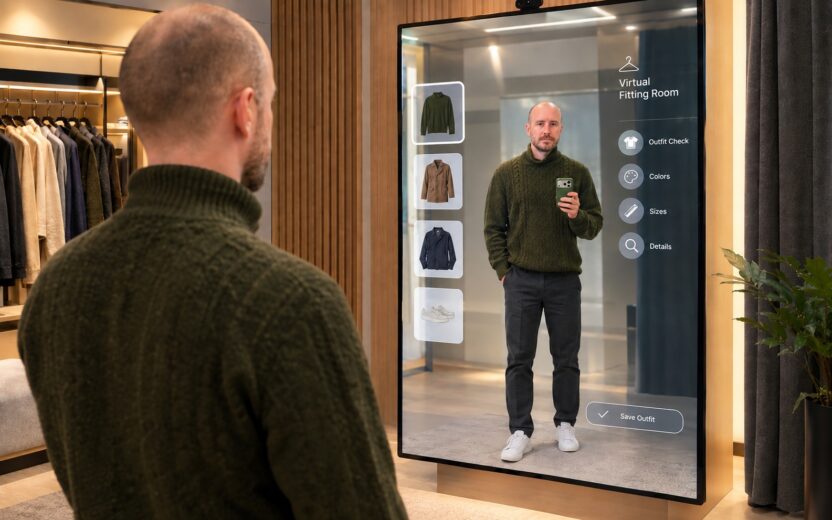
Customer Experience September 18, 2026
From webshop to virtual try-on: how AI is making its way into retail stores
Digital interfaces such as smart mirrors turn AI in the store into a tangible business case. What potential does this hold for the customer experience and in-store personalization? Matthias Vollmer explains how the retail industry can combine the best of both worlds and turn physical touchpoints into an intelligent part of the omnichannel journey.
From webshop to virtual try-on: how AI is making its way into retail stores
Customer Experience August 27, 2026
Interview: How manufacturing stays digitally visible and AI-relevant
In the manufacturing sector, purchasing decisions are increasingly being made before the sales team is even involved. Designers, planners, maintenance technicians, and buyers conduct online research—and are increasingly receiving AI-generated responses. How can marketing teams at manufacturing companies ensure digital visibility and AI relevance? Answers and recommendations from the Manufacturing Practice.
Interview: How manufacturing stays digitally visible and AI-relevantDon't miss a thing.
Subscribe to our latest blog articles.