Highlight

Successful together – our valantic Team.
Meet the people who bring passion and accountability to driving success at valantic.
Get to know usAugust 6, 2026


Every board endorses a data-driven strategy. Every technology team is modernizing its platforms. Every business unit sponsors an analytics roadmap. And yet, in most organizations, the answer to a simple question stays the same. Ask “where do I find trustworthy data about customer X?” and you get a chain of emails, a screenshot forwarded three times, and whoever happens to still work here and remembers.
That is the paradox of the modern enterprise: companies own more data than ever, but a growing share of decisions gets made on intuition, because the data never reaches the people who need it.
The instinct is to treat this as a technology gap. Buy a better platform, stand up another warehouse, form a governance committee. But two decades of accumulated capability, from warehouses and lakes to lakehouses, governance frameworks, and master data tools, have not solved the original promise: that data would behave like a strategic resource. The same questions still get answered with different numbers depending on who runs the query. Analysts still spend most of their time hunting and reconciling rather than analyzing. Even well-resourced organizations still cannot trace a board-level KPI back to its source systems with confidence.
The root cause is not technical, and that is the part most easily missed. It is that data does not move. It sits in domain silos, in personal spreadsheets, in legacy systems whose owners have long left, and in shadow extracts nobody dares delete. More than half of all enterprise data is never analyzed. This so-called dark data keeps growing, and the volume of unstructured data alone is set to nearly double, from 5.5 zettabytes in 2024 to over 10 by 2028. The gap between the data that exists and the data that flows keeps widening.

Across more than fifty data transformation engagements, the same five symptoms recur with remarkable consistency. They are worth naming precisely, because the real damage comes from how they reinforce one another.
Consumers cannot find what already exists. The organization has a CRM, an ERP, half a dozen analytical platforms, and several departmental warehouses, but no canonical view of which data sets live where, who owns them, and what they mean. The cost is hidden but enormous: teams rebuild the same data product three or four times, simply because they never knew a usable version was already there. What is invisible cannot be reused, and what cannot be reused has to be rebuilt.
Even when it is found, its meaning is ambiguous. Column names are cryptic, units are inconsistent, and the same business concept, whether active customer, net revenue, or open order, is defined differently in different domains. Without a shared semantic layer, every analytical question becomes a translation exercise, and every answer carries an implicit asterisk. Discoverability without understandability just moves the bottleneck one step downstream.
Found and understood is still not believed. Lineage is missing, quality is opaque, and the most recent number is not necessarily the most correct one. Faced with two contradictory KPIs, decision-makers default to the one that fits what they already thought, and data-driven decision-making quietly collapses into the theater of “my number versus your number.”
Where trust is missing, sharing is the next casualty. Organizational and legal friction blocks what trust alone might have allowed. Approvals take weeks. Access requests get lost between data owners, security teams, and platform administrators. The default answer becomes “no,” because “no” carries less regulatory risk than “yes.” And the slowest-moving actor in the chain sets the pace for everyone.
Where governance exists at all, it tends to be reactive, manual, and confined to a handful of regulated domains. Policy enforcement, purpose binding, audit trails, and access controls are bolted on late rather than built into the data pathway. The result is a slow oscillation between under-governance, which produces data leaks, and over-governance, which produces data freezes.
The temptation is to fix these one at a time. Buy a catalog to solve discoverability. Run a glossary project to solve understandability. But treat them as independent and you simply shift the bottleneck: a searchable catalog full of data nobody understands is no better than no catalog at all.
Taken together, these five are not separate failures. They are the visible surface of a single underlying condition. Data that is undiscoverable is also not shared. Data that is not understood is also not trusted. An organization that cannot govern at scale is also one that says no by default.
The cumulative effect is the most expensive part. The most valuable data movements, meaning the cross-domain combinations that fuel customer 360 views, AI features, and genuine strategic insight, simply never happen. Nobody sees them fail, because they were never attempted.
There is an economic way to frame this. If data is a factor of production, alongside capital, labor, and knowledge, then an enterprise without a way to allocate it is structurally like a market economy without prices. Producers do not know what consumers value. Consumers do not know what producers offer. And the resulting misallocation stays invisible, because no one ever sees the trades that fail to happen.
That reframing points to the fix. The problem is not a missing tool. It is a missing allocation mechanism: a curated, governed venue where data products are published, discovered, and consumed at scale, replacing ad-hoc bilateral exchanges with something transparent and reusable.
Which is also why, somewhere around the third stalled AI pilot, many organizations will discover the uncomfortable truth: the bottleneck was never the model. It was always the data foundation underneath it.
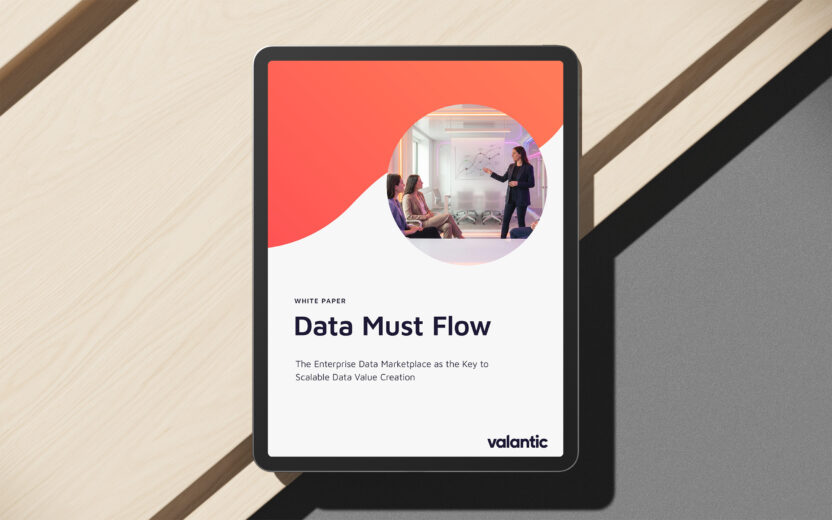
Data Must Flow: The Enterprise Data Marketplace as the Key to Scalable Data Value Creation
Data does not flow on its own. Discover why neither another data warehouse nor another governance committee is the answer, and how the Enterprise Data Marketplace turns your data from a hidden by-product into a curated, reusable asset. The white paper also shows why the reliability of agentic AI workflows depends on this data foundation, and how a focused lighthouse project delivers a business case in a quarter rather than a year.

Dr. Sven-Erik Willrich
Senior Manager
valantic

Artificial Intelligence July 15, 2026
Homework for the Autonomous Enterprise: Architecture, Data, and Processes
SAP Sapphire has refined the vision of the Autonomous Enterprise—now it’s time to put it into practice. Part 2 of our blog series highlights four key building blocks: transparent architecture and agent governance with LeanIX, the path to the cloud, a solid data foundation in the SAP Business Data Cloud, and processes made visible through process mining.
Homework for the Autonomous Enterprise: Architecture, Data, and Processes
Digitalization September 18, 2024
Essential factors and hallmarks of successful data initiatives
Thriving in today’s data-driven business environment requires strategic data thinking. Data initiatives form the foundation for long-term, sustainable strategies. But what differentiates a successful data initiative? At valantic, we’ve identified four critical factors and nine key characteristics that ensure the success of data initiatives. Data initiatives: the key to data thinking success Data is at […]
Essential factors and hallmarks of successful data initiatives
Customer Experience March 26, 2024
Navigating the Data Universe: Master Data Governance
How is AI transforming the world of master data governance? With a special focus on AI integration, this blog reveals how technologies are revolutionising master data governance, essential for improving both compliance and data quality and enhancing strategic decision-making.
Navigating the Data Universe: Master Data GovernanceDon't miss a thing.
Subscribe to our latest blog articles.