Highlight

Successful together – our valantic Team.
Meet the people who bring passion and accountability to driving success at valantic.
Get to know usAugust 20, 2026


A quick reality check: how long would it take your organization to produce an accurate, current headcount — broken down by country and function? If the honest answer is “a day or more,” your HR data isn’t integrated. It’s assembled.
That distinction matters more than it sounds. Assembled data comes from stitching together exports, spreadsheets, and manual reconciliation every time someone asks a question. Integrated data is simply there, ready to query. Most HR teams are still living in the first world.
Nearly half of HR professionals — 47 % — don’t frequently integrate business data with HR data. Even more, 77 %, name integrating disparate data sources as one of their biggest people analytics challenges (State of People Analytics 2025). The numbers explain a pattern many HR leaders will recognize instantly.
What does that look like day to day?
The result isn’t insight. It’s a snapshot — accurate for the five minutes after someone finished compiling it.
Not every organization needs the same HR system, and that’s the point often missed in the search for “the best HRIS.” The right platform depends on company size, structure, and how much complexity you actually need to manage.
Broadly, three tiers of HR systems are handling this problem right now:
Modern / SMB platforms prioritize an intuitive interface and low administrative overhead — built for lean teams that need answers fast, not a configuration project.
Modern / Enterprise platforms combine that same ease of use with enterprise-grade depth, aimed at fast-growing, multi-country organizations that have outgrown spreadsheets but don’t want SAP level complexity.
Enterprise platforms are built for large, highly regulated organizations where compliance, benchmarking, and workforce complexity are the primary drivers.
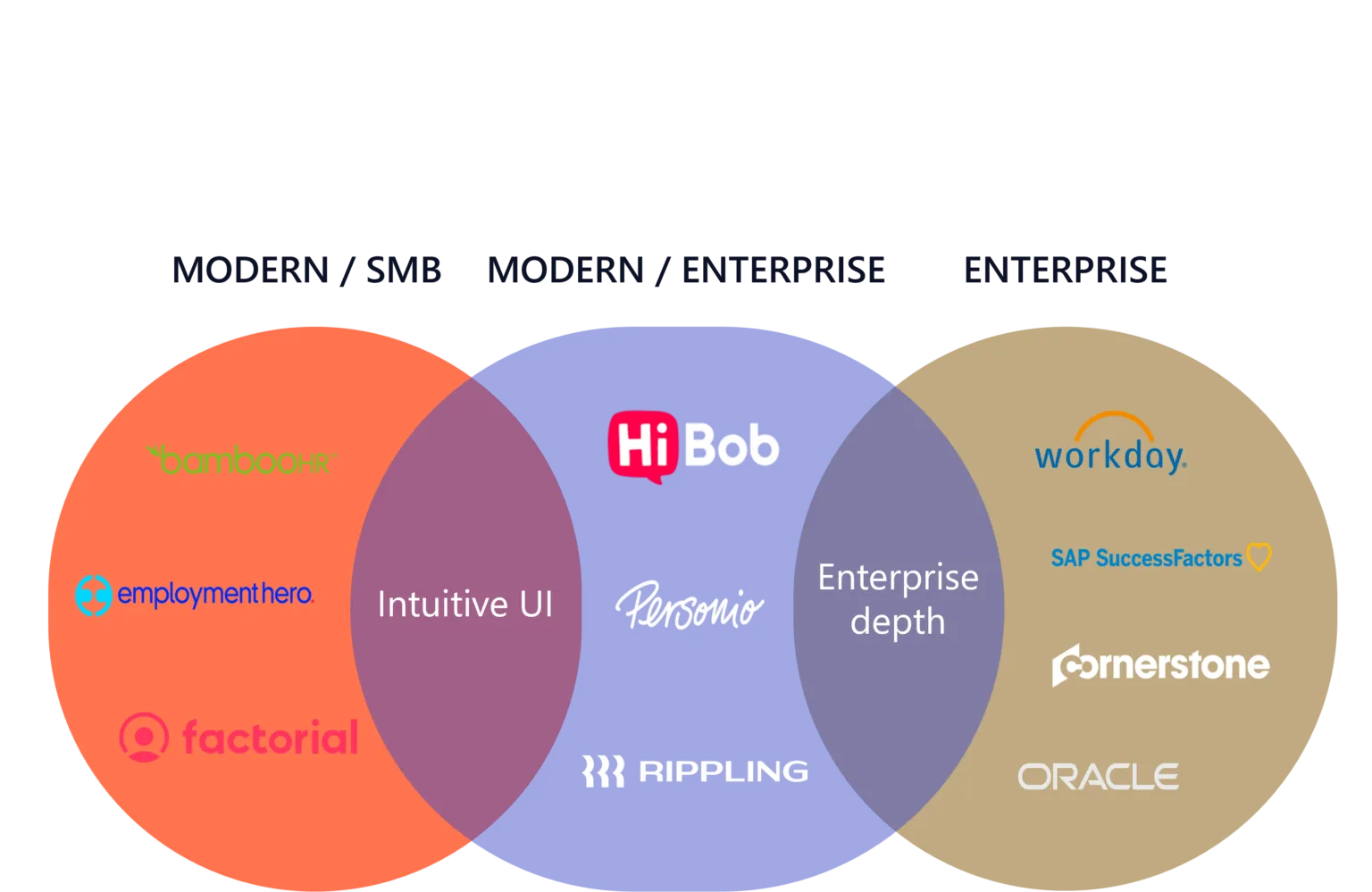
To make this concrete, here’s how three widely used HR systems actually differ in their reporting approach:
is built for fast-growing scale-ups that want accessible insights without heavy setup. Pre-built dashboards and self-service reports come ready out of the box, designed for HR teams and people managers who need headcount, attrition, and engagement figures at a glance — not a BI project.
targets large organizations that need deep, real-time, cross-domain reporting. It runs HR and finance analytics on a single data model, with highly configurable reports and the ability to blend in external data for genuinely cross-functional analysis.
is built for global enterprises already operating in the SAP ecosystem. Reporting sits embedded within the wider SAP and analytics landscape, with workforce benchmarking, governed analytics, and story-based reporting through SAP Analytics Cloud.
None of these is universally “better.” Each solves a different version of the same underlying problem — and choosing the wrong tier tends to recreate the spreadsheet chaos you were trying to escape, just inside a more expensive system.
Before comparing feature lists, it’s worth asking the simpler question: how long does it currently take your organization to answer one basic HR question with confidence? If that answer involves multiple exports, a spreadsheet, and a colleague’s tribal knowledge, the issue usually isn’t a missing report. It’s a missing single source of truth.

Ready to simplify your HR tech stack?
At valantic, we help growing multinational scale-ups evaluate, select, and implement the right, unified HRIS. Whether you’re considering HiBob, Personio, SuccessFactors, Workday, or another platform—our implementation expertise will help you choose the solution that grows with your ambitions.

Artificial Intelligence October 16, 2026
Autonomous Enterprise Journey: How AI value engineering creates measurable business value
How can the ROI of AI initiatives be reliably assessed and measured? How can companies identify the biggest levers and key processes for AI? Katrin Luft, Senior Expert at valantic and co-developer of the “Autonomous Enterprise Journey,” provides answers and recommendations in a conversation with Darya Basarhina, Vice President of Sales & Marketing and Manufacturing Practice Lead at valantic.
Autonomous Enterprise Journey: How AI value engineering creates measurable business value
Customer Experience September 18, 2026
From webshop to virtual try-on: how AI is making its way into retail stores
Digital interfaces such as smart mirrors turn AI in the store into a tangible business case. What potential does this hold for the customer experience and in-store personalization? Matthias Vollmer explains how the retail industry can combine the best of both worlds and turn physical touchpoints into an intelligent part of the omnichannel journey.
From webshop to virtual try-on: how AI is making its way into retail stores
Customer Experience August 27, 2026
Interview: How manufacturing stays digitally visible and AI-relevant
In the manufacturing sector, purchasing decisions are increasingly being made before the sales team is even involved. Designers, planners, maintenance technicians, and buyers conduct online research—and are increasingly receiving AI-generated responses. How can marketing teams at manufacturing companies ensure digital visibility and AI relevance? Answers and recommendations from the Manufacturing Practice.
Interview: How manufacturing stays digitally visible and AI-relevantDon't miss a thing.
Subscribe to our latest blog articles.