Highlight

Successful together – our valantic Team.
Meet the people who bring passion and accountability to driving success at valantic.
Get to know usOctober 15, 2025

From September 15 to 18, 2025, the European data and AI community gathered in Vienna with over 4,200 participants for FabCon Europe 2025, the largest Microsoft Fabric event of the year. The latest features were presented and discussed in over 130 sessions, workshops, and panels. A central topic was the role and use of AI agents in Microsoft Fabric for businesses and developers.
Particular focus was placed on the new features related to data agents, the combination with Azure AI Foundry, and the ability to intelligently process data and make it available to users.
Microsoft Fabric is rapidly becoming the leading platform for data integration, analysis, and AI-powered insights. With Data Agents, Microsoft is expanding the ecosystem with a feature that makes accessing information more intuitive and understandable.
Instead of needing SQL or DAX skills, business users will be able to ask questions in natural language, such as about the current order situation, deviations in production, or sales figures, and receive useful answers directly. To do this, Data Agents access OneLake, data warehouses, mirrored databases, or other connected sources without making the complexity visible to users.
At FabCon, emphasis was placed on how crucial the quality of data sources, indexing, and semantic structuring are for reliable answers. The new features (in public preview) allow creators to combine data sources in a targeted manner, describe them semantically, and enrich them with example scenarios. All this includes Markdown instructions and diagnostic tools for quality assurance. This offers the opportunity to better adapt the AI agent to individual needs and context.
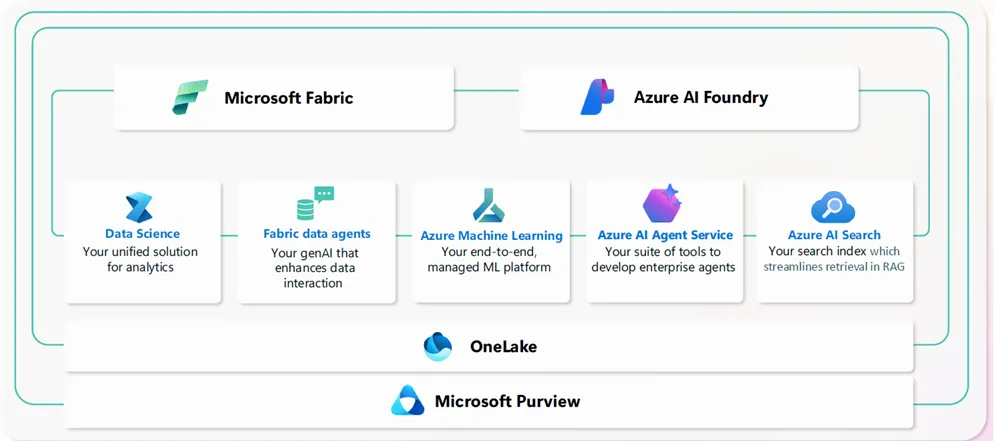
Another highlight of FabCon was the integration of Azure AI Foundry, the successor to Azure AI Studio, into the Fabric agent model. In addition to AI services in the areas of vision, document intelligence, and speech, it also offers support via AI Search. The vector indexes of AI Search support scalable RAG (retrieval-augmented generation) architectures and ensure high search accuracy. Azure AI Foundry acts as the central framework for building, managing, and orchestrating AI agents.
Particular attention was paid to connecting Foundry with Azure AI Search to implement RAG (retrieval-augmented generation) architectures. This enables generative responses based on external, vector-based indexes to be output. This feature simplifies searching across unstructured documents, PDFs, or text files. The latter has only been announced at FabCon and is therefore not yet fully available.
The ability to combine semantic search with Fabric Data Agents opens up new application scenarios, from automated document retrieval to live analysis of ticket or support data. Azure AI Search makes it possible to efficiently index and query structured and unstructured (previously only announced) information and integrate it into AI responses based on context. The response includes source references for complete transparency. This allows users to better understand the results and verify the accuracy of the statement.
Microsoft describes this connection as a way to anchor AI agents with domain-specific business knowledge. Access to the Data Agent is provided via a published endpoint, which can ultimately be shared with employees.
Particularly exciting: Microsoft announced at FabCon that unstructured data sources will be even easier to integrate into Fabric Data Agents in the future. New utilities in notebooks allow PDFs and text files to be indexed automatically without having to provide additional resources. Users simply select a Lakehouse folder and search in natural language.
Another key topic: AI Functions. These enable data to be enriched directly in notebooks, pipelines, or data flows using generative models – for example, through summarization, classification, or extraction. The public preview introduced initial use cases for large language models (LLMs) in just one line of code. Integration into SQL and Dataflows Gen2 is in the works.
These functions pave the way for a new form of low-threshold interactive data processing, a decisive step toward enabling specialist departments to use AI-supported data logic.
The innovations presented at FabCon 2025 clearly show that the future of data work lies in context-aware, interactive agents that understand natural language and are anchored in corporate data. The possible applications are manifold: document management becomes much easier when agents deliver valuable and context-related results by accessing SharePoint content, PDFs, or knowledge databases, without any manual searching. Live evaluations of material flows or production data can be accessed in the production and supply chain by agents that interact with ERP and sensor data models. Also interesting are automated response suggestions based on ticket systems and mailboxes for customer support, including escalation management and trend analysis.
The prerequisites for these scenarios are clean data models, well-configured agents, and the appropriate orchestrated AI infrastructure – all of which can be mapped with Fabric, Azure AI Foundry, and Azure AI Search.

valantic as a strategic partner
FabCon 2025 has demonstrated that technology is ready. Now the question is: How can these powerful tools be securely and purposefully integrated into their own data ecosystem with genuine strategic added value? This is precisely where our work as a strategic partner begins. As an implementation partner, we help you effectively design data agents, orchestrate them with Azure AI Foundry, and put them to productive use.
Don't miss a thing.
Subscribe to our latest blog articles.