Highlight

Successful together – our valantic Team.
Meet the people who bring passion and accountability to driving success at valantic.
Get to know usSeptember 24, 2024

In today’s global market, where competition is fierce, companies must continuously innovate to stay ahead. However, many struggle with limited expertise, especially in complex areas like technology and IT. So, how can companies still rise as leaders in innovation or become “fast followers”? At valantic, we believe that co-opetition is the key to accelerating successful development processes.
Unity is strength: Collaboration between companies to bring innovative products and business models to life could be the magic pill for staying ahead in the market. The benefits? Accelerated development, efficient use of resources, and the creation of synergistic and network effects.
The challenge, however, arises when partners are also competitors, blurring market boundaries. The silver lining? With a well-organized structure in place, nothing stands in the way of successful cooperation between otherwise competing companies.
From cooperation parameters to solution development
At valantic, we refer to this type of collaboration as “co-opetition”. Due to the overlapping domains between cooperating competitors, a well-defined governance framework is essential. Governance serves as the structure for managing, controlling, and safeguarding the organization, incorporating all tools necessary to build trust both internally and externally. In the context of co-opetition, governance must be clear, mutually beneficial, and fully compliant with legal standards.
The clarification of objectives, intentions, and modes of implementation of the cooperation should be the first step and must be anchored in the foundational structure as the organizational purpose – often formalized in a memorandum of understanding. This document should also address the following points:
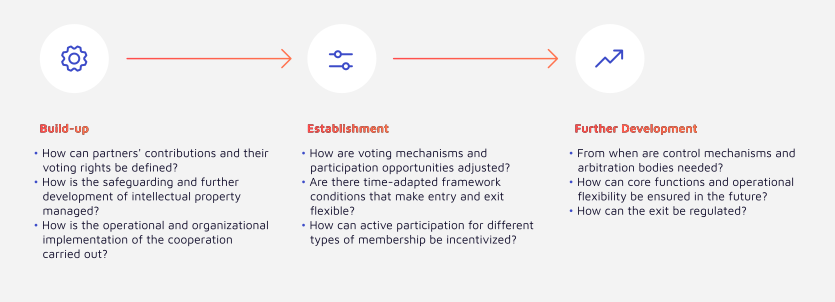
After establishing the cooperation parameters, the process of governance formation begins. This multi-stage process addresses key questions at each phase of development.
2.1 Build-up: How can the partners’ contributions and voting rights be defined? How will intellectual property be protected and further developed? What strategies will be used for the operational and organizational implementation of the cooperation?
2.2 Establishment: How can coordination mechanisms and participation opportunities be adapted? Are there time-flexible frameworks that allow for easy entry and exit? What incentives can encourage active participation among diverse member types?
2.3 Further development: When are control mechanisms and arbitration bodies necessary? How can core functions be maintained while ensuring operational flexibility in the future? What processes should govern exits?

Marc Lamhofer
Manager
valantic
Would you like to develop your business model cooperatively and align it both organizationally and constitutively? Reach out to our experts today!


Customer Experience September 18, 2026
From webshop to virtual try-on: how AI is making its way into retail stores
Digital interfaces such as smart mirrors turn AI in the store into a tangible business case. What potential does this hold for the customer experience and in-store personalization? Matthias Vollmer explains how the retail industry can combine the best of both worlds and turn physical touchpoints into an intelligent part of the omnichannel journey.
From webshop to virtual try-on: how AI is making its way into retail stores
Customer Experience August 27, 2026
Interview: How manufacturing stays digitally visible and AI-relevant
In the manufacturing sector, purchasing decisions are increasingly being made before the sales team is even involved. Designers, planners, maintenance technicians, and buyers conduct online research—and are increasingly receiving AI-generated responses. How can marketing teams at manufacturing companies ensure digital visibility and AI relevance? Answers and recommendations from the Manufacturing Practice.
Interview: How manufacturing stays digitally visible and AI-relevant
Digitalization August 20, 2026
How many spreadsheets does it take to answer one HR question?
HR teams spend hours every day stitching data together across disconnected systems — 77% say integrating people data is one of their biggest analytics challenges. Discover what real, unified people analytics looks like, and how choosing the right HRIS turns scattered snapshots into one source of truth.
How many spreadsheets does it take to answer one HR question?Don't miss a thing.
Subscribe to our latest blog articles.