Highlight

Successful together – our valantic Team.
Meet the people who bring passion and accountability to driving success at valantic.
Get to know usOctober 14, 2025

These are common objections we hear in performance marketing. But they miss the mark. When approached holistically, branding isn’t a “nice-to-have” – it’s a powerful driver of long-term digital marketing success.
So how can branding be strategically and measurably integrated into marketing initiatives? We’ll break it down for you.
Today’s customers switch effortlessly between platforms, devices, and channels – and they gravitate towards brands they recognize and associate with positive experiences. According to the Consumer Behavior Index 2025 (SOCi), consumers interact with a brand an average of 3.6 times before making a purchase decision.
To stay relevant in this complex landscape, you need:
This approach ensures your brand reaches consumers with the right message, on the right channel, at the right moment.
An omnichannel strategy was developed for a tourism region in Germany, with a focus on the federal state of Hesse, and implemented over a period of two months. The aim was to be present across different touchpoints and maximize reach and conversions. Both high-reach advertising formats and campaigns optimized for bookings were used.
The results at a glance (compared to the previous year):
Programmatic advertising automates and optimizes campaigns in real time. From branding-focused channels like CTV, DOOH, and audio to precise remarketing strategies – anything is possible. Instead of broad, untargeted distribution, programmatic advertising ensures your message reaches relevant audiences from the very first interaction – via geo, interest, or behavioral data. Every interaction is measurable and can be leveraged for retargeting.
At the same time, digital advertising formats are evolving rapidly. Traditional TV, out-of-home, and radio once offered reach but little control. Today, these channels are merging with the strengths of programmatic technology. Connected TV (CTV) and programmatic digital out-of-home (DOOH) are among the most exciting innovations. They make branding just as precise, data-driven, and measurable as performance marketing.
Connected TV (CTV) combines the emotional power of traditional TV commercials with the precision of digital advertising, offering accurate targeting, measurable results, and flexible campaign control. For advertisers, this means fewer scattering losses, higher efficiency, and access to audiences that rarely watch traditional television. With a well-designed CTV strategy, impactful TV advertising is now feasible even for smaller brands.
Particularly powerful: the combination of CTV and retargeting. Viewers who have seen a commercial can be re-engaged on their second screen, seamlessly integrating them into the digital funnel for the first time.
For the relaunch of a brand, a CTV campaign was run in selected federal states via Servus TV, SevenOne, RTL, and Samsung TV. The challenge was to re-engage viewers after the TV broadcast. The CTV environment often lacks consistent user IDs and clickable elements, making direct interaction and measurability difficult.
Using the full-stack platform Adform, available identifiers in the CTV environment were segmented via a data management platform (DMP). ID fusion technology then expanded this data by including identifiers from other devices in the household.
The result:
Conclusion: CTV retargeting makes TV advertising measurable and optimally combines branding with performance.
Programmatic DOOH is one of the fastest-growing segments in digital marketing, with forecasts predicting double-digit annual growth rates.
Key advantages:
In Lindau, digital screens were activated for one month in high-traffic locations such as train stations, the city center, and shopping malls to promote the tourism region. The objective: to specifically reach potential day visitors.
The result: a +200 % increase in website traffic from the target regions (compared to the previous year)
Another tourism company ran a DOOH campaign in high-traffic areas across Munich and enhanced it with mobile sync. Using geofencing and mobile device IDs, the campaign identified people who were near the digital screens and re-engaged them with relevant display ads on their smartphones.
The result:
Good to know: Adform is currently the only global DSP that offers an integrated DOOH planner, enabling international campaigns to be launched quickly and efficiently – and with precise audience targeting.
The examples clearly demonstrate that modern branding initiatives go far beyond generating reach. They can be precisely targeted, thoroughly tracked, and intelligently connected across channels. As a result, branding has become an essential component of the digital media mix – one that not only strengthens brand equity but also drives sustainable performance over time.


Artificial Intelligence October 16, 2026
Autonomous Enterprise Journey: How AI value engineering creates measurable business value
How can the ROI of AI initiatives be reliably assessed and measured? How can companies identify the biggest levers and key processes for AI? Katrin Luft, Senior Expert at valantic and co-developer of the “Autonomous Enterprise Journey,” provides answers and recommendations in a conversation with Darya Basarhina, Vice President of Sales & Marketing and Manufacturing Practice Lead at valantic.
Autonomous Enterprise Journey: How AI value engineering creates measurable business value
Customer Experience October 8, 2026
Interview: From PIM to Data Spine – How companies prepare their data for AI
AI is changing the requirements for data, governance, and processes. Where should companies start, and what skills do they need? In this interview, Dietmar Rietsch, CEO of Pimcore, and Timo Huguet of valantic discuss the importance of clean data, the concept of the “Data Spine,” and the changing role of humans in the age of agentic AI.
Interview: From PIM to Data Spine – How companies prepare their data for AI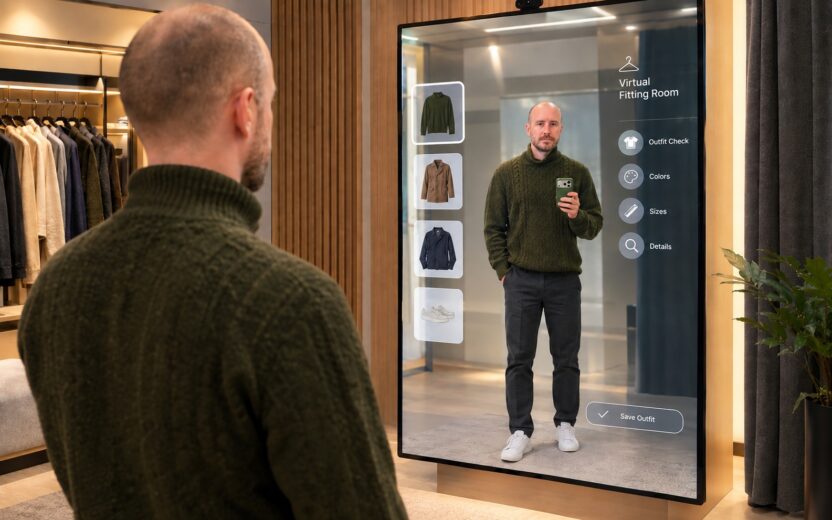
Customer Experience September 18, 2026
From webshop to virtual try-on: how AI is making its way into retail stores
Digital interfaces such as smart mirrors turn AI in the store into a tangible business case. What potential does this hold for the customer experience and in-store personalization? Matthias Vollmer explains how the retail industry can combine the best of both worlds and turn physical touchpoints into an intelligent part of the omnichannel journey.
From webshop to virtual try-on: how AI is making its way into retail storesDon't miss a thing.
Subscribe to our latest blog articles.