Highlight

Successful together – our valantic Team.
Meet the people who bring passion and accountability to driving success at valantic.
Get to know usApril 28, 2026

Over 14,000 participants, two conference days, one central message: the age of AI as a tool waiting for instructions is over.
What Adobe presented in Las Vegas are systems that understand goals, develop plans and execute processes independently – with humans as strategists, not as executors. For us at valantic, the Adobe Summit 2026 was therefore less a product fair than a preview of the decisions that companies will have to make in the next twelve to eighteen months.
Before looking at platforms and solutions, it is worth taking a look at the figures that Adobe presented in Las Vegas as a starting point: Traffic coming to retailer sites via AI assistants such as ChatGPT or Google Gemini has increased by 269 percent in the last year alone. These visitors convert 31 percent better than traditional search engine visitors and generate 254 percent more revenue per visit.
This means a fundamentally new question for every company with digital sales: Is my product range even readable for AI systems or do I simply not exist in this new world? Loni Stark, VP Strategy at Adobe, put it in a nutshell:
“For decades, brands have managed content, but now they also need to manage context.”
This is more than just a buzzword: AI models do not read websites, but interpret data, draw conclusions and make recommendations. If you want to appear in these recommendations, you have to prepare your content, product data and brand messages for this new type of processing.
Adobe not only presented new products in Las Vegas. The company has reorganized its entire brand identity. Instead of Adobe Experience Cloud, in future we will be reading more often about Adobe CX Enterprise and seeing a platform in which AI agents no longer support individual tasks, but orchestrate entire customer processes: from the first brand encounter to the purchase and customer loyalty.
The opening keynote set the tone with an unusual moment: CEO Shantanu Narayen in his last Summit keynote before announcing his retirement and NVIDIA CEO Jensen Huang together on one stage. Huang described Adobe’s role succinctly: Adobe is becoming a “marketing manufacturing system” that produces customer experiences on an industrial scale. His advice to decision-makers was unequivocal:
“You never want to be too early, but you definitely can’t afford to be late.”
At the heart of the new platform is the CX Enterprise Coworker: a permanently active AI agent that works as a digital colleague. The demo at the keynote made this tangible: A marketing team sets a target, such as increasing cross-selling performance by 3 percent. The coworker then independently develops a complete campaign plan, coordinates it with the team, implements it and measures the results. People control the strategy and the guard rails. The system takes care of the rest. Availability has been announced for the coming months.
A separate thematic block at the summit was dedicated to the question of how brands can remain visible in a world in which AI systems are becoming the first port of call for purchasing decisions.
Adobe’s answer: an extended LLM Optimizer that records how and whether a brand appears at all in large AI interfaces such as ChatGPT, Google Gemini, Perplexity or Microsoft Copilot. The tool identifies gaps and suggests optimizations. Adobe itself was the first user to achieve a five-fold increase in its own brand mentions in AI search queries in one week.
This is complemented by the Brand Concierge: this dialog-oriented AI assistant runs on your own website or app and advises customers in real conversations – with up-to-date product data, prices and availability in real time.
The most important innovation in 2026: Customers can complete purchases directly during the conversation without being redirected to a separate checkout page. DICK’S Sporting Goods presented this live at the conference as an example that is already working and not just a vision of the future.
Adobe also announced the acquisition of SEMrush to strengthen visibility in both traditional and AI-driven searches.
The second day of the conference presented an uncomfortable calculation: The demand for content will increase fivefold by 2027. At the same time, the number of channels, languages and target groups for which content needs to be produced will grow. This cannot be solved with manual processes.
This is where Adobe GenStudio comes in:
The platform for managing the entire content supply chain is growing from one product to several areas:
The presentation by Procter & Gamble was particularly impressive: CEO Shailesh Jejurikar described how AI is no longer an experimental phase at P&G, but an operational necessity – including the autonomous control of production facilities during night shifts without staff.
Commerce was not just one of many topics at the Adobe Summit 2026. It was the most concrete proof that the “Agentic Era” is not an abstract vision, but is already becoming a product reality.
Adobe has developed its commerce platform in two directions:
The latter is particularly relevant for many of our customers: AI-supported commerce functions thus become accessible even without a complete platform migration.
What this means in practice can be illustrated by three questions:
When a customer asks ChatGPT which product is suitable for their needs, does your product range appear in the answer?
Adobe automatically analyzes the product catalog and enriches it so that AI systems can understand, classify and recommend it. This is no longer an optional optimization, but the new basis of digital findability.
In future, more and more purchases will not be triggered by people on a website, but by AI assistants on behalf of their users.
Adobe Commerce supports new open standards that enable precisely these machine transactions – even completely outside your own store. Those who do not prepare for this possibility will lose sales without realizing it.
Adobe has introduced a range of new, modular functions for B2B companies: individual offer negotiation, approval processes for purchasing departments, requirements lists for recurring orders and quick ordering directly from product tables. These modules can be integrated into existing storefronts without having to rebuild the entire store. This is a considerable efficiency gain for technical procurers who order the same items in large quantities every day.
The new functions are supplemented by other AI-supported tools that are designed to significantly speed up migrations and platform changes: Existing systems are analyzed, migration plans are created in days instead of weeks and outdated adaptations are automatically transferred to modern, low-maintenance structures.
Here, too, the strategic classification remains human work. We see these AI tools as supporting our own migration expertise.
Scalable enterprise solutions with Adobe Commerce & valantic
Companies need platforms that scale flexibly, enable personalized experiences and integrate smoothly into existing system landscapes. Adobe Commerce offers exactly that: a powerful, enterprise-ready e-commerce platform “
The Adobe Summit 2026 had an unusual quality: the announcements followed a recognizable logic. From visibility in AI searches to the dialogic buying process to automated content production and agentic commerce functions, a coherent picture emerges: it is no longer just about a product catalog, but about a platform strategy.
At the same time, realism is required. The majority of the functions shown are not yet available and Adobe’s own study shows this: Three quarters of companies struggle with data quality, almost as many with a lack of know-how and unclear ROI. The tools alone will not solve these problems. Companies need a clear AI strategy to integrate all of these tools in a meaningful way.
What has changed in Las Vegas: The direction is clear, the platform is taking shape and the first companies are showing that it works. Those who start asking the right questions now will be in a much better position in two years’ time than competitors who hesitate too long.

Christian Münch
Head of Development & System Architect
valantic


Artificial Intelligence October 16, 2026
Autonomous Enterprise Journey: How AI value engineering creates measurable business value
How can the ROI of AI initiatives be reliably assessed and measured? How can companies identify the biggest levers and key processes for AI? Katrin Luft, Senior Expert at valantic and co-developer of the “Autonomous Enterprise Journey,” provides answers and recommendations in a conversation with Darya Basarhina, Vice President of Sales & Marketing and Manufacturing Practice Lead at valantic.
Autonomous Enterprise Journey: How AI value engineering creates measurable business value
Customer Experience October 8, 2026
Interview: From PIM to Data Spine – How companies prepare their data for AI
AI is changing the requirements for data, governance, and processes. Where should companies start, and what skills do they need? In this interview, Dietmar Rietsch, CEO of Pimcore, and Timo Huguet of valantic discuss the importance of clean data, the concept of the “Data Spine,” and the changing role of humans in the age of agentic AI.
Interview: From PIM to Data Spine – How companies prepare their data for AI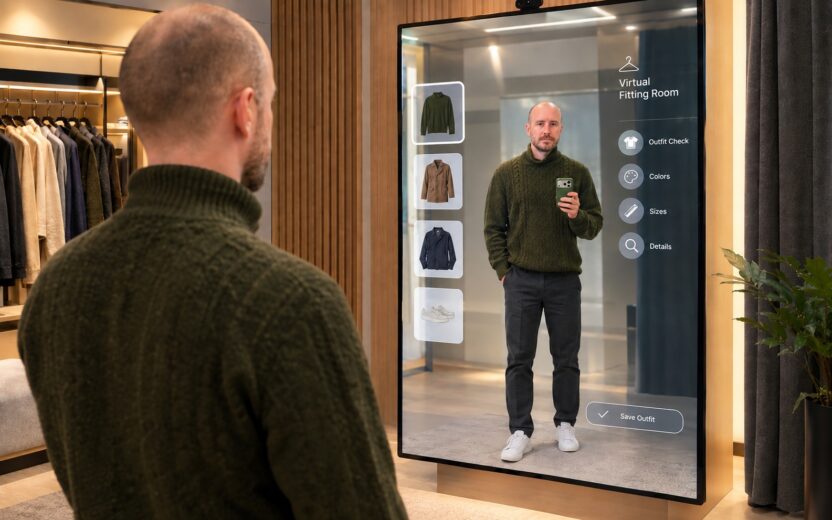
Customer Experience September 18, 2026
From webshop to virtual try-on: how AI is making its way into retail stores
Digital interfaces such as smart mirrors turn AI in the store into a tangible business case. What potential does this hold for the customer experience and in-store personalization? Matthias Vollmer explains how the retail industry can combine the best of both worlds and turn physical touchpoints into an intelligent part of the omnichannel journey.
From webshop to virtual try-on: how AI is making its way into retail storesDon't miss a thing.
Subscribe to our latest blog articles.